News
“Model conduct” captures India’s current dilemma in governing Artificial Intelligence: while the country is actively engaging with global AI safety debates and drafting regulatory frameworks, it still lacks a clear, coherent domestic strategy that simultaneously expands access to AI resources and prepares its workforce for large-scale technological disruption. The article argues that without addressing these twin gaps, India risks becoming a rule-taker rather than a rule-shaper in the AI era.
Key Issues
- Fragmented and Reactive AI Regulation
- Policies respond after harm occurs rather than anticipating risks.
- Example: Emphasis on takedown notices instead of design-stage safeguards.
- Limited Access to AI Infrastructure
- High compute costs restrict AI development to a few large firms.
- Example: Start-ups and academia lack access to advanced GPUs and datasets.
- Absence of Indigenous Frontier Models
- Dependence on foreign AI systems raises strategic and economic concerns.
- Example: Reliance on global Big Tech for foundational AI tools.
- Workforce Skill Mismatch
- AI adoption outpaces reskilling of workers.
- Example: Informal and low-skill workers face displacement without safety nets.
- Over-emphasis on Content Policing
- Regulatory focus tilts toward censorship rather than innovation governance.
- Example: Monitoring outputs instead of ensuring accountable model design.
Key Facts from the Article
- India does not yet have a comprehensive AI law, relying instead on draft advisories and sectoral guidelines.
- The IT Act, 2000 and proposed Digital Personal Data Protection Act form the legal backdrop for AI governance.
- Current regulatory approach is largely reactive, focusing on content moderation, misinformation, and platform liability.
- India lacks frontier AI models comparable to leading global players.
- Large sections of the workforce remain low-skilled or informally employed, increasing vulnerability to AI-driven disruption.
Global Practices
| European Union | Risk-based AI Act regulating high-risk use cases. |
| United States | Public funding for AI research and compute access. |
| United Kingdom | Pro-innovation AI framework with sectoral regulators. |
| China | State-supported AI infrastructure and workforce training. |
| Singapore | Model AI governance framework and industry sandboxes. |
Lesson: Effective AI governance balances regulation, innovation, and skill development.
Indian Committees / Policy & Institutional References
| NITI Aayog | National AI Strategy (“AI for All”). |
| Digital India Mission | Building digital public infrastructure. |
| Skill India Mission | Workforce reskilling and upskilling. |
| MeitY advisories | Interim AI governance guidance. |
| RBI & SEBI frameworks | Sector-specific digital risk management. |
Way Forward
- Develop a comprehensive AI law with a risk-based, future-ready approach.
- Expand public access to AI compute and datasets via shared national platforms.
- Invest heavily in AI skilling and reskilling, especially for informal workers.
- Promote indigenous AI research through public funding and academia-industry collaboration.
- Shift regulation upstream, focusing on model design, testing, and accountability.
- Align AI governance with employment policy to ensure inclusive growth.
Conclusion
India’s AI challenge is not merely about controlling risks but about unlocking opportunity. Without democratizing access to AI resources and preparing its workforce for structural change, regulation alone will not deliver technological sovereignty or inclusive growth. A proactive, capability-building approach is essential.
Pramukh Prelims Pointers (10-11 Sept 2026)
Current Affairs · UPSC Prelims & MainsPramukh Prelims Pointers10–11 September 2026PolityInternational RelationsEnvironmentScience & TechnologyDefenceSources: The Hindu, Indian Express, Mint and PIB08Topics [...]
Current Affairs MCQs by Divas Sir – 10 September 2026 | Hindi & English
Daily practice · Hindi + EnglishCurrent Affairs MCQsby Divas Sir10 September 2026 · Test your recall. Understand the why.UPSC CSEState PSCsSSC [...]
Parliament Monsoon Session 2026: Understanding Indian Polity Through Current Affairs
Parliament Monsoon Session 2026 explained for UPSC - parliamentary productivity, executive accountability, Question Hour, committees, a Prelims MCQ and a Mains answer approach.
Independence Day Celebration at Pramukh Academy
Pramukh Academy Vadodara celebrates Independence Day 2026 with Pujya Sadhujans and students - explore our UPSC and GPSC preparation ecosystem.
12 Schedules of the Indian Constitution: Complete UPSC & GPSC Notes
All 12 Schedules of the Indian Constitution explained for UPSC and GPSC Prelims & Mains — memory tricks, amendment years, and a quick revision table.
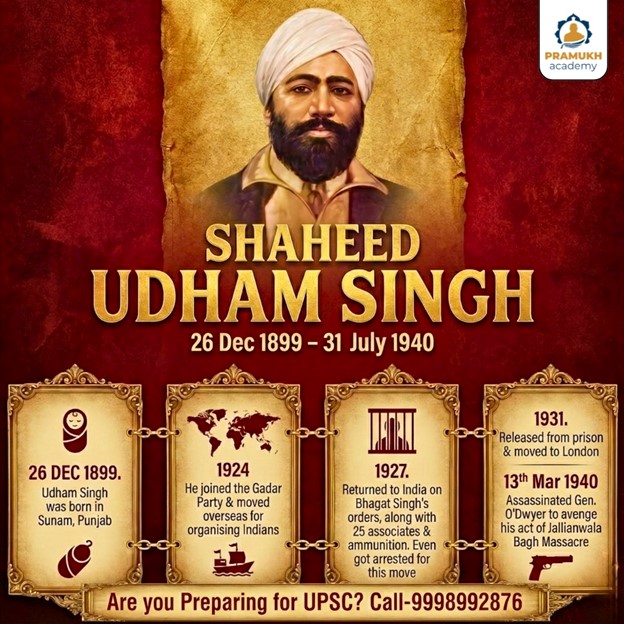
Shaheed Udham Singh: The Courageous Avenger of Jallianwala Bagh
India’s struggle for independence was shaped not only by political movements but also by the fearless acts of revolutionaries who [...]