
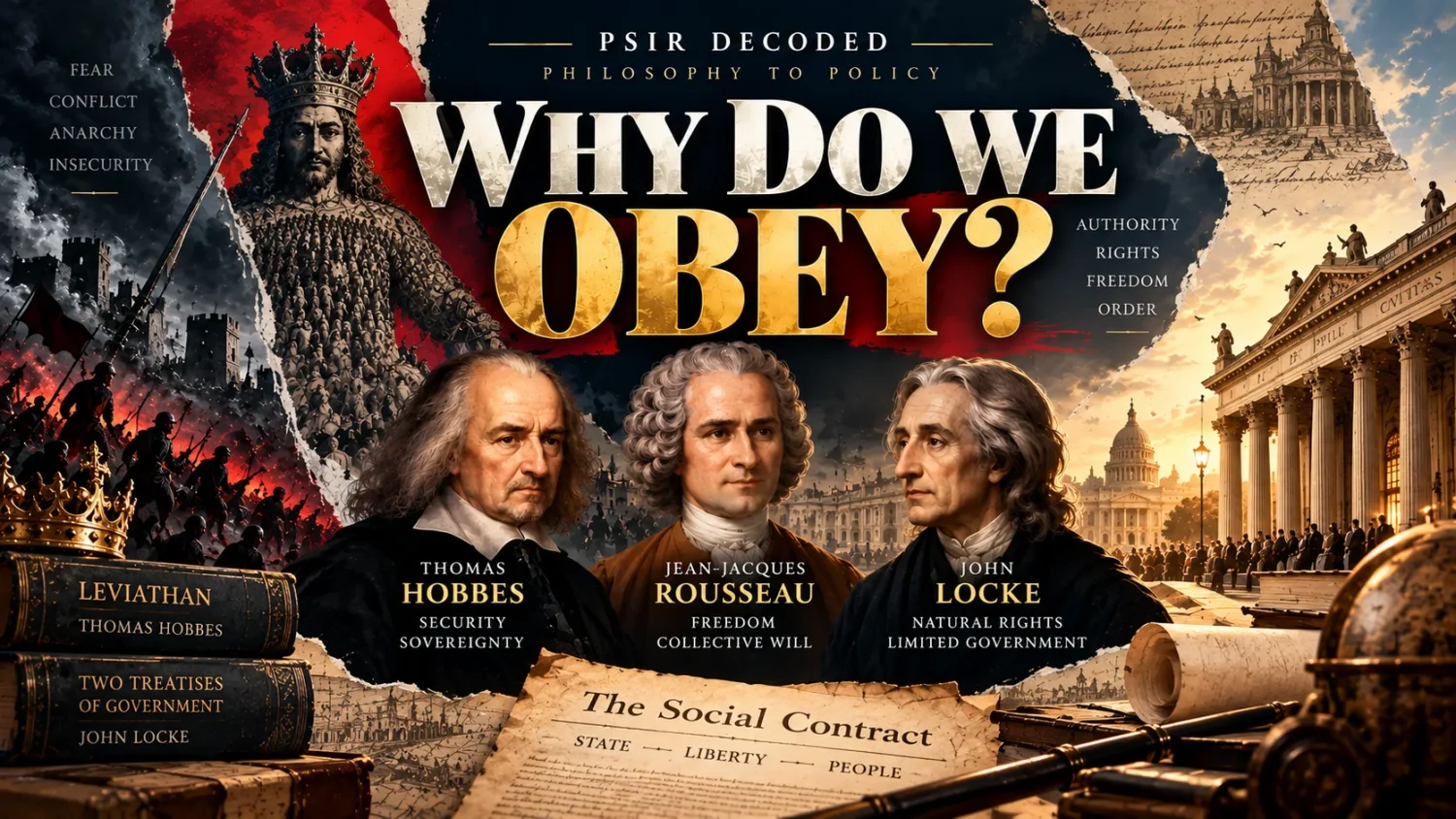
PSIR Decoded: Philosophy to Policy
PSIR DECODED: Philosophy to policy | EPISODE 01
Why Do We Obey? Thomas Hobbes, John Locke, and the Social Contract That Rules Your Life
Thematic Conflict: Absolute Sovereignty vs. Inalienable Rights
| PSIR Paper 1A | Western Political Thought: Hobbes (Sovereignty, Leviathan, State of Nature, Political Obligation); Locke (Natural Rights, Social Contract, Limited Government, Toleration) |
|---|---|
| GS Paper 2 | Article 21 (Life & Personal Liberty), Preventive Detention Laws, Emergency Provisions (Articles 352, 356), Rule of Law |
| GS Paper 4 | Ethical Justification of State Authority, Political Obligation, Civil Disobedience |
| Essay Paper | Liberty vs. Security, Constitutional Morality, Democratic Legitimacy |
| High-Yield Terms | State of Nature · Bellum Omnium Contra Omnes · Inalienable Natural Rights · Fiduciary Trust · Leviathan · Social Contract · Tacit Consent · Proportionality Test |
Block 1: The Everyday Dilemma
March 2020. The Indian government announced a nationwide lockdown with four hours’ notice.
Shops shut. Trains stopped. Police enforced a curfew that nobody voted on. And most people,
hundreds of millions of them simply stayed inside.
Why?
Think about that for a second. You are, theoretically, a free adult. The state told you to
lock yourself in your home, and you did it. You didn’t demand a referendum first. You didn’t
negotiate. You complied and if you didn’t, a police officer could legally drag you off the street.
This isn’t a Covid-specific problem. It happens every day, in smaller ways. You pay taxes you
didn’t personally approve. You stop at a red light even when no one is watching. You submit your
Aadhaar details to access welfare you’re entitled to. The state has enormous power over your life,
and a rational, autonomous person mostly accept it.
This is the oldest and most important question in political philosophy. Not “who should rule?”
or “what policies should we have?” but the more fundamental one underneath all of that:
what gives any government the right to tell us what to do at all?
Two men, writing in seventeenth-century England, gave answers so different that they still define
the fault lines in every debate about state power, fundamental rights, and civil liberties.
Their names were Thomas Hobbes and John Locke.
Block 2: The Core Theory in Plain English
Part A Thomas Hobbes: The Case for the Leviathan
Who Was He, and Why Did He Think This Way?
Hobbes (1588 – 1679) watched England tear itself apart. The English Civil War (1642 – 1651)
a conflict between Parliament and King Charles I that ended in regicide and years of chaos,
destroyed his faith in any romantic view of human nature. He fled to Paris. He saw what happens
when political authority collapses.
When he wrote Leviathan in 1651, he wasn’t theorizing in the abstract. He was trying
to answer a concrete, terrifying question:
what stops civilized society from eating itself alive?
The Mechanical Human
Here’s how Hobbes sees you. You are not a special, soul-bearing creature made in God’s image.
You are a body in motion -driven by desires (things you want) and aversions (things you fear).
The strongest aversion of all is the fear of violent death. Rationality, for
Hobbes, is not wisdom. It is calculation: “What keeps me alive and comfortable?”
Imagine a World Without Government
Hobbes asks you to strip away every law, every institution, every police force, every court.
No government. Just humans.
Your neighbour could take your food. You’d want to take his first, just in case. He knows that,
so he’s already planning to take yours before you can. Because you’re roughly equal in
vulnerability, even a physically weaker person can kill a stronger one with a weapon, no one is safe.
Hobbes calls this the State of Nature, and identifies three engines that keep it violent:
- Competition: everyone wants the same scarce resources.
- Diffidence: everyone is scared of what everyone else might do,
so they strike first. - Glory: everyone wants to be respected and feared, so insults invite violence.
Important: Hobbes is not saying everyone is constantly stabbing each other. He means something more precise.
If there is no reliable authority to enforce agreements, the possibility of violence is always
present and that possibility alone is enough to prevent trust, cooperation, or any stable society.
“…there is no place for industry, because the fruit thereof is uncertain…
no arts, no letters, no society; and which is worst of all, continual fear,
and danger of violent death; and the life of man, solitary, poor, nasty,
brutish, and short.” – Leviathan, Chapter XIII
The Contract: Trading Liberty for Safety
Rational people will eventually realize this is unsustainable. The solution: everyone agrees
simultaneously to surrender their individual right to govern themselves to a central power.
You give up your right to harm me; I give up my right to harm you; we both give those rights
to the Sovereign, who enforces the peace on everyone.
This is the Social Contract. And it creates the Leviathan.
The Hobbesian Sovereign has three key properties:
- Absolute and Indivisible: power cannot be split between parliament and king,
or between church and state. Divided authority is a slow-motion civil war. - Irrevocable: you can’t dissolve the government when you disagree with it.
Tear up the contract and you return to the State of Nature. - One Narrow Exception: if the sovereign directly tries to kill or destroy you,
you may resist. The entire reason you entered the contract was self-preservation.
Wrong. Hobbes distinguishes between liberty (absence of external obstacles) and political
authorization (what you’ve given the sovereign the right to do). Citizens retain liberty
in all areas where the sovereign has issued no law. Also wrong: Hobbes was not simply
defending monarchy. His theory works equally for republics and assemblies. What matters
is whether authority is effective and undivided not whether it wears a crown.
Part B John Locke: The Case for Limited Government
Who Was He, and Why Did He Think Differently?
Locke (1632 – 1704) lived through a different chapter of the same English political upheaval
one that ended not in chaos, but in constitutional settlement. The Glorious Revolution of 1688
removed King James II without bloodshed and established Parliamentary supremacy. Locke had a
fundamentally different empirical data point: constitutional reform works.
His Two Treatises of Government (1689) is partly a dismantling of Hobbes, partly a
philosophical defence of why Parliament had the right to do what it did.
A More Optimistic Starting Point
Locke’s State of Nature is not a battlefield. It is a state of
freedom, equality, and moral obligation governed by the Law of Nature,
which says: you are free, but you have no right to harm others in their life, health,
liberty, or possessions.
So Why Create Government at All?
Because peace without institutions is fragile. Locke identifies three structural problems
he calls them “inconveniences“:
- No established common law: everyone interprets natural law according to
their own interests. - No impartial judge: when you’re personally wronged, you are also personally biased.
- No reliable enforcement: even if you win a judgment, you may not be strong
enough to enforce it.
The Two-Stage Contract
Stage 1 Civil Society: People agree to leave the State of Nature and form a
political community, pooling their power to enforce natural law collectively.
Stage 2 Government as Trustee: The community creates institutions a legislature,
an executive to carry out enforcement. But the government does not own the power it receives.
It holds it in trust, for specific purposes: protecting life, liberty, and property.
This is the Fiduciary Trust model. The government is like a lawyer managing your
estate real authority, but only in your interest, only for the purposes you specified. You can fire
them for misusing the power.
The Right to Revolution
When the government violates the terms of the trust -when it becomes tyrannical, when it systematically
attacks the rights it was created to protect its authority dissolves. Power reverts to the people,
who have the right to alter or replace the government.
No. Locke distinguishes between a government that makes bad policy and a government that destroys
the very basis of legitimate political authority. The first deserves protest, elections, and legal
challenge. The second forfeits its mandate entirely. The threshold is high -persistent, systematic
tyranny, not policy disagreement.
Part C Rousseau: The Third Voice
Hobbes and Locke both ask: why do we obey? Rousseau (1712 – 1778) asks a different question:
can we obey and still be free?
Both Hobbes and Locke imagine freedom as something that pre-exists the state. You start free;
you give some of that freedom up when you enter the contract. Rousseau rejects this framing entirely.
In The Social Contract (1762), he argues that genuine human freedom is only possible
within a well-ordered political community not despite it.
His concept of the General Will is the mechanism. When citizens participate in making
laws that apply to everyone equally, they are not being constrained by those laws. They are
authoring them. Obedience to a law you helped create is not submission it is self-rule.
For PSIR purposes, Rousseau prevents the Hobbes-Locke comparison from collapsing into a simple
“strong state vs. weak state” debate. He introduces collective self-governance
as a third option one with enormous relevance for democratic theory, constitutional design,
and popular sovereignty.
Block 3: The Comparison Matrix
| Dimension | Hobbes (1651) | Locke (1689) |
|---|---|---|
| Philosophical Tradition | Classical Materialism / Authoritarian Realism | Classical Liberalism / Constitutionalism |
| Human Nature | Selfish, fearful, driven by appetite and diffidence | Rational, moral, capable of cooperation |
| State of Nature | Continuous war -nasty, brutish, short | Peaceful but institutionally defective |
| Rights Before Government | No stable rights; only raw desires and power | Inalienable natural rights (Life, Liberty, Property) |
| Why We Need Government | To escape violent anarchy | To fix structural inconveniences |
| Nature of State Power | Absolute, indivisible, irrevocable | Conditional, limited, fiduciary trust |
| Can Citizens Revolt? | Virtually never anarchy is worse than tyranny | Yes when government systematically breaches trust |
| Central Fear | A state too weak to maintain order | A state too powerful to be constrained |
| Modern Legacy | Realpolitik, sovereign security state, legal positivism | Liberal democracy, constitutionalism, human rights |
Hobbes fears what happens when political authority disappears.
Locke fears what happens when political authority becomes arbitrary.
Both fears are legitimate. That is what makes this debate unresolved.
Block 4: The Contemporary Mirror
Case Study 1 Preventive Detention vs. Due Process
India’s preventive detention laws the UAPA, NSA, PSA allow the state to detain individuals
before they commit any crime, on the basis of anticipated threat.
The Hobbesian logic: The state must be able to preempt threats to public order.
Waiting for harm to occur before acting is precisely the luxury you cannot afford if your job is
to prevent the State of Nature from reasserting itself. Order must come first.
The Lockean counterargument: Detention without trial is the clearest example of
the state acting without established law, without an impartial judge, and without due process
the exact three inconveniences that political society was created to solve.
In Maneka Gandhi v. Union of India (1978), the Supreme Court held that
“procedure established by law” under Article 21 must be fair, just, and reasonable not arbitrary.
The Court created a Lockean firewall inside the Indian Constitution against executive overreach.
Case Study 2 Digital Surveillance and Privacy
The Hobbesian case: Mass data collection, biometric databases, facial recognition
modern Leviathan capabilities justified under the state’s duty to prevent crime, fraud, and external threats.
The Lockean check: In Justice K.S. Puttaswamy (Retd.) v. Union of India (2017),
a nine-judge Constitution Bench ruled unanimously that privacy is a fundamental right under Article 21
one that pre-dates the Constitution itself. The Court established the
Three-Fold Proportionality Test:
- Legality: is there a valid law authorizing the action?
- Legitimate State Aim: does the action serve a rational public purpose?
- Proportionality: is this the least intrusive measure that achieves the aim?
Do NOT write: “The Supreme Court applied Locke.”
DO write: “Locke provides a conceptual lens for examining why state authority must be justified
by the rights it is entrusted to protect a principle the Court operationalized through the
proportionality doctrine in Puttaswamy.”
Case Study 3 Emergency Powers and Constitutional Democracy
Every democracy has emergency provisions. India’s Articles 352, 356, and 360 grant the executive
sweeping powers during national, state, and financial emergencies respectively.
Hobbes explains why such provisions exist:
Moments of existential threat require undivided, rapid authority. The survival of the political
community cannot wait for ordinary procedural constraints.
Locke asks six harder questions about every emergency power invoked:
- Who authorized the restriction?
- Under what law?
- For what purpose?
- For how long?
- What institutional safeguards remain?
- What prevents exceptional power from becoming permanent?
The Emergency of 1975 – 77 is the defining Indian case study where Hobbesian emergency logic
became precisely the Lockean nightmare where the exception swallowed the rule, and the fiduciary
trust was comprehensively breached.
Block 5: The Mains Answer Sheet
Trigger Keywords When to Deploy Hobbes and Locke
| Keyword in Question | Deploy |
|---|---|
| “Liberty vs. Security” | Both as the structural tension |
| “Constitutionalism and checks on executive authority” | Locke primarily; Hobbes as the counter |
| “Sovereignty in the digital era” | Both Hobbes for state capacity, Locke for rights limits |
| “Political obligation and legitimate dissent” | Hobbes (obligation) vs. Locke (right to resist) |
| “Basis of state authority” | Hobbes primarily |
| “Limits on state power / Rule of Law” | Locke primarily |
| “Natural rights / Fundamental rights” | Locke primarily |
| “Emergency powers and civil liberties” | Both with Puttaswamy as the Indian anchor |
Counter-Thinkers Required for Balanced Answers
- Against Hobbes: Use Locke (rights, limited government),
Rousseau (political freedom), or Arendt (danger of unconstrained bureaucratic
authority Episode 04). - Against Locke: Use Hobbes (the state needs coercive capacity to function),
or communitarians like Sandel (rights don’t pre-exist community).
Master UPSC Mains Archive & Question Bank (PSIR, GS-2, GS-4 & Essay)
A. PSIR Optional Paper 1A (Western Political Thought)
Locke is the father of classical liberalism and constitutionalism.” Discuss in the light
of his theory of natural rights and limited government. (20 Marks / 250 Words)
“Hobbesian political society is an outcome of fear and self-interest.” Comment.
(10 Marks / 150 Words)
“Lockean social contract establishes a fiduciary trust rather than an absolute sovereign.”
Examine. (15 Marks / 250 Words)
“Hobbesian concept of sovereignty is absolute and indivisible.” Comment.
(10 Marks / 150 Words)
“Hobbes starts as an individualist, but ends as an absolutist.” Comment.
(15 Marks / 250 Words)
“John Locke is a defender of private property and limited state.” Critically examine.
(15 Marks / 250 Words)
Compare the State of Nature as depicted by Thomas Hobbes and John Locke. How does their
view of human nature determine their respective forms of government?
(20 Marks / 250 Words)
“Covenants without the sword are but words and of no strength to secure a man at all.”
(Hobbes). Comment. (10 Marks / 150 Words)
“The reason why men enter into society is the preservation of their property.”
(Locke). Comment. (10 Marks / 150 Words)
Discuss Locke’s theory of natural rights and show how it limits the sovereign’s authority.
(15 Marks / 250 Words)
“Hobbes’s theory of political obligation is based on the fear of violent death.”
Examine. (15 Marks / 250 Words)
B. General Studies Paper 2 (Indian Constitution, Polity & Governance)
“Constitutional morality is not a natural sentiment. It has to be cultivated.”
In this context, examine how the judiciary balances state power with individual liberty
under Article 21. (10 Marks / 150 Words)
Discuss the reasonable restrictions on the Right to Freedom of Speech and Expression
under Article 19(2). Does the invocation of public order and national security lean
towards an overbearing executive? (15 Marks / 250 Words)
“Individual privacy must yield to legitimate state interest in the delivery of welfare
services and national security.” Critically examine in the backdrop of the Puttaswamy
judgment. (15 Marks / 250 Words)
Critically examine the balance between the state’s power of preventive detention and
the individual’s right to personal liberty under the Indian Constitution.
(15 Marks / 250 Words)
C. General Studies Paper 4 (Ethics, Integrity & Aptitude)
“An unexamined life is not worth living.” In public service, when does adherence to
state orders conflict with personal conscience and moral duty? Discuss the ethical
limits of obedience. (10 Marks / 150 Words)
What are the basic principles of public duty? Under what ethical grounds can a citizen
or civil servant question state authority? (10 Marks / 150 Words)
Explain the ethical basis of political obligation. Why should an individual obey the
laws of the state, and where does legitimate civil disobedience begin?
(10 Marks / 150 Words)
D. UPSC Essay Paper (Thematic Reflections)
“Mindful minds make a peaceful society; fearful minds make an authoritarian state.”
“Need brings us together; fear keeps us apart.”
“Liberty without order is anarchy; order without liberty is tyranny.”
Ready-to-Use Conclusion Sentences
“Modern constitutional democracies operate along a dialectic between Hobbes and Locke.
While the state requires a Hobbesian capacity for coercive order to prevent societal
disintegration, its ethical legitimacy remains fundamentally Lockean: power is held
in fiduciary trust, strictly subordinated to inalienable fundamental rights and
judicial review.”
“Political authority becomes legitimate not merely because it possesses power, but
because its exercise can be justified in relation to the purposes for which political
society was constituted -the protection, not the subordination, of the individual.”
“The enduring relevance of the social-contract tradition lies precisely in its recognition
that modern governance must simultaneously manage two risks: the insecurity produced by
insufficient authority, and the domination produced by unconstrained authority. Democratic
constitutionalism is the institutional attempt to hold both at bay.”
PSIR Decoded: Philosophy to Policy
PSIR DECODED: Philosophy to policy | EPISODE 01
Why Do We Obey? Thomas Hobbes, John Locke, and the Social Contract That Rules Your Life
Thematic Conflict: Absolute Sovereignty vs. Inalienable Rights
| PSIR Paper 1A | Western Political Thought: Hobbes (Sovereignty, Leviathan, State of Nature, Political Obligation); Locke (Natural Rights, Social Contract, Limited Government, Toleration) |
|---|---|
| GS Paper 2 | Article 21 (Life & Personal Liberty), Preventive Detention Laws, Emergency Provisions (Articles 352, 356), Rule of Law |
| GS Paper 4 | Ethical Justification of State Authority, Political Obligation, Civil Disobedience |
| Essay Paper | Liberty vs. Security, Constitutional Morality, Democratic Legitimacy |
| High-Yield Terms | State of Nature · Bellum Omnium Contra Omnes · Inalienable Natural Rights · Fiduciary Trust · Leviathan · Social Contract · Tacit Consent · Proportionality Test |
Block 1: The Everyday Dilemma
March 2020. The Indian government announced a nationwide lockdown with four hours’ notice.
Shops shut. Trains stopped. Police enforced a curfew that nobody voted on. And most people,
hundreds of millions of them simply stayed inside.
Why?
Think about that for a second. You are, theoretically, a free adult. The state told you to
lock yourself in your home, and you did it. You didn’t demand a referendum first. You didn’t
negotiate. You complied and if you didn’t, a police officer could legally drag you off the street.
This isn’t a Covid-specific problem. It happens every day, in smaller ways. You pay taxes you
didn’t personally approve. You stop at a red light even when no one is watching. You submit your
Aadhaar details to access welfare you’re entitled to. The state has enormous power over your life,
and a rational, autonomous person mostly accept it.
This is the oldest and most important question in political philosophy. Not “who should rule?”
or “what policies should we have?” but the more fundamental one underneath all of that:
what gives any government the right to tell us what to do at all?
Two men, writing in seventeenth-century England, gave answers so different that they still define
the fault lines in every debate about state power, fundamental rights, and civil liberties.
Their names were Thomas Hobbes and John Locke.
Block 2: The Core Theory in Plain English
Part A Thomas Hobbes: The Case for the Leviathan
Who Was He, and Why Did He Think This Way?
Hobbes (1588 – 1679) watched England tear itself apart. The English Civil War (1642 – 1651)
a conflict between Parliament and King Charles I that ended in regicide and years of chaos,
destroyed his faith in any romantic view of human nature. He fled to Paris. He saw what happens
when political authority collapses.
When he wrote Leviathan in 1651, he wasn’t theorizing in the abstract. He was trying
to answer a concrete, terrifying question:
what stops civilized society from eating itself alive?
The Mechanical Human
Here’s how Hobbes sees you. You are not a special, soul-bearing creature made in God’s image.
You are a body in motion -driven by desires (things you want) and aversions (things you fear).
The strongest aversion of all is the fear of violent death. Rationality, for
Hobbes, is not wisdom. It is calculation: “What keeps me alive and comfortable?”
Imagine a World Without Government
Hobbes asks you to strip away every law, every institution, every police force, every court.
No government. Just humans.
Your neighbour could take your food. You’d want to take his first, just in case. He knows that,
so he’s already planning to take yours before you can. Because you’re roughly equal in
vulnerability, even a physically weaker person can kill a stronger one with a weapon, no one is safe.
Hobbes calls this the State of Nature, and identifies three engines that keep it violent:
- Competition: everyone wants the same scarce resources.
- Diffidence: everyone is scared of what everyone else might do,
so they strike first. - Glory: everyone wants to be respected and feared, so insults invite violence.
Important: Hobbes is not saying everyone is constantly stabbing each other. He means something more precise.
If there is no reliable authority to enforce agreements, the possibility of violence is always
present and that possibility alone is enough to prevent trust, cooperation, or any stable society.
“…there is no place for industry, because the fruit thereof is uncertain…
no arts, no letters, no society; and which is worst of all, continual fear,
and danger of violent death; and the life of man, solitary, poor, nasty,
brutish, and short.” – Leviathan, Chapter XIII
The Contract: Trading Liberty for Safety
Rational people will eventually realize this is unsustainable. The solution: everyone agrees
simultaneously to surrender their individual right to govern themselves to a central power.
You give up your right to harm me; I give up my right to harm you; we both give those rights
to the Sovereign, who enforces the peace on everyone.
This is the Social Contract. And it creates the Leviathan.
The Hobbesian Sovereign has three key properties:
- Absolute and Indivisible: power cannot be split between parliament and king,
or between church and state. Divided authority is a slow-motion civil war. - Irrevocable: you can’t dissolve the government when you disagree with it.
Tear up the contract and you return to the State of Nature. - One Narrow Exception: if the sovereign directly tries to kill or destroy you,
you may resist. The entire reason you entered the contract was self-preservation.
Wrong. Hobbes distinguishes between liberty (absence of external obstacles) and political
authorization (what you’ve given the sovereign the right to do). Citizens retain liberty
in all areas where the sovereign has issued no law. Also wrong: Hobbes was not simply
defending monarchy. His theory works equally for republics and assemblies. What matters
is whether authority is effective and undivided not whether it wears a crown.
Part B John Locke: The Case for Limited Government
Who Was He, and Why Did He Think Differently?
Locke (1632 – 1704) lived through a different chapter of the same English political upheaval
one that ended not in chaos, but in constitutional settlement. The Glorious Revolution of 1688
removed King James II without bloodshed and established Parliamentary supremacy. Locke had a
fundamentally different empirical data point: constitutional reform works.
His Two Treatises of Government (1689) is partly a dismantling of Hobbes, partly a
philosophical defence of why Parliament had the right to do what it did.
A More Optimistic Starting Point
Locke’s State of Nature is not a battlefield. It is a state of
freedom, equality, and moral obligation governed by the Law of Nature,
which says: you are free, but you have no right to harm others in their life, health,
liberty, or possessions.
So Why Create Government at All?
Because peace without institutions is fragile. Locke identifies three structural problems
he calls them “inconveniences“:
- No established common law: everyone interprets natural law according to
their own interests. - No impartial judge: when you’re personally wronged, you are also personally biased.
- No reliable enforcement: even if you win a judgment, you may not be strong
enough to enforce it.
The Two-Stage Contract
Stage 1 Civil Society: People agree to leave the State of Nature and form a
political community, pooling their power to enforce natural law collectively.
Stage 2 Government as Trustee: The community creates institutions a legislature,
an executive to carry out enforcement. But the government does not own the power it receives.
It holds it in trust, for specific purposes: protecting life, liberty, and property.
This is the Fiduciary Trust model. The government is like a lawyer managing your
estate real authority, but only in your interest, only for the purposes you specified. You can fire
them for misusing the power.
The Right to Revolution
When the government violates the terms of the trust -when it becomes tyrannical, when it systematically
attacks the rights it was created to protect its authority dissolves. Power reverts to the people,
who have the right to alter or replace the government.
No. Locke distinguishes between a government that makes bad policy and a government that destroys
the very basis of legitimate political authority. The first deserves protest, elections, and legal
challenge. The second forfeits its mandate entirely. The threshold is high -persistent, systematic
tyranny, not policy disagreement.
Part C Rousseau: The Third Voice
Hobbes and Locke both ask: why do we obey? Rousseau (1712 – 1778) asks a different question:
can we obey and still be free?
Both Hobbes and Locke imagine freedom as something that pre-exists the state. You start free;
you give some of that freedom up when you enter the contract. Rousseau rejects this framing entirely.
In The Social Contract (1762), he argues that genuine human freedom is only possible
within a well-ordered political community not despite it.
His concept of the General Will is the mechanism. When citizens participate in making
laws that apply to everyone equally, they are not being constrained by those laws. They are
authoring them. Obedience to a law you helped create is not submission it is self-rule.
For PSIR purposes, Rousseau prevents the Hobbes-Locke comparison from collapsing into a simple
“strong state vs. weak state” debate. He introduces collective self-governance
as a third option one with enormous relevance for democratic theory, constitutional design,
and popular sovereignty.
Block 3: The Comparison Matrix
| Dimension | Hobbes (1651) | Locke (1689) |
|---|---|---|
| Philosophical Tradition | Classical Materialism / Authoritarian Realism | Classical Liberalism / Constitutionalism |
| Human Nature | Selfish, fearful, driven by appetite and diffidence | Rational, moral, capable of cooperation |
| State of Nature | Continuous war -nasty, brutish, short | Peaceful but institutionally defective |
| Rights Before Government | No stable rights; only raw desires and power | Inalienable natural rights (Life, Liberty, Property) |
| Why We Need Government | To escape violent anarchy | To fix structural inconveniences |
| Nature of State Power | Absolute, indivisible, irrevocable | Conditional, limited, fiduciary trust |
| Can Citizens Revolt? | Virtually never anarchy is worse than tyranny | Yes when government systematically breaches trust |
| Central Fear | A state too weak to maintain order | A state too powerful to be constrained |
| Modern Legacy | Realpolitik, sovereign security state, legal positivism | Liberal democracy, constitutionalism, human rights |
Hobbes fears what happens when political authority disappears.
Locke fears what happens when political authority becomes arbitrary.
Both fears are legitimate. That is what makes this debate unresolved.
Block 4: The Contemporary Mirror
Case Study 1 Preventive Detention vs. Due Process
India’s preventive detention laws the UAPA, NSA, PSA allow the state to detain individuals
before they commit any crime, on the basis of anticipated threat.
The Hobbesian logic: The state must be able to preempt threats to public order.
Waiting for harm to occur before acting is precisely the luxury you cannot afford if your job is
to prevent the State of Nature from reasserting itself. Order must come first.
The Lockean counterargument: Detention without trial is the clearest example of
the state acting without established law, without an impartial judge, and without due process
the exact three inconveniences that political society was created to solve.
In Maneka Gandhi v. Union of India (1978), the Supreme Court held that
“procedure established by law” under Article 21 must be fair, just, and reasonable not arbitrary.
The Court created a Lockean firewall inside the Indian Constitution against executive overreach.
Case Study 2 Digital Surveillance and Privacy
The Hobbesian case: Mass data collection, biometric databases, facial recognition
modern Leviathan capabilities justified under the state’s duty to prevent crime, fraud, and external threats.
The Lockean check: In Justice K.S. Puttaswamy (Retd.) v. Union of India (2017),
a nine-judge Constitution Bench ruled unanimously that privacy is a fundamental right under Article 21
one that pre-dates the Constitution itself. The Court established the
Three-Fold Proportionality Test:
- Legality: is there a valid law authorizing the action?
- Legitimate State Aim: does the action serve a rational public purpose?
- Proportionality: is this the least intrusive measure that achieves the aim?
Do NOT write: “The Supreme Court applied Locke.”
DO write: “Locke provides a conceptual lens for examining why state authority must be justified
by the rights it is entrusted to protect a principle the Court operationalized through the
proportionality doctrine in Puttaswamy.”
Case Study 3 Emergency Powers and Constitutional Democracy
Every democracy has emergency provisions. India’s Articles 352, 356, and 360 grant the executive
sweeping powers during national, state, and financial emergencies respectively.
Hobbes explains why such provisions exist:
Moments of existential threat require undivided, rapid authority. The survival of the political
community cannot wait for ordinary procedural constraints.
Locke asks six harder questions about every emergency power invoked:
- Who authorized the restriction?
- Under what law?
- For what purpose?
- For how long?
- What institutional safeguards remain?
- What prevents exceptional power from becoming permanent?
The Emergency of 1975 – 77 is the defining Indian case study where Hobbesian emergency logic
became precisely the Lockean nightmare where the exception swallowed the rule, and the fiduciary
trust was comprehensively breached.
Block 5: The Mains Answer Sheet
Trigger Keywords When to Deploy Hobbes and Locke
| Keyword in Question | Deploy |
|---|---|
| “Liberty vs. Security” | Both as the structural tension |
| “Constitutionalism and checks on executive authority” | Locke primarily; Hobbes as the counter |
| “Sovereignty in the digital era” | Both Hobbes for state capacity, Locke for rights limits |
| “Political obligation and legitimate dissent” | Hobbes (obligation) vs. Locke (right to resist) |
| “Basis of state authority” | Hobbes primarily |
| “Limits on state power / Rule of Law” | Locke primarily |
| “Natural rights / Fundamental rights” | Locke primarily |
| “Emergency powers and civil liberties” | Both with Puttaswamy as the Indian anchor |
Counter-Thinkers Required for Balanced Answers
- Against Hobbes: Use Locke (rights, limited government),
Rousseau (political freedom), or Arendt (danger of unconstrained bureaucratic
authority Episode 04). - Against Locke: Use Hobbes (the state needs coercive capacity to function),
or communitarians like Sandel (rights don’t pre-exist community).
Master UPSC Mains Archive & Question Bank (PSIR, GS-2, GS-4 & Essay)
A. PSIR Optional Paper 1A (Western Political Thought)
Locke is the father of classical liberalism and constitutionalism.” Discuss in the light
of his theory of natural rights and limited government. (20 Marks / 250 Words)
“Hobbesian political society is an outcome of fear and self-interest.” Comment.
(10 Marks / 150 Words)
“Lockean social contract establishes a fiduciary trust rather than an absolute sovereign.”
Examine. (15 Marks / 250 Words)
“Hobbesian concept of sovereignty is absolute and indivisible.” Comment.
(10 Marks / 150 Words)
“Hobbes starts as an individualist, but ends as an absolutist.” Comment.
(15 Marks / 250 Words)
“John Locke is a defender of private property and limited state.” Critically examine.
(15 Marks / 250 Words)
Compare the State of Nature as depicted by Thomas Hobbes and John Locke. How does their
view of human nature determine their respective forms of government?
(20 Marks / 250 Words)
“Covenants without the sword are but words and of no strength to secure a man at all.”
(Hobbes). Comment. (10 Marks / 150 Words)
“The reason why men enter into society is the preservation of their property.”
(Locke). Comment. (10 Marks / 150 Words)
Discuss Locke’s theory of natural rights and show how it limits the sovereign’s authority.
(15 Marks / 250 Words)
“Hobbes’s theory of political obligation is based on the fear of violent death.”
Examine. (15 Marks / 250 Words)
B. General Studies Paper 2 (Indian Constitution, Polity & Governance)
“Constitutional morality is not a natural sentiment. It has to be cultivated.”
In this context, examine how the judiciary balances state power with individual liberty
under Article 21. (10 Marks / 150 Words)
Discuss the reasonable restrictions on the Right to Freedom of Speech and Expression
under Article 19(2). Does the invocation of public order and national security lean
towards an overbearing executive? (15 Marks / 250 Words)
“Individual privacy must yield to legitimate state interest in the delivery of welfare
services and national security.” Critically examine in the backdrop of the Puttaswamy
judgment. (15 Marks / 250 Words)
Critically examine the balance between the state’s power of preventive detention and
the individual’s right to personal liberty under the Indian Constitution.
(15 Marks / 250 Words)
C. General Studies Paper 4 (Ethics, Integrity & Aptitude)
“An unexamined life is not worth living.” In public service, when does adherence to
state orders conflict with personal conscience and moral duty? Discuss the ethical
limits of obedience. (10 Marks / 150 Words)
What are the basic principles of public duty? Under what ethical grounds can a citizen
or civil servant question state authority? (10 Marks / 150 Words)
Explain the ethical basis of political obligation. Why should an individual obey the
laws of the state, and where does legitimate civil disobedience begin?
(10 Marks / 150 Words)
D. UPSC Essay Paper (Thematic Reflections)
“Mindful minds make a peaceful society; fearful minds make an authoritarian state.”
“Need brings us together; fear keeps us apart.”
“Liberty without order is anarchy; order without liberty is tyranny.”
Ready-to-Use Conclusion Sentences
“Modern constitutional democracies operate along a dialectic between Hobbes and Locke.
While the state requires a Hobbesian capacity for coercive order to prevent societal
disintegration, its ethical legitimacy remains fundamentally Lockean: power is held
in fiduciary trust, strictly subordinated to inalienable fundamental rights and
judicial review.”
“Political authority becomes legitimate not merely because it possesses power, but
because its exercise can be justified in relation to the purposes for which political
society was constituted -the protection, not the subordination, of the individual.”
“The enduring relevance of the social-contract tradition lies precisely in its recognition
that modern governance must simultaneously manage two risks: the insecurity produced by
insufficient authority, and the domination produced by unconstrained authority. Democratic
constitutionalism is the institutional attempt to hold both at bay.”