|
Dimension |
Syllabus Mapping |
|---|---|
|
PSIR Paper 1A |
Western Political Thought: Niccolò Machiavelli (The Prince, Discourses on Livy): Autonomy of Politics, Separation of Politics from Ethics and Religion, Human Nature, Virtù vs. Fortuna, Lion and Fox, Dual Morality. Indian Political Thought: Kautilya (Arthashastra): Saptanga Theory, Mandala Theory, Shadgunya Niti, Four Upayas, Matsyanyaya, Yogakshema, Rajadharma. |
|
GS Paper 2 |
Strategic autonomy in foreign policy; realism vs. moralism; national security vs. rights; Article 21 and the Puttaswamy proportionality test. |
|
GS Paper 4 |
The “Dirty Hands” dilemma; ends vs. means; public duty vs. personal conscience; ethics of secrecy and necessity in administration. |
|
Essay Paper |
Ethics vs. effectiveness; power and morality; “Can a good leader be a good person?”; the lesser evil in public life. |
|
High-Yield Terms |
Raison d’État · Autonomy of Politics · Virtù and Fortuna · Verità Effettuale · Dual Morality · Lion and Fox · Matsyanyaya · Saptanga · Mandala · Shadgunya · Yogakshema |
BLOCK 1 | THE EVERYDAY DILEMMA
Imagine you are the National Security Advisor.
Your agency has just intercepted solid intelligence: a bomb has been planted in a crowded metro station. It will go off in ninety minutes. The man who knows the location is in your custody. He refuses to speak.
The law is clear. Constitutional safeguards and human rights rules forbid coercive interrogation.
What do you do?
If you follow every rule, hundreds of innocent people may die. If you break the rules, you may save them, but you have knowingly done something illegal and morally wrong.
Now make it harder. Suppose you break the rules and it works. The attack is stopped. Were you right?
And what if the same government starts using “national security” to watch journalists, opponents and ordinary citizens? At what point does necessity turn into an excuse for unlimited power?
Political theory calls this the Problem of Dirty Hands: can a leader do wrong in order to do right?
In private life, the rules feel simple. Tell the truth. Keep your promises. Avoid violence. But does a ruler, responsible for millions of lives, have the luxury of staying morally spotless?
Two thinkers, separated by nearly two thousand years and thousands of kilometres, faced this question with unusual honesty:
- In Renaissance Italy, Niccolò Machiavelli argued that a ruler who insists on being good among people who are not good will destroy himself and his state.
- In ancient India, Kautilya (also called Chanakya) argued that without strong authority, society falls into Matsyanyaya, where big fish eat small fish. Yet he tied all that hard power to one purpose: the welfare of the people (Yogakshema).
|
THE REALIST PARADIGM |
||
|---|---|---|
|
CAN STATE SURVIVAL OBEY PRIVATE ETHICS? |
||
|
NICCOLÒ MACHIAVELLI |
KAUTILYA |
|
|
(1469–1527, Renaissance Italy) |
(Traditionally 4th Century BCE, India) |
|
|
Autonomy of Politics from Morality |
Political Realism within Rajadharma |
|
|
Universal Egoism & Fear Over Love |
Matsyanyaya (The Law of the Fish) |
|
|
The Lion and the Fox |
Saptanga Theory (Organic State) |
|
|
Virtù vs. Fortuna |
Mandala Theory & Shadgunya Niti |
|
|
Dual Morality: Private vs. Public |
Realpolitik Anchored to Yogakshema |
|
BLOCK 2 | THE CORE THEORY IN PLAIN ENGLISH
Part A
Niccolò Machiavelli and the Autonomy of Politics
Who was he, and why did he think this way?
Machiavelli (1469–1527) was a diplomat and senior official of the Florentine Republic. He watched Italy break into rival territories (Florence, Venice, Milan, the Papal States, Naples) and become a playground for French and Spanish armies.
When the Republic fell and the Medici returned, he was removed from office, jailed and tortured. From exile on his farm he wrote The Prince (1513), not as a philosophy lecture but as a practical survival guide for a leader who could unify Italy.
The big move: change the question
Before Machiavelli, thinkers like Plato, Aristotle and Aquinas treated politics as part of ethics. The state existed to make people good.
Machiavelli changed the question. He did not ask, “What should an ideal ruler be?” He asked, “What does a ruler actually have to do to gain, keep and protect power?”
He called this the effectual truth (verità effettuale): study politics as it is, not as it ought to be. This is why he is called the first modern political thinker.
- Autonomous sphere: Politics has its own logic and its own measure of success. It is not a branch of religion or moral philosophy.
- Currency of politics: The test is not holiness but whether the state survives and stays strong (mantenere lo stato).
“A man who wishes to make a profession of goodness in everything must necessarily come to grief among so many who are not good. Therefore it is necessary for a prince who wishes to maintain himself to learn how not to be good, and to use this knowledge and not use it, according to the necessity of the case.” (The Prince, Chapter XV)
Universal Egoism: how he sees human nature
Machiavelli’s advice rests on a gloomy view of people. Men, he says, are ungrateful, fickle, deceitful, keen to avoid danger and greedy for gain (The Prince, Chapter XVII).
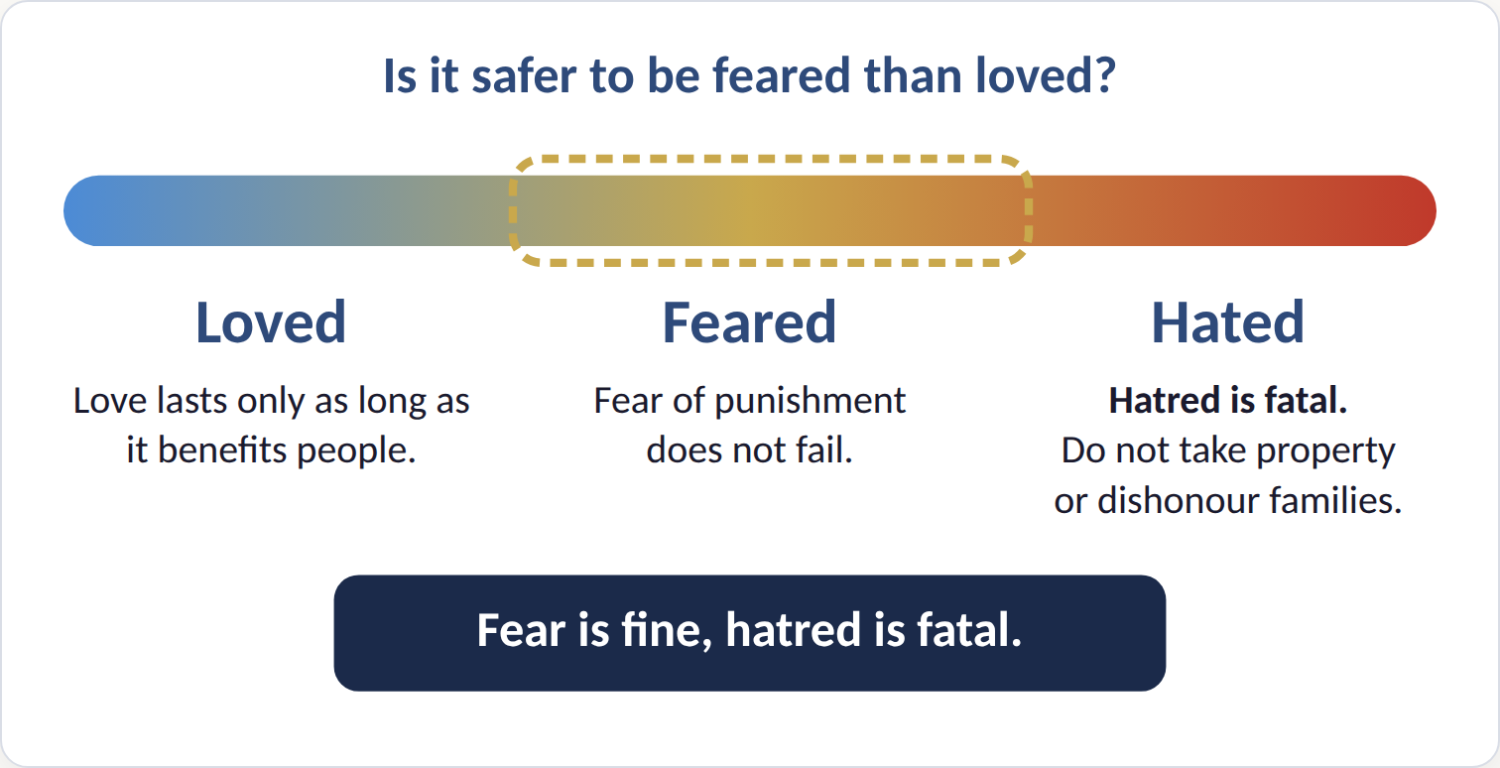
- Love lasts only as long as it benefits people. Fear of punishment does not fail.
- So, “it is much safer to be feared than loved, if one cannot be both.”
- The key condition: Fear is fine, hatred is fatal. A ruler must not take his subjects’ property or dishonour their families. As Machiavelli puts it, a man will sooner forgive the death of his father than the loss of his inheritance.
Virtù vs. Fortuna
- Fortuna is luck and uncertainty: accidents, crises, events nobody controls. Machiavelli compares it to a violent river that floods the land.
- Virtù is not moral virtue. It means political ability: courage, decisiveness, strategic intelligence and the skill to adapt. A leader with virtù cannot stop the river, but he builds dykes and dams in calm times so the flood does less damage.
The lesson: realism is not fatalism. Machiavelli does not say “everything is luck.” He says “luck is real, so prepare.”
The Lion and the Fox
- The Lion has force but cannot spot traps.
- The Fox has cunning but cannot fight wolves.
- A ruler needs both: strength to deter enemies and intelligence to see through them. A ruler who only uses force gets trapped. A ruler who only uses cleverness cannot enforce his decisions.
Dual Morality: the realist solution
Machiavelli does not praise cruelty for its own sake. Read together, his ideas point to two moral standards:
- Private morality: honesty, humility and keeping promises, for ordinary citizens.
- Public morality (Raison d’État): judged by whether the state is preserved. An act that is a sin in private life (deception, force, breaking a promise) can become a duty of office when the state’s survival is at stake.
🚫 Myth-Buster 01: “Machiavelli was simply an advocate of tyranny.”
PART B
Kautilya and Strategic Realism within Rajadharma
Who was he, and why did he think differently?
Kautilya (also Chanakya or Vishnugupta, traditionally placed in the 4th century BCE) lived when northern India was split into rival kingdoms and republics while Alexander’s invasion exposed that weakness. He is traditionally credited with helping Chandragupta Maurya overthrow the Nanda dynasty and found the Mauryan Empire.
His masterwork, the Arthashastra, is a manual on economy, administration, law, spying, diplomacy and war. (Scholars debate its exact date and authorship, so write “traditionally attributed to Kautilya” in exams.)
Matsyanyaya: the law of the fish
Kautilya starts with a simple image. Without a strong ruler enforcing the law through Danda (legitimate punishment and coercion), the big fish eat the small fish.
- So the first job of a state is to protect the weak from the strong.
- The primacy of Artha: Kautilya says material well-being is the foundation, because spiritual good (Dharma) and pleasure (Kama) depend on it (Arthashastra 1.7). A hungry, insecure society cannot practise morality.
The Saptanga Theory: the state is more than the king
Kautilya sees the state as a system of seven connected parts:
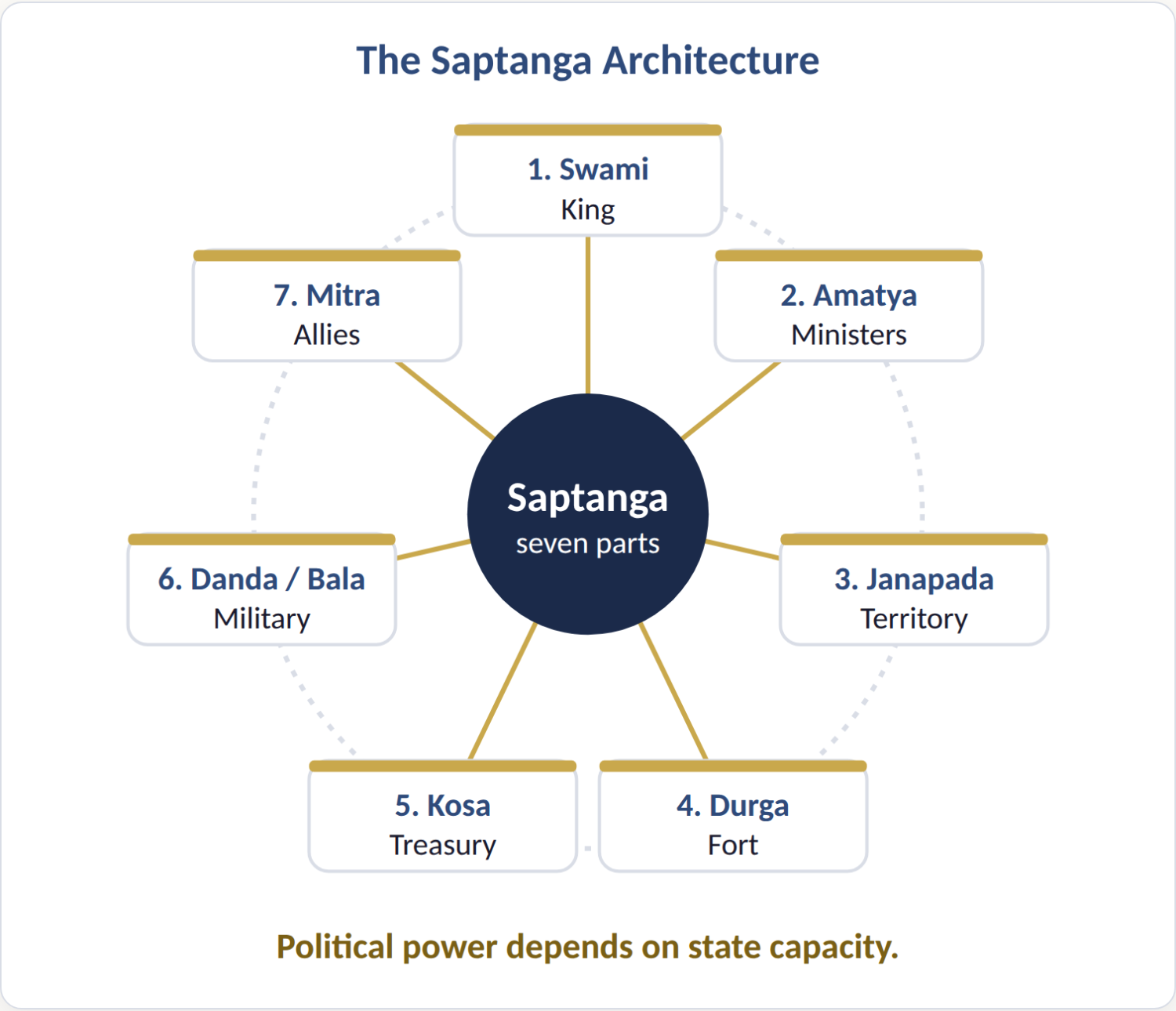
Think of it like a company. A great CEO cannot save a firm with no cash, a weak staff and no partners. In the same way, a ruler cannot stay secure if the treasury collapses, the army is disloyal or the administration fails. Political power depends on state capacity.
Foreign policy: Mandala Theory and Shadgunya Niti
Kautilya treats relations between states as a constant contest for advantage.
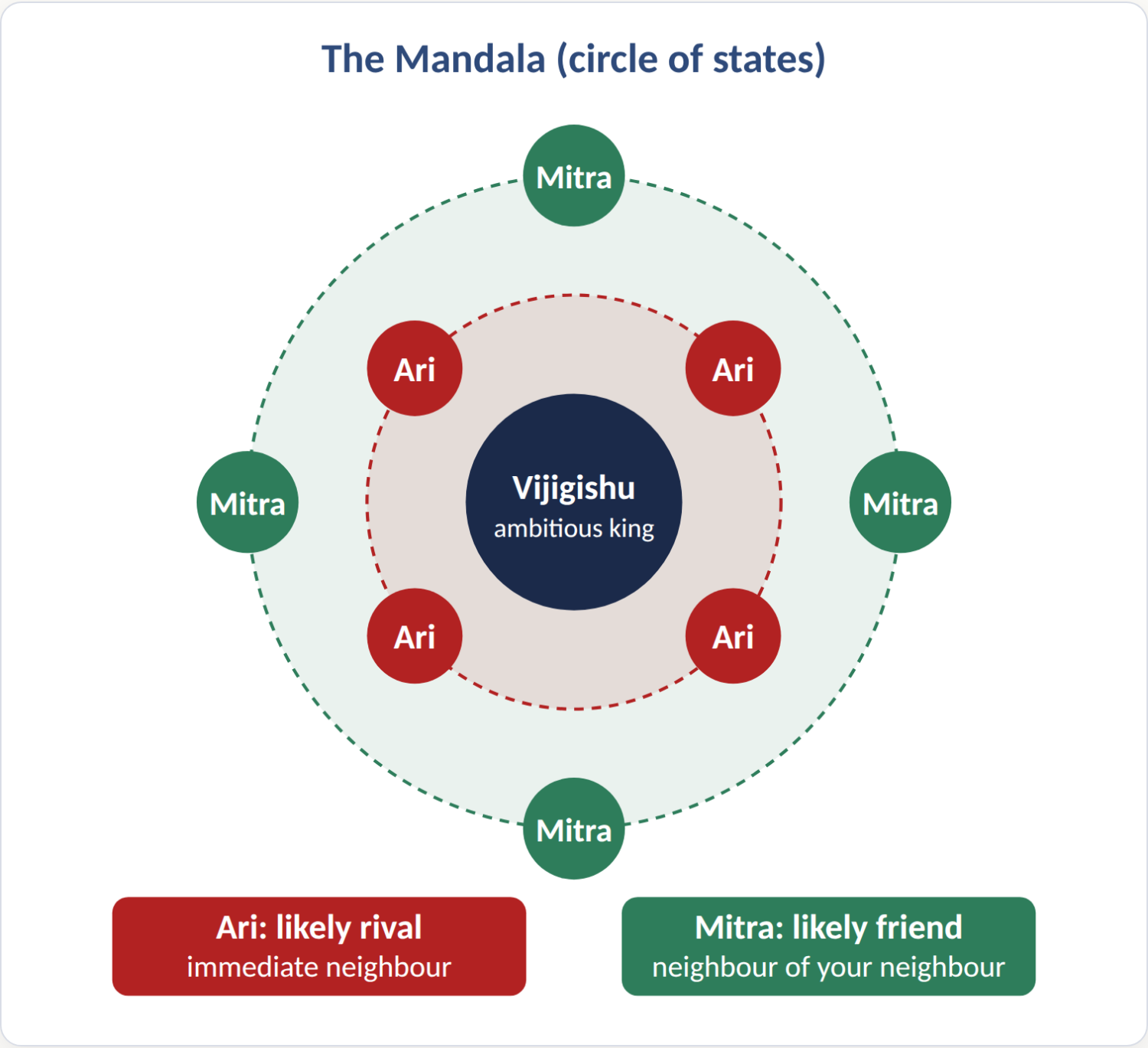
- The Mandala (circle of states): Your immediate neighbour is a likely rival (Ari). The neighbour of your neighbour is a likely friend (Mitra). The ambitious king (Vijigishu) sits at the centre of this circle and calculates who is strong, who is weak and who can be used.
- Shadgunya (six-fold policy): Choose the right tool for the moment.
- Sandhi: make peace, when you are weaker.
- Vigraha: go to war, when you are clearly stronger.
- Asana: stay neutral and wait, when neither side can hurt the other.
- Yana: march or mobilise, when you are prepared.
- Samsraya: seek shelter with a stronger ally.
- Dvaidhibhava: a double policy, peace with one and pressure on another.
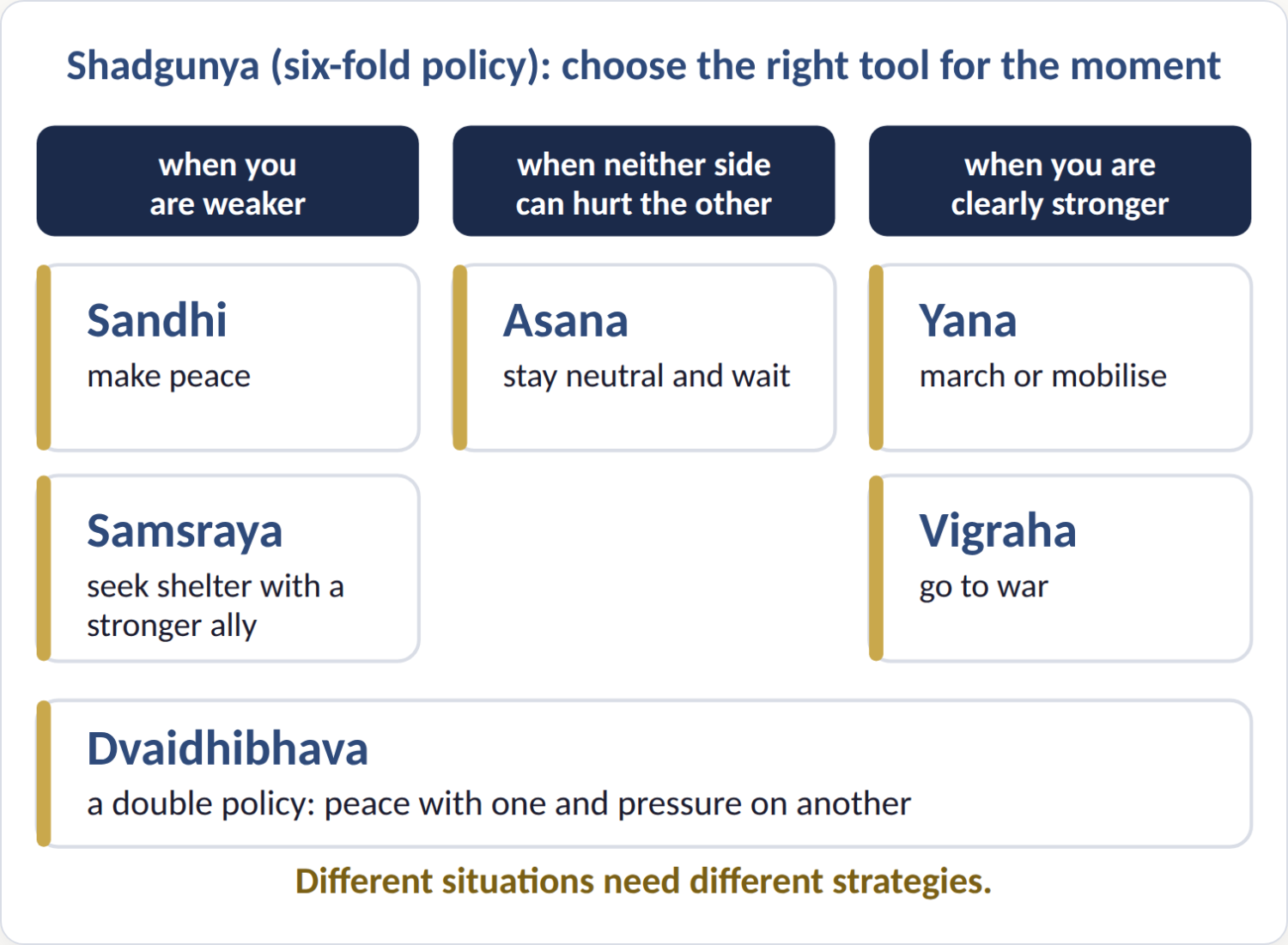
The principle underneath: different situations need different strategies. Kautilya is not promoting endless war. He is promoting strategic choice.
The Four Upayas: tools of statecraft
- Sama: conciliation and negotiation.
- Dana: gifts, aid and concessions.
- Bheda: dividing the opponent by exploiting internal rivalries.
- Danda: force and punitive action.
The key difference: Yogakshema and Rajadharma
Kautilya allows spies, secrecy and force. But he ties all of it to a purpose: the security and welfare of the people (Yogakshema) and the ruler’s duty (Rajadharma).
“In the happiness of his subjects lies the king’s happiness; in their welfare his welfare. Whatever pleases himself the king shall not consider as good, but whatever pleases his subjects he shall consider as good.” (Arthashastra, 1.19)
For Kautilya, hard power is justified only when it serves the stability of the community. The ruler is meant to be the first servant of the state, not its owner.
🚫 Myth-Buster 02: “Kautilya is the Indian Machiavelli.”
BLOCK 3 | THE COMPARISON MATRIX
|
Dimension |
Machiavelli (The Prince) |
Kautilya (Arthashastra) |
|---|---|---|
|
Context |
16th-century Renaissance Italy: fragmented city-states, foreign invasion |
Ancient India (traditionally 4th century BCE): fragmented kingdoms, Mauryan unification |
|
Main works |
The Prince (1513), Discourses on Livy |
Arthashastra |
|
Tradition |
Modern European realism; secularisation of politics |
Classical Indian realism; Artha within Dharma |
|
Human nature |
Selfish, fickle, fearful, greedy |
Self-interested and prone to Matsyanyaya; orderly under Danda |
|
Politics and ethics |
Separation: politics is autonomous; Dual Morality |
Subordination: hard tactics anchored to Yogakshema |
|
Focus of power |
The virtù and skill of the Prince |
Institutional and organic: seven elements (Saptanga) |
|
Foreign policy |
Balance of power; citizen armies over mercenaries |
Systematic: Mandala and Shadgunya |
|
Instruments |
Lion (force) and Fox (cunning) |
Four Upayas; organised intelligence |
|
Justification of power |
Preserve the state (and the ruler’s glory) |
Welfare, security and prosperity of subjects |
|
Liberty |
Strongly developed in the Discourses |
Not the same as modern liberal liberty |
|
Core question |
How can political power survive? |
How can the whole state survive and prosper? |
|
Main criticism |
Slides into tyranny and cynicism |
Large surveillance apparatus; paternalism |
Similarities (for your 15-marker): both start from real conditions, not ideals; both stress adapting to circumstances; both accept that order needs power and intelligence.
Differences: ruler-centred (Machiavelli) vs. state-centred (Kautilya); welfare is explicit in Kautilya; republican liberty is explicit in Machiavelli’s Discourses; Kautilya gives a far more detailed vocabulary for inter-state strategy.
BLOCK 4 | THE CONTEMPORARY MIRROR
Realism is not a museum piece. It runs quietly under modern diplomacy, counter-terror policy and administrative decisions. But constitutional democracies add one thing the old realists did not stress: limits on how power may be used.
|
THE REALIST POLICY MIRROR |
||
|---|---|---|
|
MACHIAVELLIAN PRAGMATISM ◄────────────► KAUTILYAN STRATEGIC REALISM |
||
|
MACHIAVELLIAN PRAGMATISM |
KAUTILYAN STRATEGIC REALISM |
|
|
Strategic Autonomy & Quad Diplomacy |
Multi-Alignment & Mandala Balancing |
|
|
Covert Operations & Intelligence Gathering |
Internal Security & Saptanga Fortification |
|
|
“Dirty Hands” Administrative Dilemmas |
Yogakshema Welfare Delivery Systems |
|
Case Study 1 : Strategic Autonomy in Indian Foreign Policy
- The dilemma: After the 2022 Russia-Ukraine war, Western countries pressed India to reduce defence ties with Russia and join sanctions.
- The realist reading: India’s stated position was that foreign policy must serve national interest and not follow another bloc’s moral script. It kept buying discounted Russian crude to protect consumers from inflation, while deepening ties with the Quad and other partners.
- The theory link: This is often read as Shadgunya and Mandala thinking: no permanent friends or enemies, only interests and relative power. (Critics call it opportunism. A balanced answer notes both views.)
- Answer bridge: “India’s multi-alignment reflects Kautilyan logic of choosing policy by relative power and interest, preserving strategic autonomy rather than being bound by ideological blocs.”
Case Study 2 : Surveillance, Security and Article 21
- The dilemma: Counter-terror work needs intelligence, interception and covert operations.
- The realist case: Kautilya devoted large parts of the Arthashastra to secret agents (Gudhapurusha) because undetected conspiracies destroy public safety. Machiavelli warned that a ruler who refuses to be the fox will be ambushed by enemies who play by no rules.
- The constitutional counter-check: In Justice K.S. Puttaswamy v. Union of India (2017), the Supreme Court held privacy to be a fundamental right under Article 21. Any state intrusion must meet a three-fold test: legality, legitimate aim and proportionality.
- The modern shift: The old realist asks, “Is it necessary for security?” The constitutional court adds, “Even if the aim is legitimate, are the means lawful, necessary and proportionate, with safeguards against abuse?”
- Same test, welfare context: In the Aadhaar judgment (2018), the Court upheld Aadhaar for welfare and subsidies (a Yogakshema goal) but struck down its mandatory use for private services, applying proportionality again. State capacity and liberty are not automatic opposites, but the state must prove its measure is suitable, necessary and proportionate.
Case Study 3 : “Dirty Hands” in Public Administration (GS-4)
- The dilemma: A District Magistrate faces a mob about to burn a hospital. Crowd control has failed. Firing will likely kill a few people. Not firing may mean dozens die inside.
- The ethical conflict:
- Kant: Taking a life is wrong regardless of consequences.
- Machiavelli and Kautilya: When public order is collapsing into Matsyanyaya, the official must act with resolve, as the Lion would. Michael Walzer calls this the “Problem of Dirty Hands”: the act may be justified, yet it still leaves a moral cost the official must own and be accountable for.
- Answer bridge: “Civil servants often face Walzer’s ‘dirty hands’: a lesser-evil choice that protects public life but must still be proportionate, documented and answerable to law.”
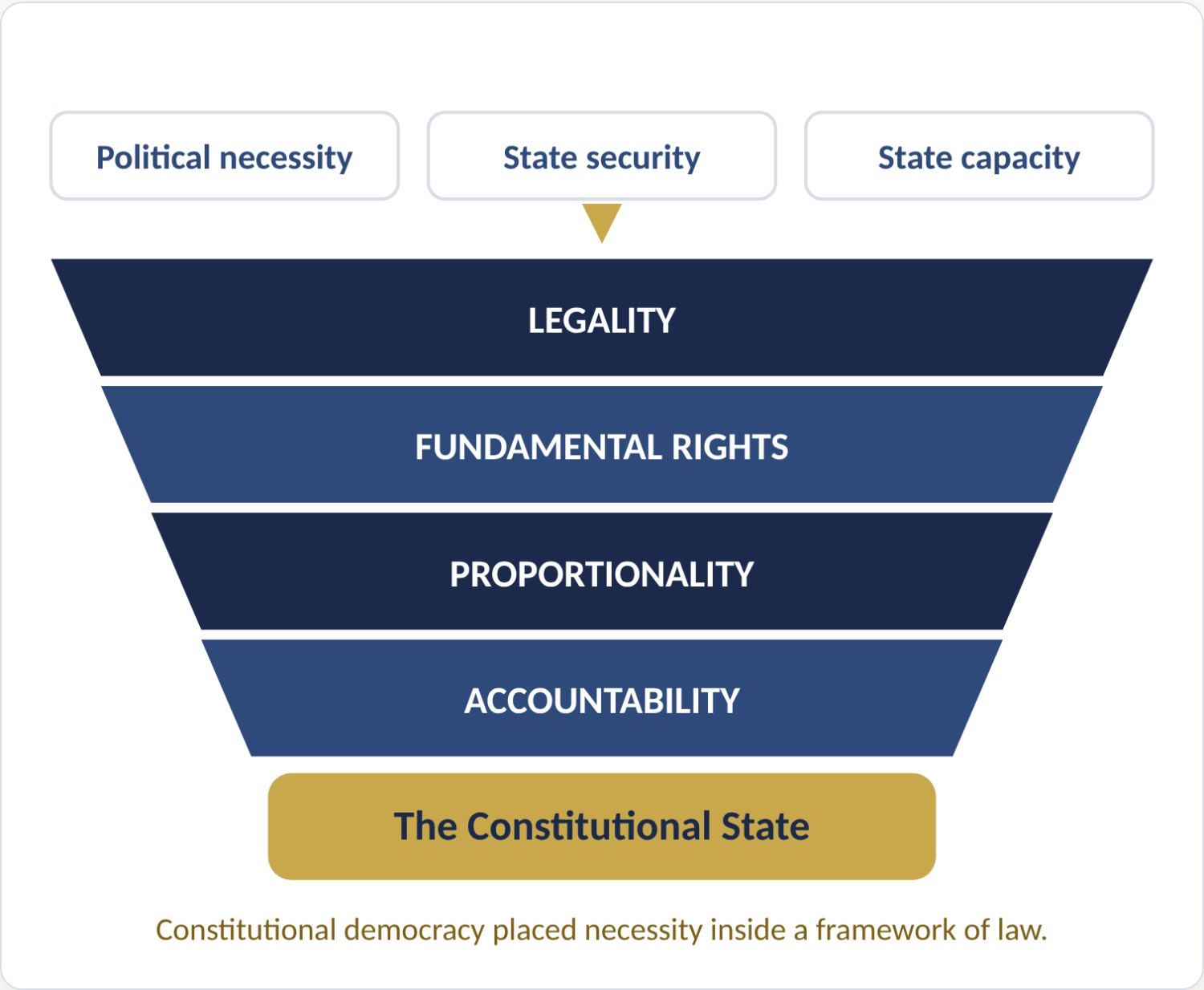
Constitutional democracy did not abolish political necessity. It did something harder: it placed necessity inside a framework of law.
BLOCK 5 | THE MAINS ANSWER SHEET
Trigger Keywords: When to Use Which Thinker
|
If the question says… |
Deploy |
|---|---|
|
Realism vs. moralism in foreign policy |
Raison d’État and Mandala vs. Kantian/Wilsonian idealism |
|
Autonomy of politics |
Machiavelli’s separation of politics from theology and virtue ethics |
|
Political necessity |
Machiavelli |
|
Republicanism, liberty |
Machiavelli’s Discourses |
|
Statecraft, state capacity |
Kautilya’s Saptanga |
|
Strategic autonomy, balance of power |
Shadgunya Niti and Mandala |
|
National security vs. human rights |
Danda and surveillance vs. Puttaswamy proportionality |
|
Ends vs. means in governance |
Dual Morality vs. Gandhi’s purity of means |
|
Administrative ethics, moral dilemmas |
Walzer’s Dirty Hands with Machiavelli’s Lion and Fox |
|
Welfare, good governance |
Kautilya’s Yogakshema |
Counter-Thinkers for a Balanced Answer
To critique Machiavelli and Kautilya:
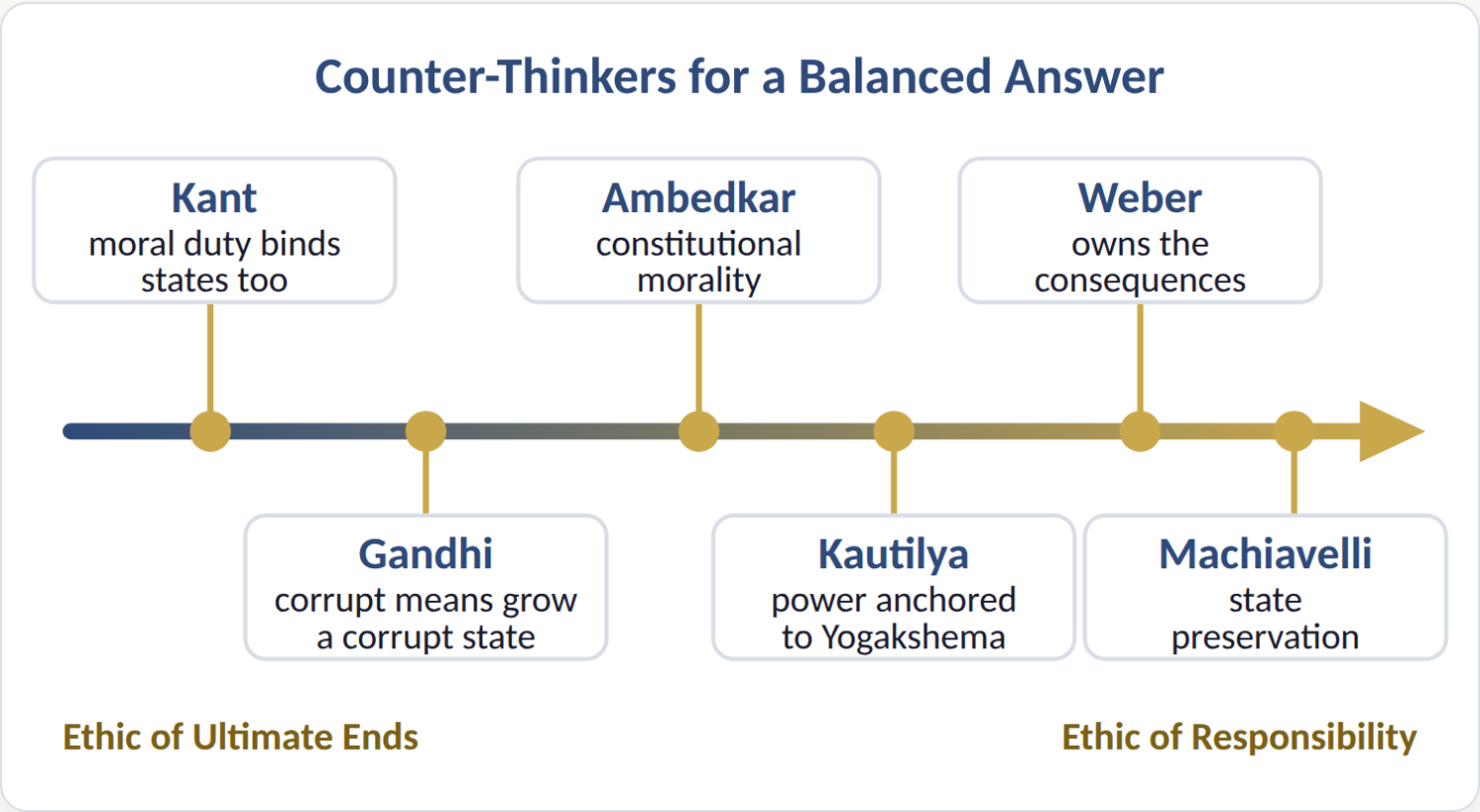
- Mahatma Gandhi: Ends and means are inseparable. In Hind Swaraj he compares means to a seed and ends to a tree: corrupt means grow a corrupt state.
- Immanuel Kant (Perpetual Peace): Moral duty binds states too; an action must be universalisable.
- Jawaharlal Nehru: Built early foreign policy on principle (Panchsheel), showing the tension between idealism and Kautilyan realism.
- B.R. Ambedkar: Constitutional morality: power must stay within institutions and accountability.
To defend them:
- Max Weber (Politics as a Vocation): Distinguishes the Ethic of Ultimate Ends (moral purity regardless of results) from the Ethic of Responsibility (owning the foreseeable consequences of political action). Weber sits close to the realists.
Master UPSC Mains PYQ Archive
A. PSIR Optional Paper 1 (Section A)
|
Year |
Question |
Deployment Strategy |
|---|---|---|
|
2020 |
Comment in 150 words: Machiavelli’s secularism. |
Secularisation of politics → autonomy from the Church → Machiavelli’s view of religion as a civic tool |
|
2019 |
Discuss Kautilya views on the elements of the State. |
Saptanga (seven limbs) → interdependence → state capacity |
|
2018 |
Critically examine Machiavelli’s views on religion and politics. |
Religion as an instrument of civic order → autonomy of politics → Dual Morality |
|
2017 |
What do you understand by the notion of Statecraft? Discuss the theory of statecraft as given by Kautilya. |
Matsyanyaya → Saptanga → Mandala → Shadgunya → Four Upayas → Yogakshema |
|
2015 |
Compare and contrast the views of Kautilya and Machiavelli on Statecraft. |
Block 3 matrix → similarities → differences → welfare vs. ruler-centred power |
|
2014 |
Explain how Machiavelli’s application of empirical method to human affairs marks an important stage in the evolution of political science. |
Verità effettuale → “is” over “ought” → first modern political thinker |
|
2013 |
Analyse, as per Kautilya, the Saptanga theory of the state. |
Seven elements → organic view of the state → state capacity |
|
2012 |
Draw parallels between Arthashastra tradition and the ‘Realist’ tradition represented by Machiavelli. |
Power, security, strategic calculation, adaptation → then qualify with Yogakshema and republicanism |
|
2010 |
Compare and contrast Dharmasastra and Arthasastra with reference to State power. |
Danda and Matsyanyaya → Artha within Dharma → Rajadharma |
|
2009 |
Compare and contrast Kautilya and Machiavelli on statecraft. |
Block 3 matrix → critical evaluation → contemporary relevance |
|
2007 |
Critically examine the ‘Sapta Prakriti’, of state as envisaged by Kautilya. |
Saptanga → each limb’s role → interdependence |
|
2007 |
Discuss the importance of Machiavelli in the history of political thought. Is it correct to say that Machiavelli’s theory is ‘narrowly local and narrowly dated’? |
Autonomy of politics → Virtù and Fortuna → Discourses → Italian context vs. universal relevance |
|
2007 |
Comment: “In the happiness of his subjects lies the king’s happiness; in their welfare his welfare.” (Kautilya) |
Yogakshema → Rajadharma → ruler as first servant of the state |
|
2003 |
Comment: “Machiavelli’s political philosophy was narrowly local and narrowly dated.” (Sabine) |
Italian context vs. enduring realism |
|
2003 |
Comment: Mandal theory. |
Vijigishu, Ari, Mitra → Shadgunya |
|
2000 |
Comment: Power is an end in itself and he (Machiavelli) inquires into the means that are best suited to acquire, retain and expand power, thus separates power from morality, ethics, religion and metaphysics. (Ebenstein on Machiavelli) |
Autonomy of politics → Dual Morality → Raison d’État |
|
1998 |
Comment: “The prince must be fox and the lion at the same time.” (Machiavelli) |
Lion and Fox → force and cunning |
|
1993 |
Comment: “Material well-being alone is supreme. For, spiritual good and sensual pleasures depends upon material well-being.” (Kautilya) |
Primacy of Artha → Matsyanyaya |
B. GS Paper 4 and Prelims
|
Year |
Paper |
Question |
Deployment Strategy |
|---|---|---|---|
|
2018 |
GS-4 |
With regard to the morality of actions, one view is that means is of paramount importance and the other view is that the ends justify the means. Which view do you think is more appropriate? Justify your answer. |
Dual Morality → Gandhi’s seed and tree → Weber’s Ethic of Responsibility |
|
2018 |
Prelims GS-1 |
Right to Privacy is protected as an intrinsic part of Right to Life and Personal Liberty. Which of the following in the Constitution of India correctly and appropriately imply the above statement? |
Puttaswamy → Article 21 and Part III → proportionality (Block 4) |
How to Structure Your Answer
- 10-marker: Definition → thinker’s central argument → 2–3 concepts → example → balanced conclusion.
- 15-marker: Define realism → Machiavelli → Kautilya → similarities → differences → critical evaluation → conclusion balancing effectiveness with legitimacy.
- 20-marker (three layers): Descriptive (what does the thinker say?) → Analytical (why?) → Critical (what are the limits?). Then add a counter-thinker, an Indian constitutional example and a contemporary link. This turns “Machiavelli said X” into “Machiavelli argued X because of Y; however, Z exposes its limit.”
Ready-to-Use Conclusions
10-marker (about 60 words)
“Machiavelli and Kautilya shattered the illusion that governance can rely on moral sermons alone. Statecraft needs realism to protect the community from chaos. Yet in a constitutional democracy, power is not self-justifying: realism must stay anchored to constitutional morality, legality and Kautilya’s ultimate test, the welfare of the people (Yogakshema).”
15-marker (about 85 words)
“The enduring relevance of Machiavelli and Kautilya lies in recognising that politics works in a competitive, imperfect world. Machiavelli secured the autonomy of politics by separating state preservation from private ethics; Kautilya offered a wider institutional design that joins hard strategy to public duty. Modern governance needs both insights: cold realism in security and strategic autonomy, and strict constitutional discipline, transparency and public welfare at home.”
20-marker (about 105 words)
“Realpolitik without ethics decays into tyranny; ethics without power produces tragic vulnerability. Machiavelli diagnosed the hard facts of power, while Kautilya turned them into a welfare-oriented state design. Modern constitutional democracies bridge this gap through Weber’s ‘Ethic of Responsibility’: leaders need the competence to face existential crises, but must never confuse necessity with despotism. The true mark of statecraft is not the accumulation of power but authority exercised under the Rule of Law and for the common good.”
GS-4 one-liner (about 40 words)
“The ethical statesman rejects both naive sentimentalism and unprincipled cynicism, combining Machiavellian realism with Kautilyan devotion to public welfare, and exercising power under the discipline of constitutional morality.”
Essay closing
“The tragedy of leadership is that virtue and effectiveness sometimes seem to diverge. The achievement of constitutional democracy is not that it removed this dilemma, but that it built institutions through which power can be questioned, limited and justified.”
One-Line Revision Sheet
|
Thinker |
Core Formula |
|---|---|
|
Machiavelli |
Politics is an autonomous science of power, where state preservation justifies departing from private morality. |
|
Kautilya |
Realpolitik prevents Matsyanyaya, but all power is anchored to Yogakshema. |
|
Max Weber |
Political ethics means owning the real-world consequences of power. |
|
Mahatma Gandhi |
Corrupt means poison even the noblest ends. |
30-Second Revision
MACHIAVELLI
- Problem: fragmentation, foreign invasion, naive moralism
- Solution: the Prince as Lion (force) and Fox (cunning)
- Framework: Virtù vs. Fortuna; Dual Morality; verità effettuale
- Risk: cynicism and tyranny. Remember the republican Discourses.
KAUTILYA
- Problem: Matsyanyaya and external threat
- Solution: strong state (Saptanga) and strategic foreign policy (Mandala, Shadgunya)
- Tools: Sama, Dana, Bheda, Danda
- Anchor: power is legitimate only when serving Yogakshema
MODERN CONSTITUTIONAL REALISM
- Realism abroad (strategic autonomy), constitutional morality at home (rule of law, Article 21, proportionality)
The PSIR Decoded Chain
REALISM → AUTONOMY → STATECRAFT → SECURITY → YOGAKSHEMA → CONSTITUTIONAL LIMITS
That is the journey from philosophy to policy.
THE FINAL QUESTION: CAN A GOOD LEADER BE A GOOD PERSON?
Perhaps the question is too simple. A leader faces uncertainty, security threats and constitutional duties, not just private morality.
- Machiavelli: Do not confuse personal goodness with political effectiveness.
- Kautilya: Do not confuse the ruler’s interest with the state’s; the ruler owes duties to the community.
- Constitutionalism: Even legitimate ends do not justify every means.
The real test of leadership is not whether power can survive without morality. It is whether power can stay effective without becoming unaccountable.