Source: The Hindu
Key Facts:
-
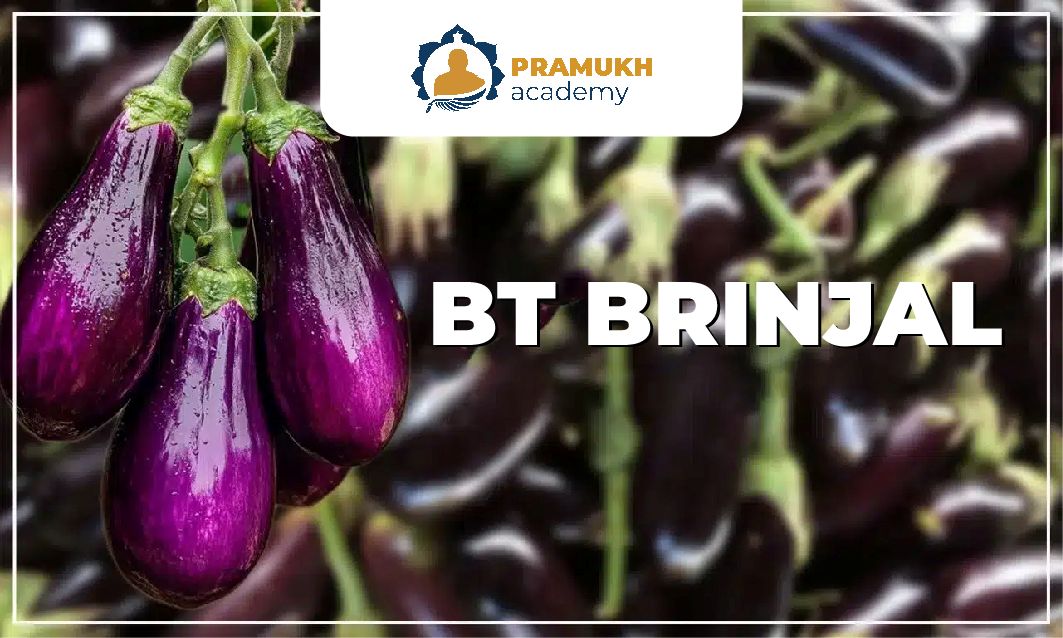
In 2019, a farmer in Nathwan village, Fatehabad, unknowingly planted illegal GM Bt brinjal purchased from a roadside vendor.
- Bt brinjal cultivation is banned in India; only field trials are allowed under strict regulation.
- Authorities uprooted and buried the crop on May 17, 2019 to prevent contamination.
- Multiple RTIs (2019–2025) reveal the government still cannot trace the origin of the GM seeds.
- Haryana’s Biotechnology Coordination Committee investigated but found no evidence about the seed source.
- Horticulture Department admitted receiving complaints but denied information on how seeds entered the market.
- Environmental activists accuse the government of a “casual approach” to a serious biosafety breach.
- Concerns raised:
- Illegal GM seeds may contaminate the food chain.
- Gene flow could occur through cross-pollination in open fields.
- Farmers lack awareness and are vulnerable to spurious seed sellers.
- Farmer said he purchased the saplings from a roadside vendor, but no record exists in official files.
- Activists say the failure to trace the source after six years shows weak seed surveillance and biosafety enforcement.
- Demands include:
- Prioritising GM contamination monitoring,
- Ensuring accountability of officials,
- Strengthening seed supply chain regulation.
Static Information
Source: Genetic Engineering Appraisal Committee (GEAC), Ministry of Environment; Food Safety and Standards Authority of India (FSSAI)
-
GM crop regulation in India is overseen by the GEAC under the Environment (Protection) Act, 1986.
- Commercial cultivation of Bt brinjal is banned in India since 2010; only Bangladesh has approved it.
- Introduction of GMOs in open fields risks:
- Transgene escape via cross-pollination,
- Contamination of non-GM crops,
- Unintended ecological impacts.
- Sale or distribution of unapproved GM seeds is a violation of the Seed Act, 1966, and the EPA, 1986.
- India uses a case-by-case biosafety evaluation, including environmental risk assessment before any GM crop release.
- GM food import or presence in food items is restricted unless cleared under FSSAI GMO safety rules.
- Seed certification and supply chain monitoring falls under state agriculture and horticulture departments.
India and Mali Hold Inaugural India-Mali Forum to Promote Exports
UPSC & GPSC · Current Affairs India and Mali Hold Inaugural India-Mali Forum to Promote Exports Source: PIB Delhi What's [...]
INS Trikand
UPSC & GPSC · Current Affairs INS Trikand Source: Indian Navy What's in News Recently, the INS Trikand successfully thwarted [...]
Pramukh Prelims Pointers (10-11 Sept 2026)
Current Affairs · UPSC Prelims & MainsPramukh Prelims Pointers10–11 September 2026PolityInternational RelationsEnvironmentScience & TechnologyDefenceSources: The Hindu, Indian Express, Mint and PIB08Topics [...]
Current Affairs MCQs by Divas Sir – 10 September 2026 | Hindi & English
Daily practice · Hindi + EnglishCurrent Affairs MCQsby Divas Sir10 September 2026 · Test your recall. Understand the why.UPSC CSEState PSCsSSC [...]
Parliament Monsoon Session 2026: Understanding Indian Polity Through Current Affairs
Parliament Monsoon Session 2026 explained for UPSC - parliamentary productivity, executive accountability, Question Hour, committees, a Prelims MCQ and a Mains answer approach.
Independence Day Celebration at Pramukh Academy
Pramukh Academy Vadodara celebrates Independence Day 2026 with Pujya Sadhujans and students - explore our UPSC and GPSC preparation ecosystem.