1. Introduction and Nomenclature
The Indus Valley Civilization (IVC) represents the zenith of the Bronze Age in South Asia, flourishing primarily from 2600 BCE to 1900 BCE in its mature phase. It stands as one of the three earliest pristine civilizations of the Old World, alongside Mesopotamia and Ancient Egypt.
2. Chronological Framework
The evolution of the IVC is not an abrupt phenomenon but a gradual, continuous transition from nomadic pastoralism to highly sophisticated urban centers. Historians divide it into three primary phases:
| Phase | Timeline | Characteristics & Key Sites |
| Early Harappan (Formative Phase) | ~3300 BCE – 2600 BCE | Granaries emerge; defensive walls appear; proto-urbanism. Large villages transition into towns.
Key Sites: Mehrgarh (proto-Harappan shift), Amri, Kot Diji, Kalibangan (early levels). |
| Mature Harappan (Urban Phase) | ~2600 BCE – 1900 BCE | Full-scale urbanization, grid-iron planning, standardization of weights and measures, extensive long-distance trade, script usage.
Key Sites: Harappa, Mohenjo-daro, Lothal, Dholavira, Rakhigarhi. |
| Late Harappan (De-urbanization Phase) | ~1900 BCE – 1300 BCE | Breakdown of urban administrative machinery, localization of crafts, disappearance of script and long-distance trade, ruralization.
Key Sites: Cemetery H (Harappa), Jhukar and Jhangar cultures (Sindh), Rangpur (Gujarat). |
3. Geographical Distribution and Extent
The IVC was the largest of all ancient contemporary civilizations, covering an area of approximately 1.3 million square kilometers across modern-day India, Pakistan, and parts of Afghanistan.
NORTH: Manda (Jammu & Kashmir) - On
Chenab River
WEST: Suktagendor
Makran Coast, Pakistan)
EAST: Alamgirpur
(Uttar Pradesh) - On Hindon River
SOUTH: Daimabad (Maharashtra) -
On Pravara River
4. Core Geographical Features:
- Shape: Roughly triangular in its total geographic spread.
- Frontier Stations: Shortughai and Mundigak in Afghanistan served as trading outposts, critically positioned to control the extraction and trade of Lapis Lazuli.
5. Urban Planning & Architecture
The defining hallmark of the Mature Harappan phase is its advanced civic sense and architectural engineering, unmatched in the ancient world.
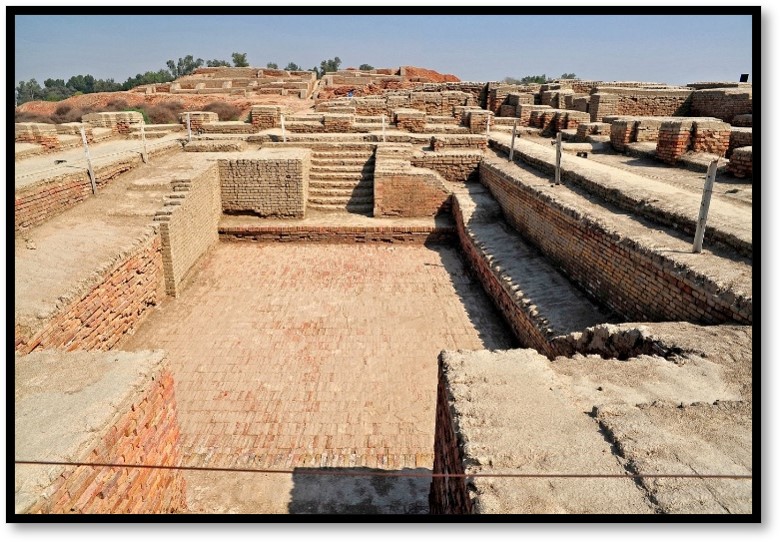
The Great Bath at Mohenjo-daro: A marvel of Bronze Age hydraulic engineering.. Source: Antonio Ciufo / Getty Images
A. Town Layout (The Dual-Citadel Paradigm)
Most Harappan cities were divided into two distinct functional zones:
- The Citadel (Western Mound):
- Built on a raised, fortified mud-brick platform.
- Housed public buildings, administrative structures, and likely elite residences.
- Exceptions: Dholavira is uniquely divided into three sections (Citadel, Middle Town, and Lower Town). Chanhudaro is the only major city entirely lacking a fortified citadel.
- The Lower Town (Eastern Mound):
- Significantly larger in area, laid out in a residential format.
- Inhabited by common citizens, artisans, merchants, and laborers.
B. Grid System and Road Infrastructure
- Towns were planned on a strict grid-iron pattern, where streets cut each other at right angles (90∘), creating rectangular housing blocks.
- Main avenues were broad (up to 10 meters wide in Mohenjo-daro), while lanes were narrower. Roads were purposefully left unpaved to allow rainwater percolation, though some sections showed signs of calcified packing.
C. Domestic Architecture
- Building Material: The absolute standardization of burnt clay bricks with a uniform ratio of 4:2:1 (Length : Breadth : Thickness) across all sites is a testament to centralized administrative oversight. Sun-dried bricks were restricted to fortifications and platform bases.
- Privacy and Comfort: Residential houses opened into inner courtyards rather than the main street. Ground-floor walls were completely devoid of window openings to ensure privacy.
- Multi-Storeyed Units: Presence of staircases indicates two or more storeys. Almost every house possessed an independent bathing area, a kitchen hearth, and a private well.
D. Advanced Drainage and Sanitation System
- Arguably the most unique feature of Harappan urbanism. Wastewater from individual households flowed via clay pipes into small street drains.
- These street drains ran parallel to roads and were systematically covered with loose brick slabs or limestone blocks to facilitate cleaning.
- Soakage pits and brick-lined sediment traps were placed at regular intervals along the network to filter solid waste before the water discharged outside the city walls.
E. Specialized Public Structures
- The Great Bath (Mohenjo-daro): A large rectangular pool enclosed by flights of steps on the north and south. Lined with finely fitted bricks, set in gypsum mortar, and sealed with a thick layer of natural bitumen (tar) to prevent water leakage. It was likely used for ritualistic or religious purification bathing.
- The Great Granary (Mohenjo-daro / Harappa): Massive brick foundations designed with strategic air vents to facilitate air circulation, keeping stored cereal grain dry and preventing rot. Represents a state-managed buffer stock system for tax collection or famine relief.
- Dockyard (Lothal): An artificial, tidal-regulated brick basin connected to the old river bed of the Bhogavo. It featured a sluice-gate mechanism to maintain water levels during low tides, allowing seafaring boats to load and unload cargo safely.
6. Economic Organization
The Harappan economy was multifaceted, supported by a highly productive agricultural surplus, advanced domestic cottage industries, and a robust network of international maritime and overland trade.
A. Agriculture and Animal Husbandry
- Primary Crops: Wheat (two varieties), Barley, Peas, Sesamum, Mustard, and Lentils.
- Milestones: The Harappans were the earliest people in the world to produce cotton (referred to as Sindon by the Greeks, derived from ‘Sindh’).
- Rice Culture: Evidence of rice husks has been recovered from Lothal and Rangpur, though it was not a staple crop in the core Indus region.
- Agricultural Technology: A terracotta model of a plow has been recovered from Banawali (Haryana), and furrow marks confirming double-cropping patterns were found at Kalibangan (Rajasthan). Shortughai (Afghanistan) provides definitive evidence of stone-lined irrigation canals.
- Domestication: Cattle (humped zebu was highly prized), sheep, goats, water buffalo, and pigs. Wild animals like elephants and rhinoceroses were well-known, as depicted on seals.
- The Horse Debate: True horse remains are generally absent from early and mature layers. Surkotada (Gujarat) yielded controversial equine bone fragments, but mainstream historians conclude that the horse was not an integral part of Harappan life, distinguishing it from the later Vedic period.
B. Craft Production and Metallurgy
- The Bronze Age Matrix: The Harappans belonged to the Bronze Age and knew how to alloy copper with tin to produce bronze. However, they remained largely dependent on stone tools (such as Chert blades). They were completely unaware of Iron.
- Bead-Making Industry: Centers like Chanhudaro and Lothal featured specialized workshops. Beads were manufactured from precious stones (Jasper, Agate, Carnelian, Steatite, Lapis Lazuli) and metals.
- Shell Working: Highly developed at coastal sites like Balakot and Nageshwar, which specialized in making bangles, ladles, and inlay work from marine shells.
C. Trade and Commerce Network
- Nature of Trade: Predominantly a barter-based economy; no metal coins have been found. Trade was regulated by a strict, centralized system of weights and measures.
- Weights and Measures: Weights followed a dual system—binary in the lower denominations (1,2,4,8,16,32 up to 64, where unit 16=13.63 grams) and decimal in higher denominations. Chert was the primary material used to shape cubic weights.
D. Provenance of Imported Raw Materials:
- Copper: Khetri Mines (Rajasthan) and Oman.
- Gold: Kolar Gold Fields (Karnataka) and river beds of Central India.
- Silver: Javan mines (Rajasthan), Afghanistan, and Iran.
- Tin: Afghanistan and Hazaribagh (Jharkhand).
- Lapis Lazuli: Badakshan/Shortughai (Afghanistan).
- Jade: Central Asia.
- Steatite: Southern Rajasthan and Northern Gujarat.
E. International Maritime Connections
- Mesopotamian cuneiform inscriptions (dating to King Sargon of Akkad, ~2300 BCE) document trade links with three distant lands: Dilmun (likely Bahrain), Magan (the Makran Coast/Oman), and Meluhha (the Indus region).
- The Mesopotamians famously referred to Meluhha as a “land of seafaring boats.” Harappan seals and weights found at Ur, Kish, and Susa definitively confirm long-term commercial links.
7. Social and Political Structure
Because the Indus script remains undeciphered, reconstruction of Harappan socio-political organization relies entirely on archaeological layout and material distributions.
A. Egalitarian vs. Stratified Society
- The sharp division between the Citadel and Lower Town houses indicates clear social stratification based on economic status and occupation.
- Society was likely stratified into four distinct classes:
- Ruling/Priestly Elite (inhabiting the Citadel platforms).
- Merchant and Trading Class (living in large villas in the Lower Town).
- Artisans and Craftsmen (occupying compact, workshop-attached quarters).
- Laborers and Domestic Slaves (living in small, single-room barracks, such as those found near the granaries at Harappa).
B. Nature of the State (Political Authority)
Historians remain divided over how such vast uniformity in brick sizes, weights, town plans, and crop storage was enforced without an obvious, centralized military apparatus:
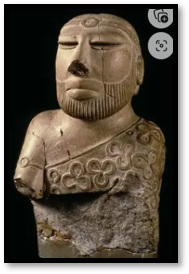
- Priest-King Model: Proposed by early scholars like Stuart Piggott, suggesting a twin-capital empire (Harappa and Mohenjo-daro) ruled by a religious oligarchy, similar to ancient Mesopotamia. This theory relies on the famous “Priest-King” steatite stone sculpture found at Mohenjo-daro.
- Merchant Oligarchy Model: A more widely accepted modern view holding that a civilization centered around trade was likely administered by a powerful corporate guild or council of wealthy merchants, rather than an absolute monarch.
- Decentralized Polities Model: Scholars like Kenoyer suggest that the IVC was not a single, unified empire, but a loose confederation of independent city-states (similar to ancient Greece), sharing identical cultural traits, measures, and architectural traditions due to deep economic integration.
8. Religious Beliefs and Practices
Harappan religion was highly localized and earthy, focusing primarily on fertility cults and animistic worship. Notably, there is no evidence of any large monumental temples anywhere in the civilization.
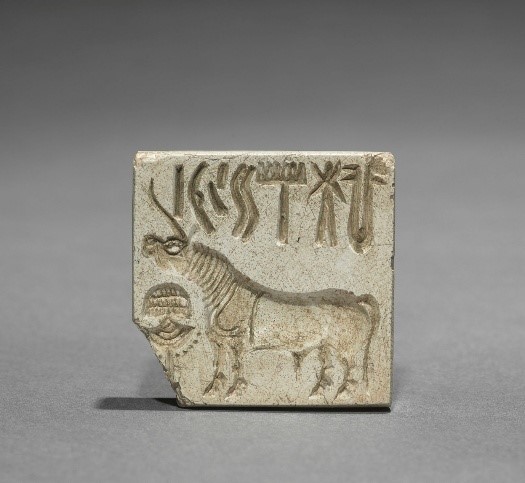
The Proto-Shiva / Pashupati Seal recovered from Mohenjo-daro.. Source: Sepia Times / Sepia Times/Universal Images Group via Getty Images
A. Chief Deities
- Mother Goddess (Matridevi): Represented by numerous terracotta female figurines found across sites, often depicted with elaborate fan-shaped headdresses. Some figurines show a plant growing out of a woman’s womb, symbolizing the Earth Goddess (Prithvi), heavily tied to agricultural fertility.
- Pashupati Mahadeva (Proto-Shiva): Depicted on a famous steatite seal sitting in a yogic posture (Padmasana), wearing a three-horned headdress. He is surrounded by four wild animals: an Elephant, a Tiger, a Rhinoceros, and a Water Buffalo. Two Deer appear near his feet. This icon represents an early configuration of the historical Hindu god Shiva in his aspect as lord of animals.
B. Cultic Practices and Rituals
- Phallic and Yoni Worship: Abundant discoveries of stone rings (toruses) and conical phallic stones point to the early worship of Lingam and Yoni representations of generative power.
- Animism (Nature Worship): Deep reverence for trees, particularly the Pipal tree (often depicted on pottery with stylized leaves), and animals. The most prominent animal icon is the mythical Unicorn (one-horned beast), followed closely by the humped bull.
- Fire Altars: Brick-lined pits containing charcoal, ash, and animal bone fragments have been excavated at Kalibangan and Lothal, confirming the practice of ritualistic fire sacrifices.
- Amulets and Magic: A large number of small clay amulets suggest a widespread belief in ghosts, evil spirits, and witchcraft, with individuals wearing tokens for protection.
C. Funerary and Burial Customs
The Harappans practiced three distinct methods of disposing of the dead:
- Complete Earth Burial: The standard practice. The body was laid out in a north-south orientation, with the head facing north, placed inside a simple unlined pit. Grave goods like pottery, personal mirrors (made of polished bronze), and bead necklaces were included, indicating a clear belief in an afterlife.
- Fractional Burial: The body was exposed to wild animals and the elements, after which the remaining bones were collected and buried in urns.
- Urn/Cremation Burial: Ash and bone fragments following cremation were placed inside large earthen jars and interred.
Specialized Burial Highlights:
- Wooden Coffins: Discovered uniquely at Harappa.
- Joint/Twin Burial: Lothal yielded a grave containing a male and a female skeleton buried together, which early archaeologists mistakenly linked to a proto-Sati practice.
- Dog with Master Burial: Excavated at Ropar (Punjab), where a pet dog was interred directly beneath its owner’s grave.
9. Harappan Art, Script, and Technology
Harappan art displays remarkable technical skill and an eye for natural movement, prioritizing everyday utility over grand royal monuments.
A. The Indus Script
- Nature: The script is purely pictographic and logo-syllabic (where each symbol represents a word or syllable). It contains roughly 400 unique signs.
- Direction of Writing: Written in the Boustrophedon style—alternating from right-to-left on the first line, and left-to-right on the second line.
- Status: Despite numerous computational models, the script remains completely undeciphered to this day.
- The Dholavira Signboard: Excavators discovered a large wooden board containing ten large Indus script characters, considered one of the earliest public signboards in human history.
B. Sculpture Types
- Bronze Casting (Lost-Wax Technique / Cire Perdue): The finest example is the “Dancing Girl“ figurine from Mohenjo-daro. She is depicted naked except for an armful of bangles, standing in a lively, defiant Tribhanga (three-bend) posture. A bronze figure of a humped bull from Kalibangan also highlights this masterful casting technique.
- Stone Sculptures: Highly realistic but rare.
- The Bearded Priest-King (Mohenjo-daro): Carved from steatite, showing a contemplative man with an elaborately braided beard, wearing a shawl decorated with a trefoil (three-leaf) pattern.
- Male Torso (Harappa): Sculpted from red sandstone, featuring realistic musculature and socket holes for attaching a head and arms.
- Terracotta Art: Earthenware figurines made of fire-baked clay, mostly sculpted by hand using the “pinch method.” These include toys, small animal figurines (monkeys that could slide down cords, horned bulls with moveable heads), and representations of the Mother Goddess.
C. Seals and Pottery
- Seals: Mostly square or rectangular plaques made of soft steatite stone. They features a highly detailed animal engraving on one side, alongside a short line of Indus script. These functioned primarily as commercial authentications—stamped onto clay tags over rope knots to secure cargo bundles during transit.
- Pottery: Mass-produced on fast potter’s wheels. The classic style is Red-and-Black Pottery, where vessels were coated with a smooth red slip and hand-painted with detailed geometric shapes, interlocking circles, pipal leaves, and fish-scale designs in black pigme
10. Comprehensive Mapping of Major Harappan Sites
| Major Site | Present Location | River Bank | Key Excavator | Unique Archaeological Discoveries |
| Harappa | Sahiwal District, Punjab, Pakistan | Ravi | Daya Ram Sahni (1921) | Row of 6 granaries; working floors with wheat/barley flour remnants; red sandstone male torso; wooden coffin burial; Cemetery-H culture. |
| Mohenjo-daro | Larkana District, Sindh, Pakistan | Indus | R.D. Banerjee (1922) | Great Bath; Great Granary; assembly hall; bronze “Dancing Girl”; Steatite Priest-King; “Pashupati” seal; multiple layers of devastating floods. |
| Lothal | Ahmedabad District, Gujarat, India | Bhogavo | S.R. Rao (1954) | Artificial brick tidal dockyard; bead-making factories; Persian Gulf type seal; terracotta horse model; double burials; rice husk remains. |
| Kalibangan | Hanumangarh District, Rajasthan, India | Ghaggar | Amlananda Ghosh / B.B. Lal | Furrowed agricultural fields (earliest evidence); wooden furrow plow; fire altars; camel bone fragments; lower town fortification. |
| Dholavira | Kutch District, Gujarat, India | Seasonal streams Manhar / Mansar | R.S. Bisht (1985) | Unique three-tier city planning; sophisticated storm-water harvesting dams and stone reservoirs; 10-sign public inscription board. |
| Chanhudaro | Indus District, Sindh, Pakistan | Indus | N.G. Majumdar / Mackay | Only city without a citadel; inkpot remains; bead-maker’s workshop; terracotta model of a bullock cart; footprint of a dog chasing a cat on a brick. |
| Rakhigarhi | Hisar District, Haryana, India | Ghaggar-Hakra | Amarendra Nath | Identified as the largest IVC site in terms of physical area; ancient DNA extraction from skeletons showing zero steppe ancestry lines. |
| Banawali | Fatehabad District, Haryana, India | Lost Saraswati bed | R.S. Bisht | High-quality barley grains; terracotta toy plow model; complete lack of a systematic grid-iron street drainage plan. |
| Surkotada | Kutch District, Gujarat, India | – | J.P. Joshi | Definitive structural remains of horse bones; stone-fortified citadel mound; oval graves with stone cairn covers. |
11. Decline of the Indus Valley Civilization
Around 1900 BCE, the highly structured urban machinery of the IVC began to collapse. This decline was a gradual transformation over centuries rather than a sudden cataclysm, with cities devolving into smaller, localized farming cultures.
Analytical Theories of Decline:
| Core Theory | Key Proponent Scholars | Core Arguments & Modern Critiques |
| Aryan Invasion Theory | Sir Mortimer Wheeler, Stuart Piggott | Argument: Rig Vedic descriptions of Indra as Purandara (fort-destroyer) and unburied skeletons found in the streets of Mohenjo-daro suggested a violent massacre by invading Indo-Aryans.
Critique: Completely debunked by modern forensic anthropology. The skeletons belong to different chronological layers and show zero signs of military trauma. |
| Tectonic Uplift and River Diversion | Robert Raikes, H.T. Lambrick | Argument: Intense tectonic shifts blocked the lower Indus course, turning the river into an expanding lake that drowned Mohenjo-daro in deep silt. Alternatively, the Yamuna and Sutlej shifted their courses away from the Ghaggar channel, drying up the agricultural core. |
| Ecological Imbalance & Deforestation | Walter Fairservis | Argument: Over-exploitation of fragile semi-arid soils by a growing population, combined with massive deforestation to bake millions of clay bricks, stripped the vegetation cover. This led to systemic crop failures and soil salinization. |
| Gradual Monsoonal Aridity | Shereen Ratnagar, Madhusudan Vagri | Argument: A widespread shift in global weather patterns weakened the Indian Summer Monsoon around 2000 BCE. Decreasing rainfall turned perennial rivers into seasonal streams, forcing populations to migrate eastward into the Ganga-Yamuna plains. |
12. Legacy and Continuity in Later Indian Culture
The Indus Valley Civilization did not vanish entirely; it bequeathed a rich material and spiritual legacy that integrated seamlessly into later Indian traditions:
- Religious Continuities: The worship of Pashupati (Shiva), Mother Goddess figures, the sacredness of the Pipal tree, holy water ablutions (baths), and the use of Lingam and Yoni motifs remain pillars of popular Hinduism today.
- Symbolic Continuities: The Swastika icon, the endless knot motif, and the practice of wearing ivory or terracotta bangles up the forearm can all be traced back to Harappan crafts.
- Metrological Continuity: The binary and decimal base-16 system (1 Rupee=16 Annas) remained the standard basis of Indian currency and weight measurement networks until the adoption of the metric system in the mid-20th century.
- Architectural Legacy: The layout of the inner courtyard house to provide natural cooling and privacy remains a defining feature of traditional domestic architecture across rural India and Pakistan today.