UPSC & GPSC · Editorial Analysis
The Indo-Pacific is Here to Stay, With or Without Washington
Source: The Indian Express Editorial | Author: C. Raja Mohan
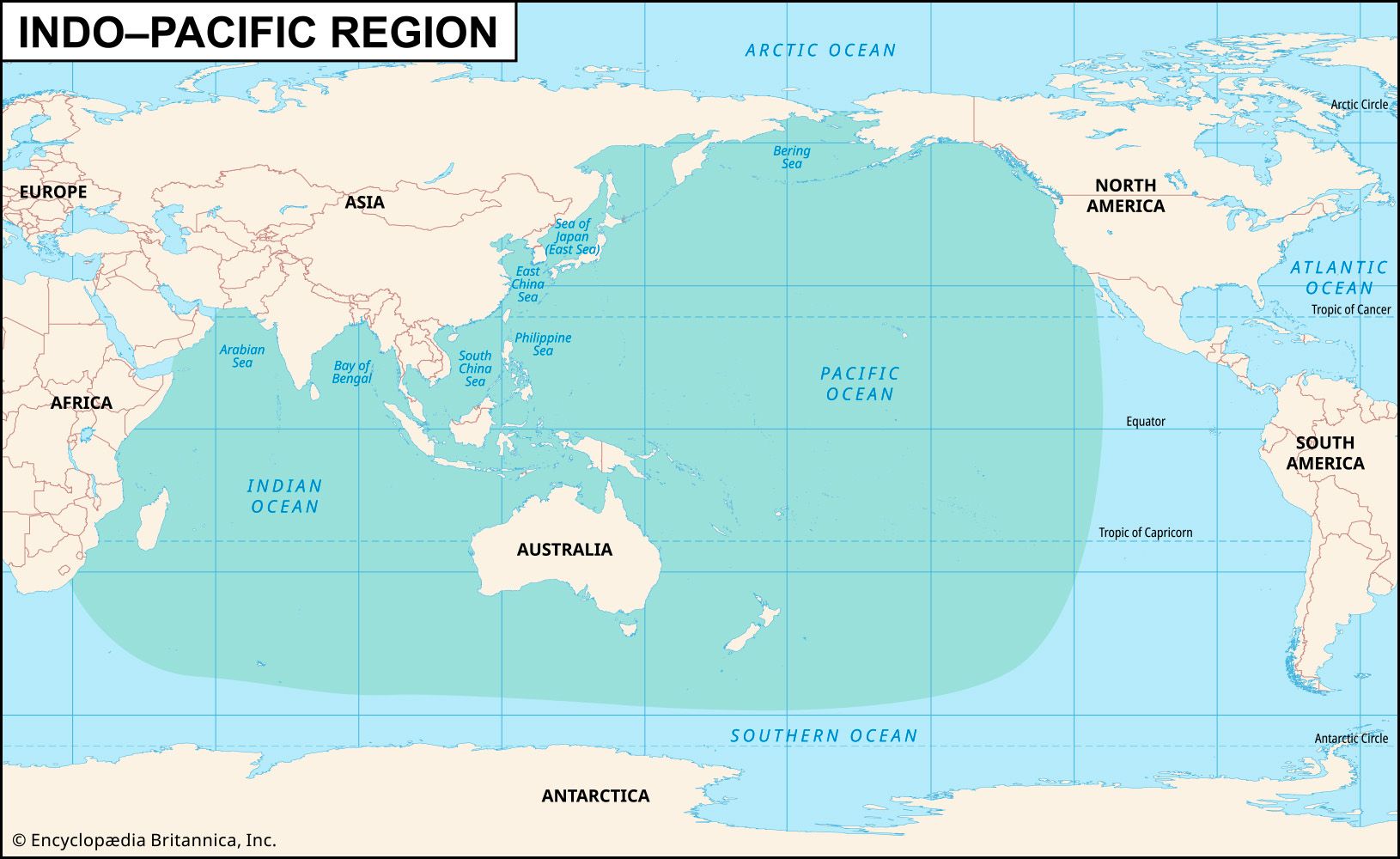
The Indo-Pacific has emerged as the defining strategic geography of the 21st century, linking the Indian and Pacific Oceans into an interconnected economic and security space. While debates continue regarding the future role of the United States in the region, the Indo-Pacific’s significance is increasingly being driven by structural realities such as Asia’s economic rise, maritime trade routes, supply-chain resilience, and growing strategic competition among major powers.
For India, the Indo-Pacific is not merely a foreign-policy construct but a core component of its economic prosperity and national security.
Key Issues
1. Uncertainty regarding U.S. Strategic Commitment
- Changes in U.S. domestic politics can influence American engagement in Asia.
- Debates over burden-sharing and military commitments have affected perceptions of U.S. involvement.
2. Rise of China and Regional Balancing
- China’s military modernisation and assertive maritime policies have altered regional power equations.
- Activities in the South China Sea and expansion of the Belt and Road Initiative (BRI) are important examples.
3. Maritime Security Challenges
- The Indo-Pacific contains some of the world’s busiest sea lanes and critical chokepoints.
- The Malacca Strait is particularly important for global trade and energy shipments.
4. Supply Chain Vulnerabilities
- The COVID-19 pandemic and geopolitical tensions exposed excessive dependence on concentrated manufacturing hubs.
- Semiconductor shortages and critical-mineral disruptions highlighted these vulnerabilities.
5. Competing Regional Architectures
- Different countries promote varying institutional visions for the Indo-Pacific.
- Important frameworks include the Quad, ASEAN Outlook on the Indo-Pacific (AOIP), IPEF and BRI.
Global Practices
Japan: Promotes a Free and Open Indo-Pacific (FOIP), maritime partnerships and infrastructure investment.
Australia: Focuses on supply-chain diversification and maritime capabilities.
European Union: Its Indo-Pacific strategy emphasises connectivity and sustainability.
ASEAN: Promotes an inclusive regional order through the ASEAN Outlook on the Indo-Pacific (AOIP).
Indian Policies & Recommendations
SAGAR
- Security and Growth for All in the Region – India’s maritime vision for cooperative security and development in the Indian Ocean Region.
Act East Policy
- Strengthens India’s economic and strategic engagement with Southeast Asia.
Indo-Pacific Oceans Initiative (IPOI)
- Launched in 2019, it promotes cooperation in maritime security, disaster-risk reduction, marine ecology, and capacity building.
Quad Cooperation
- Major areas include Maritime Domain Awareness, emerging technologies, supply-chain resilience, and infrastructure development.
National Maritime Security Coordinator Framework
- Strengthens coordination among India’s maritime agencies.
UPSC Prelims Pointers
- Indo-Pacific: A geopolitical and strategic concept connecting the Indian and Pacific Ocean regions.
- Quad: India, Japan, Australia and the United States.
- SAGAR: Security and Growth for All in the Region.
- IPOI: Indo-Pacific Oceans Initiative, launched by India in 2019.
- AOIP: ASEAN Outlook on the Indo-Pacific, representing ASEAN’s approach towards an inclusive Indo-Pacific.
- FOIP: Free and Open Indo-Pacific, strongly associated with Japan’s regional strategic approach.
- Malacca Strait: One of the world’s major maritime chokepoints and an important route for trade and energy transportation.
- BRI: Belt and Road Initiative, led by China.
- Act East Policy: India’s policy for deeper economic, political and strategic engagement with Southeast Asia and the wider Indo-Pacific.
- Maritime Domain Awareness (MDA): Involves obtaining and sharing information about activities and developments in the maritime domain.
Way Forward
1. Strengthen Maritime Capabilities
- Enhance naval modernisation, maritime surveillance and coastal infrastructure.
2. Diversify Supply Chains
- Reduce excessive dependence on single-country supply chains, particularly for semiconductors and critical minerals.
3. Deepen Partnerships
- Expand cooperation with Japan, Australia, ASEAN, France and Indian Ocean partners.
4. Support ASEAN Centrality
- Maintain an inclusive and rules-based regional architecture.
5. Preserve Strategic Autonomy
- Continue issue-based partnerships without entering rigid military blocs.
6. Expand Economic Engagement
- Increase trade connectivity and investment partnerships across the Indo-Pacific.
Conclusion
The Indo-Pacific has evolved from a diplomatic expression into an enduring geopolitical reality shaped by geography, trade, technology and strategic competition. Its future will be determined less by the choices of any single power and more by the collective actions of regional countries.
For India, the objective should be to strengthen strategic autonomy while contributing to a free, open, inclusive and rules-based Indo-Pacific order.
Practice Questions
Consider the following statements regarding the Indo-Pacific:
1. The Quad consists of India, Japan, Australia and the United States.
2. India’s SAGAR doctrine focuses on maritime cooperation in the Indian Ocean Region.
3. ASEAN has proposed the ASEAN Outlook on the Indo-Pacific (AOIP).
Which of the statements given above are correct?
All three statements are correct.
“The Indo-Pacific is no longer merely a strategic concept but an enduring geopolitical reality.” Examine India’s interests and policy options in the evolving Indo-Pacific order.