The Vedic Age (c. 1500 BCE – 600 BCE)
The Vedic Age marks a monumental transition in the history of the Indian subcontinent, moving from the bronze-age urbanism of the Indus Valley Civilization to a rural, pastoral, iron-using society that laid the foundational institutional frameworks of classical Hinduism, social organization, and early state formation.
| THE VEDIC AGE TIMELINE | |
| ↓ | |
| Early Vedic Period (c. 1500–1000 BCE) | Later Vedic Period (c. 1000–600 BCE) |
| – Saptasindhu Core Region | – Upper Ganga Valley Migration |
| – Pastoral, Semi-Nomadic Tribal | – Sedentary Agricultural Economy |
| – Egalitarian Tribal Assemblies | – Emergence of Janapadas & Rigid Varna |
1. Geographical Matrix and Migration Patterns
A. The Early Vedic Settlement: Saptasindhu
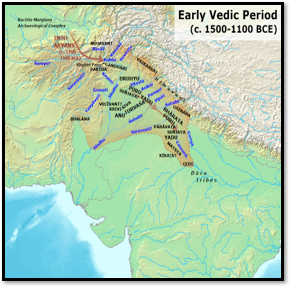
The Rig Vedic composition took place in the region known as the Saptasindhu (Land of the Seven Rivers), encompassing modern Punjab, Haryana, and parts of Pakistan and Afghanistan.
- Key Rivers Identified: The Nadi-sukta hymn of the Rig Veda names major river systems. The Indus (Sindhu) is the most mentioned river due to its commercial and physical importance. The Saraswati (now identified mostly with the dry bed of the Ghaggar-Hakra) is hailed as the holiest river (Naditama – best of all rivers).
- Peripheral Awareness: The Ganga and Yamuna are rarely mentioned (Ganga only once, Yamuna thrice), indicating that the core concentration of Rig Vedic tribes remained west of the Yamuna channel.
B. The Later Vedic Expansion: Aryavarta
By c. 1000 BCE, the discovery and active mining of iron ore accelerated eastward migration into the Upper Ganga Valley (the Indo-Gangetic divide and the fertile Doab region).
- The Textual Proof: The Satapatha Brahmana contains the famous legend of Videgha Mathava, who traveled eastward accompanied by his priest Gotama Rahugana and the sacrificial fire-god Agni Vaisvanara, who burned down the dense forests up to the Sadanira River (modern Gandhak River in Bihar). This story records the actual historical clearing of dense monsoon jungles using fire and iron axes.
2. Literary and Archaeological Sources: The Problem of Correlation
A primary challenge in reconstructing Vedic history is reconciling the vast oral literary tradition with sparse material findings.
A. Literary Architecture (Sruti Literature)
The primary sources are the four Vedas, which transitioned from oral preservation (Sruti – that which is heard) to written records centuries later:
| Text Component | Analytical Sub-divisions | Historical and Socio-Political Value for UPSC |
| Rig Veda Samhita | 10 Mandalas (Books).
Mandalas 2–7 are the oldest (“Family Books”). Mandalas 1 & 10 are late additions. |
Depicts a semi-nomadic, pastoral society. Contains the Purusha Sukta (10th Mandala), which provides the earliest structural justification for the four-fold Varna system. |
| Sama Veda | Collection of musical tunes and stanzas. | Indicates the early evolution of Indian classical music (Svara) and chanting protocols for public sacrifices. |
| Yajur Veda | Divided into Shukla (White/Pure) and Krishna (Black/Mixed). | Contains the precise ritual manuals, formulas, and geometrical descriptions for constructing sacrificial altars. Reflects an institutionalized priesthood. |
| Atharva Veda | Non-Aryan popular traditions incorporated into Vedic thought. | Contains charms, magic spells, popular folk medicine, and defensive prayers. Highly valuable for understanding the everyday life and anxieties of the common people. |
B. Auxiliary Literature
- Brahmanas: Prose commentaries appended to each Veda explaining the hidden theological meanings behind sacrificial rituals.
- Aranyakas: “Forest Texts” dealing with mysticism and initial philosophical allegories, serving as a bridge between ritualism and metaphysics.
- Upanishads (Vedanta): Developed toward the end of the Late Vedic period (c. 600 BCE). They criticize empty ritualism and redirect focus toward core philosophical concepts: Atman (soul), Brahman (cosmic spirit), Karma (action), and Samsara (cycle of rebirth).
C. The Archaeological Interface
Historians generally correlate the material culture of the Vedic age with two distinct pottery traditions:
- Ochre Coloured Pottery (OCP) / Black & Red Ware: Found in early levels in the upper Doab; represents the transitional phase between Late Harappan cultures and early pastoral settlements.
- Painted Grey Ware (PGW) Culture: Associated with the Later Vedic Period. Characterized by high-quality, thin-walled grey pottery wheel-turned and painted with simple black geometric lines. Discovered alongside early iron implements (spearheads, arrows) at key sites like Hastinapur, Atranjikhera, Noh, Kurukshetra, and Alamgirpur.
3. Political Structure: From Lineage to Territory
The political landscape changed fundamentally during this period, moving away from kin-based tribal groups toward fixed territorial kingdoms.
A. Early Vedic Polity: The Tribal Democracy
- Nature of Power: The state was not territorial. The chief was called the Rajan, or Gopa (protector of cattle) and Janasyagopa (protector of the tribe). Power was not absolute; the Rajan was a war-leader chosen for physical strength and leadership skills, rather than an absolute, hereditary ruler.
- The Administrative Structure: No standing army or bureaucratic civil administration existed. Defense relied on the Milisha, a mobilization of all able-bodied young men in the clan.
- Tribal Assemblies: Strong collective checks on the leader’s power existed through active assemblies:
- Sabha: An exclusive, elite council of elder clansmen and elites. Women (Sabhavati) were permitted to participate.
- Samiti: A broad, plenary assembly of the entire tribe (Vis) responsible for choosing or deposing the chief.
- Vidatha: The oldest tribal assembly, dedicated to distributing war spoils, organizing tribal rituals, and resolving internal disputes.
B. Later Vedic Polity: Structural Monarchy
- Territorial Statehood: The Rajan transformed into a territorial monarch ruling over a defined region called a Janapada. Tribal identities merged into territorial unions; for example, the Purus and Bharatas united to form the Kuru kingdom, while the Turvasas and Krivis became the Panchala state.
- Growth of Royal Power: The Sabha and Samiti lost their democratic authority, turning into rubber-stamp bodies for elite lineages. Women were barred from attending the Sabha. The ancient Vidatha disappeared entirely.
- Emergence of Bureaucracy: The king was now supported by a rudimentary administrative circle of 12 officials known as the Ratnins (Jewel-bearers), listed in the Taittiriya Samhita:
-
- Purohita: Chief Priest and advisor.
- Senani: Commander of the forces.
- Sangrahitri:
- Bhagadugha: Tax Collector (indicating the shift toward formal resource extraction).
- Suta: Royal chronicler or charioteer.
- Grand Ritual Sacrifices: To legitimize absolute authority, rulers performed elaborate, long-term public sacrifices (Yajnas):
-
- Asvamedha (Horse Sacrifice): A consecrated horse was set free to wander for a year; any territory it crossed uncontested was claimed by the king.
- Rajasuya: A consecration ceremony that infused the king with divine powers.
- Vajapeya (Chariot Race): A staged race where the king’s chariot was allowed to win, establishing dominance over his kinsmen.
4. Economic Transformation: Pastoralism to Sedentary Agriculture
| Early Vedic Economy: Wealth = Cows (Gavisti) -> Minimal land ownership |
| (Introduction of Iron Axes & Plows) ↓ |
| Later Vedic Economy: Wealth = Land (Janapada) -> Permanent agricultural surplus |
A. Early Vedic Economy
- The Pastoral Centrality: Essentially a subsistence economy driven by pastoralism. Domesticated cattle (Gau) were the primary measure of wealth and value.
- Linguistic Evidence of Cattle Importance:
-
- Gavisti: Literally “a search for cows,” used as the standard term for war.
- Gomat: A wealthy individual possessing large herds.
- Duhitr: Daughter, literally meaning “one who milks the cows.”
- Godhuli: A measure of time, referring to the dusk twilight when cattle return home.
- Land and Resource Rights: Land was held collectively by the clan (Vis); there was no system of private land ownership. Agriculture was a secondary occupation, focusing on a single cereal crop: barley (Yava).
- Revenue: No regular tax system existed. The chief survived on Bali, a purely voluntary tribute or gift offered by tribal members out of loyalty or after a successful raid.
B. Later Vedic Economy
- The Agricultural Shift: Sedentary agriculture became the primary economic engine. The Satapatha Brahmana devotes an entire section to detailing the agricultural calendar, describing plowing, sowing, harvesting, and threshing.
- New Crops: Rice (Vrihi) and Wheat (Godhuma) became staple foods, alongside lentil pulses.
- Technological Shift: The introduction of iron, referred to in texts as Shyama Ayas (black metal) to distinguish it from copper, which was called Loha Ayas (red metal). Heavy iron-shod plows drawn by teams of up to 24 oxen allowed farmers to cut deep into the heavy alluvial clays of the middle Ganga valley.
- Resource Management: Voluntary tributes evolved into mandatory taxes, managed by the Bhagadugha (collector) and stored by the Sangrahitri (treasurer). Land began to transition toward private and family holdings, reducing the role of collective clan property.
- Trade and Urbanization: Craft specialization increased, leading to early guilds. Mention of Niska, Satamana, and Krishnala in texts indicates early metallic weight standards, though a true currency system had not yet developed. This era represents the transition toward the Second Urbanization in ancient India.
5. Social Evolution: From Kinship to Rigid Caste Stratification
The social fabric transformed from an open, flexible clan network into a rigid, birth-based hierarchy.
A. Early Vedic Social Fabric
- Egalitarian Framework: Society was organized around kinship lines (Kula). Social stratification was minimal and flexible.
- The Meaning of Varna: The term Varna originally referred to “color” or “light,” used to differentiate between the incoming Aryas and the indigenous populations, whom they called Dasas or Dasyus.
- Occupational Mobility: Differentiation based on occupation emerged late in the period but remained flexible and non-hereditary. This fluidity is captured in a famous hymn from the 9th Mandala of the Rig Veda:
“I am a singer, my father is a physician, and my mother grinds corn with stones. We all pursue different occupations but live together harmoniously.”
- Status of Women: Women held a respected position in Early Vedic society:
-
- They had access to education; several women, including Gargi, Maitreyi, Lopamudra, and Apala, composed Rig Vedic hymns.
- They participated equally with their husbands in public religious sacrifices and attended political assemblies (Sabha).
- Child marriage did not exist; cohabitation began after maturity (N विवाह). The practice of Niyoga (levirate cohabitation) was socially accepted to ensure lineage survival, and widows were permitted to remarry.
B. Later Vedic Social Stratification
- Institutionalization of the Varna System: Society became rigidly divided into four distinct, hereditary classes (Varnas), anchored by religious law:
-
- Brahmin: Performed sacrifices, received gifts (Dana), and provided religious legitimacy to the state.
- Kshatriya: Controlled the political apparatus, led military defense, and enforced law.
- Vaishya: The only class subject to regular taxation. Engaged in agriculture, pastoralism, and trade.
- Shudra: Positioned at the base of the hierarchy to serve the upper three classes. Denied the Upanayana (sacred thread) initiation ritual and barred from hearing or reciting Vedic mantras.
- Decline in the Status of Women: Women lost their institutional rights. They were barred from political assemblies and denied access to formal education. The Aitareya Brahmana goes so far as to label a daughter as the “source of all misery,” while a son is celebrated as the “protector of the family.”
- The Gotra Institution: The Gotra system emerged, literally meaning “cow-pen.” It designated ancestral descent from a common rishi, making Gotra exogamy (marrying outside one’s Gotra) mandatory to maintain clan alliances.
- The Ashrama System: To structure an individual’s ideal life cycle, the text systems outlined the four distinct stages (Ashramas), though the fourth phase became fully established only in the post-Vedic era:
-
- Brahmacharya: Student life focused on learning and celibacy.
- Grihastha: Householder life focused on wealth generation (Artha) and family responsibilities (Kama).
- Vanaprastha: Partial retirement to the forest for meditation.
- Sannyasa: Total renunciation of worldly ties (codified in the later Jabala Upanishad).
6. Religious Shift: Cosmic Order to Ritualistic Hegemony
Vedic religion moved away from naturalistic pantheism toward complex, expensive rituals, which eventually sparked a philosophical counter-reaction.
A. Early Vedic Religion: Naturalistic Polytheism
- Anthropomorphism: Harappans personified the powerful forces of nature into distinct deities.
- The Concept of Rita: A central cosmic principle. Rita represented the moral, natural, and rhythmic order of the universe. Keeping Rita balanced was essential for cosmic survival, and Varuna was worshipped as its primary guardian (Ritasya Gopa).
- The Pantheon: Deities were divided into three spheres: Terrestrial (Prithvi), Atmospheric (Antariksha), and Celestial (Dyus).
| PRIMARY EARLY VEDIC DEITIES | ||
| ↓ | ||
| INDRA (Purandara) | AGNI (Fire God) | VARUNA (Cosmic Order) |
| – 250 Dedicated Hymns | – 200 Dedicated Hymns | – Guardian of Rita |
| – War Lord & Rain Maker | – Intermediary Deity | – Water God |
- Mode of Worship: Simple prayers and direct invocations, accompanied by modest offerings of milk, grain, and Soma juice. The primary goal of worship was practical and material—seeking children (Praja), cattle (Pashu), health, and victory in war, rather than spiritual liberation (Moksha).
B. Later Vedic Religion: Priesthood and Ritualism
- Decline of Older Deities: Indra and Agni lost their primary importance.
- Rise of the Trinity Deities: New gods representing creation and transformation grew to prominence:
-
- Prajapati (or Brahma): The supreme creator god.
- Rudra (an early form of Shiva): The god of wilderness, animals, and healing.
- Vishnu: The protector and preserver of human order.
- Pushan: The god who protected cattle in the early period was reclassified as the protector deity of the Shudras.
- Hegemony of the Ritual: Sacrifices became complex, highly expensive, and centralized events. The simple focus of early invocations was replaced by a belief that the correct pronunciation of phrases (Mantras) by trained priests could compel the gods to grant favors.
- The Philosophical Backlash: This heavy focus on expensive rituals and animal sacrifices met strong intellectual resistance toward the end of the period. Thinkers gathered in forest retreats to compose the Upanishads, rejecting empty rituals and focusing instead on deep philosophical inquiry into the relationship between the individual soul (Atman) and the cosmic truth (Brahman).
7. Comparative Analytical Summary: Quick Reference
This table provides a concise distillation of the structural shifts between the two periods, serving as a rapid review tool for civil services candidates.
| Comparative Theme | Early Vedic Period (c. 1500 – 1000 BCE) | Later Vedic Period (c. 1000 – 600 BCE) |
| Geographical Core | Saptasindhu (Punjab / Haryana region) | Aryavarta (Upper Ganga Valley / Doab) |
| Political Unit | Jana (Tribal lineage organization) | Janapada (Territorial statehood matrix) |
| Nature of Monarch | Rajan (War leader checked by assemblies) | Samrat / Bhupathi (Hereditary territorial ruler) |
| Economic Base | Pastoralism; cattle-driven asset value | Sedentary Agriculture; rice and wheat production |
| Metal Profile | Copper and Bronze dominant | Widespread usage of Iron (Shyama Ayas) |
| Social Divisions | Flexible, fluid, occupation-based groupings | Rigid, hereditary four-fold Varna system |
| Position of Women | High; active in education and political assemblies | Restricted; barred from public assemblies |
| Primary Deities | Indra, Agni, Varuna | Prajapati, Rudra, Vishnu |
| Dominant Pottery | Ochre Coloured Pottery / Black & Red Ware | Painted Grey Ware (PGW) culture |
8. Previous Years’ UPSC Civil Services Questions (Analytical Check)
While the Middle Ganga Valley was consolidating into an empire, the northwestern frontier of the Indian subcontinent remained fragmented, leaving it open to foreign invasions.
Mains Focus Questions:
- “The transformation from a pastoral, nomadic society to a sedentary, agrarian economy during the late Vedic period fundamentally reshaped the socio-political institutions of ancient India.” Critically analyze. (15 Marks, 250 Words)
- Evaluate how the archaeological discoveries of the Painted Grey Ware (PGW) sites correlate with the geography and events described in Later Vedic literature. (10 Marks, 150 Words)