
1. HISTORIOGRAPHICAL CONTEXT & SOURCES
The 6th century BCE represents a major turning point (epochal transition) in early Indian history. It marks the definitive shift from the pastoral-agrarian, semi-nomadic tribal structures of the Later Vedic Period to a highly stratified, urbanized, state-level society.
A. Literary Sources: The Cross-Referencing of Traditions
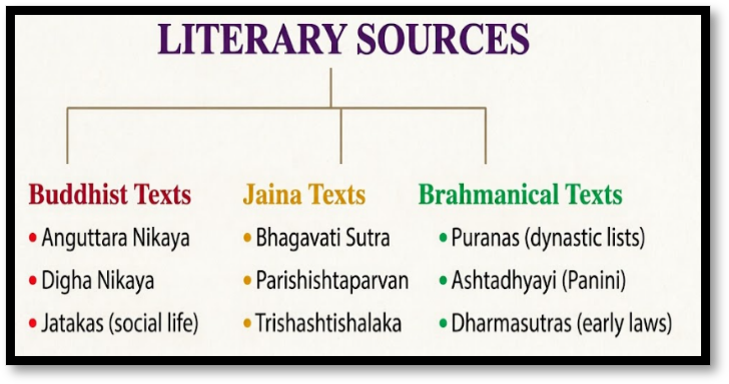
Because contemporary historical chronicles are absent, historians reconstruct this period by cross-referencing three independent textual traditions:
- Buddhist Canonical Literature:
- Anguttara Nikaya (Sutta Pitaka): Provides the standard, canonical list of the 16 Mahajanapadas.
- Digha Nikaya: Contains the Mahaparinibbana Sutta, which outlines the geopolitics of the era, urban centers, and the demise of contemporary rulers like Bimbisara and Ajatashatru.
- The Jatakas: These folklore appendices describe socio-economic realities, trade routes (Vanias), merchant guilds (Srenis), and the transition to cash economies.
- Jaina Canonical Literature:
- Bhagavati Sutra: Provides an alternate list of 16 Mahajanapadas (including states like Malaya, Malava, and Kochcha, reflecting a slightly different geographical focus toward the east and south).
- Brahmanical & Grammatical Works:
- Panini’s Ashtadhyayi (c. 5th Century BCE): A foundational Sanskrit grammar treatise that provides invaluable secular terminology regarding political institutions, distinguishing between Monarchies (Ekarajas) and Ganas (Oligarchies), and listing individual janapadas like Kamboja and Gandhara.
- The Puranas: Post-facto dynastic chronicles providing genealogical successions of Magadhan dynasties (Shaishunaga, Nanda), crucial for reconstructing political chronology despite their highly mythologized framework.
B. Archaeological Anchors: The NBPW Phase
The material culture of the Mahajanapada period is archaeologically tied to the Northern Black Polished Ware (NBPW) culture phase (c. 700 BCE – 200 BCE).
- Technological Signature: NBPW is a luxury, wheel-made, fine-fabric pottery characterized by a glossy, mirror-like black metallic slip. It indicates advanced pyrotechnology, utilizing kiln temperatures reaching up to 1200°C with reduction firing.
- Stratigraphic Continuity: In the Ganges Plain, NBPW sits directly above the Painted Grey Ware (PGW) strata, establishing a clear technological evolution from the Later Vedic period to the historical urban period.
- Distribution and Scale: Major excavations at Rajgir, Shravasti, Kausambi, Ahichchhatra, and Pataliputra show clear signs of permanent urban settlements: burnt-brick structures, ring-wells (for waste management), and defensive fortifications.
2. THE DYNAMICS OF THE “SECOND URBANIZATION”
The 6th century BCE is called the Second Urbanization to distinguish it from the First Urbanization (the Bronze Age Indus Valley Civilization). It was a distinct, iron-driven historical process centered in the Middle Ganga Valley.
A. The Core Material Drivers
The transition to an urban economy was driven by a combination of technological, ecological, and social changes:
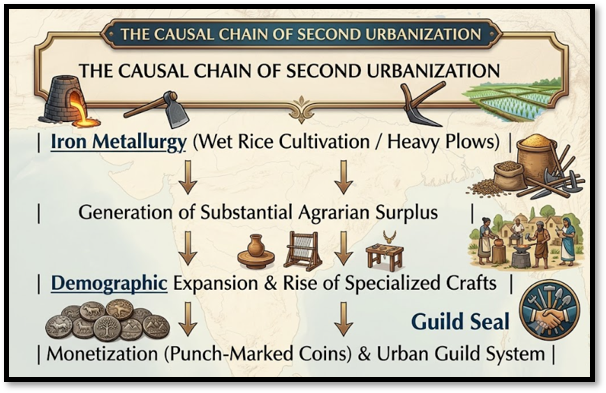
- The Iron Technology Revolution: While iron was used in the Later Vedic period (Shyama Ayas), its application was largely restricted to weaponry. In the NBPW phase, iron production shifted to agrarian tools. The transition from wrought iron to carburized steel enabled the mass manufacturing of socketed axes, iron sickles, and heavy plowshares.
- Ecological Adaptation to the Middle Ganga Plain: The Lower and Middle Ganga plains featured dense, monsoon-fed forests and heavy alluvial soil. Clearing these areas required both fire and sturdy steel axes. Once cleared, the land was ideal for Wet Rice Cultivation (Transplantation / Rupa). Paddy transplantation vastly increased crop yields compared to broadcast sowing, generating the substantial food surplus required to support non-agricultural urban populations.
- Monetization and the Emergence of Currency: Barter transactions were replaced by the introduction of India’s earliest metallic currency: Punch-Marked Coins (PMC), known in literature as Kahapanas or Karshapanas.
- Composition: Mostly silver, with occasional copper issues.
- Manufacturing Technique: Pieces of metal sheet were clipped to standard weights and stamped with symbols like hills, trees, fish, and elephants using separate punches. They lacked inscriptions or dynastic names, which points to initial issuance by merchant guilds (Srenis) or early state authorities to standard weights.
B. Classification of Urban Centers
According to Buddhist texts, urban spaces grew around specific economic and administrative roles:
- Mahanagaras (Metropolises): The six premier cities of northern India during Buddha’s time were Champa, Rajagriha, Shravasti, Saketa, Kausambi, and Kashi.
- Pura / Nagara: Fortified administrative or regional market towns.
- Nigama: Market towns that acted as an intermediary link between rural production centers (Grama) and primary consuming cities (Nagara).
- Rajadhani: Specifically planned capital cities with royal palaces and defensive brick walls.
3. THE SIXTEEN MAHAJANAPADAS: AN ANALYTICAL DIRECTORY
The Anguttara Nikaya lists 16 major territorial states (Mahajanapadas) that stretched across the Indo-Gangetic divide, from the Hindu Kush mountains to the borders of Bengal.
Below is an exhaustive political breakdown of the 16 states, grouped by their geographical distribution and systemic relevance.
A. The Trans-Indus and Northwestern Frontier
- Kambojas
- Capital: Rajapura / Hataka (located in modern-day southwest Kashmir, Hindu Kush, and parts of Afghanistan).
- UPSC Key Insights: Renowned in the Artha shastra and epic literature for its high-quality breeds of horses and its unique corporate military structure. Kautilya explicitly characterizes the Kamboja state as a Varta-Shastropajivin Sangha—a corporation of merchants, agriculturists, and warriors.
- Gandhara
- Capital: Taxila (Takshashila) / Pushkalavati.
- UPSC Key Insights: Strategically positioned along the Uttara Patha (Northern Trade Route), making it a vital hub for commercial exchange with Central Asia. Taxila developed into India’s earliest intellectual and educational center, drawing scholars like Panini and Jivaka. In the late 6th century BCE, King Pukkusati of Gandhara sent an embassy to King Bimbisara of Magadha, but the region was soon annexed by the Achaemenid Empire of Persia under Darius I.
B. The Western and Central Indian Formations
- Kuru
- Capital: Indraprastha / Hastinapur (spanning the Delhi-Meerut-Thanesar region).
- UPSC Key Insights: Transitioned from a dominant Late Vedic tribal chiefdom into a minor, secondary political entity during the 6th century BCE. The state shifted its governance model, adopting a republican constitution (Sangha) during the Buddha’s lifetime.
- Panchala
- Capital: Ahichchhatra (Northern Panchala – Bareilly, UP) and Kampilya (Southern Panchala – Farrukhabad, UP).
- UPSC Key Insights: Divided by the Ganga River, this state also transitioned from a strong Vedic monarchical base to a decentralized confederacy or Sangha structure by the 6th century BCE.
- Matsya
- Capital: Viratanagara (modern Jaipur-Alwar-Bharatpur region of Rajasthan).
- UPSC Key Insights: Located on the fringes of the semi-arid western plains, its economy relied heavily on cattle rearing rather than the intensive rice cultivation seen in the eastern river valleys.
- Surasena
- Capital: Mathura (situated on the banks of the Yamuna River).
- UPSC Key Insights: Positioned at the strategic crossroads where the Uttarapatha met the trade routes leading down to the Deccan (Dakshinapatha). King Avantiputta of Surasena was a prominent disciple of the Buddha, helping play an early role in spreading Buddhism across central India.
- Avanti
- Capital: Ujjain (Northern Avanti) and Mahishmati (Southern Avanti – Malwa region).
- UPSC Key Insights: One of Magadha’s most formidable rivals. The state sat on rich iron ore deposits in the Jhabua and Gwalior belts, which allowed it to develop advanced military metallurgy. Under the rule of Chanda Pradyota, Avanti expanded aggressively, clashing frequently with surrounding states like Vatsa, Magadha, and Kosala.
C. The Central and Upper Gangetic Valley
- Vatsa
- Capital: Kausambi (modern Allahabad/Prayagraj, UP).
- UPSC Key Insights: Centered at the confluence of the Ganga and Yamuna rivers, making it a vital economic hub. Its famous ruler, Udayana, was a contemporary of the Buddha. Udayana’s political alliances, military campaigns, and romantic escapades inspired major literary classics, including Bhasa’s Svapnavasavadatta and Harsha’s Ratnavali.
- Chedi
- Capital: Suktimati (located in the modern Bundelkhand region along the MP-UP border).
- UPSC Key Insights: Positioned along the river routes running into central India, maintaining strong economic connections with the Matsya and Avanti states.
- Mallas
- Capital: Kusinara and Pava (modern Gorakhpur-Deoria region, UP).
- UPSC Key Insights: Organized as a non-monarchical Gana-Sangha (oligarchy) governed by a collective council of Kshatriya clans. The state holds deep religious significance: Gautama Buddha passed away at Kusinara (Mahaparinirvana), while Vardhamana Mahavira attained liberation at Pava (Parinirvana).
- Kosala
- Capital: Shravasti (Ayodhya/Saketa served as another major urban center).
- UPSC Key Insights: A dominant power in the central plains that incorporated the prosperous clan territory of the Shakyas (the Buddha’s clan). Under King Prasenajit (Pasenadi), a contemporary of the Buddha, Kosala fought a prolonged war with Magadha over the control of valuable revenues from Kashi.
- Kashi
- Capital: Varanasi.
- UPSC Key Insights: Initially the most powerful of all early Mahajanapadas due to its flourishing textile, ivory, and horse markets. However, its high economic value made it a frequent target; it was ultimately annexed by Kosala and later absorbed into the Magadhan Empire.
D. The Eastern Plains & The Vindhyan Lineage
- Vrijjis (Vajji)
- Capital: Vaishali (modern Basarh in Vaishali district, Bihar).
- UPSC Key Insights: A powerful confederacy composed of eight distinct clans (atthakula), with the Videhas, Jnatrikas, and Lichchhavis being the most prominent. It was governed as a highly organized republic (Gana-Sangha). Defeating the Vajji confederacy required Magadha to wage an intense, 16-year campaign involving internal sabotage and innovative siege weapons.
- Anga
- Capital: Champa (near modern Bhagalpur, Bihar).
- UPSC Key Insights: Situated on the eastern edge of the Middle Ganga Plain, Champa served as a key river port for merchants sailing down to the Bay of Bengal for maritime trade. The state was conquered by Bimbisara early on, marking Magadha’s first major step toward imperial expansion.
- Magadha
- Capital: Girivraja / Rajagriha (flanked by hills), later shifted to Pataliputra (at the confluence of major rivers).
- UPSC Key Insights: The ultimate victor in the struggle for regional hegemony, evolving into the base for India’s first great pan-regional empire.
E. The Trans-Vindhyan Frontier
- Assaka (Asmaka)
- Capital: Potana / Podanya (modern Bodhan in Telangana/Maharashtra border region).
- UPSC Key Insights: The only Mahajanapada located south of the Vindhya Range, situated deep within the Godavari Valley. It served as a critical southern terminal and trade gateway along the Dakshinapatha route.
4. SYSTEMIC COMPARISON: MONARCHIES VS. GANA-SANGHAS
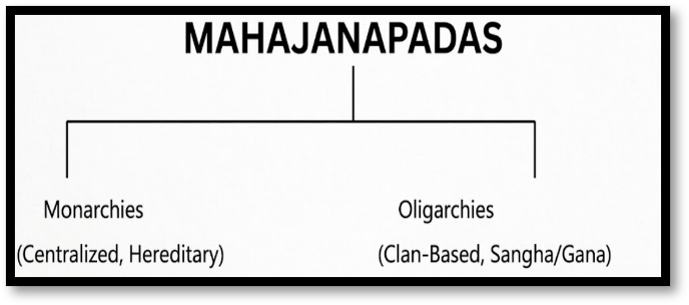
The political landscape of the 6th century BCE featured a competition between two distinct models of state formation: the centralized Monarchy (Rajya) and the oligarchic republic (Gana-Sangha). This structural divergence is a frequent theme in UPSC Mains evaluation.
| Structural Attribute | Monarchies (Rajya) | Gana-Sanghas (Oligarchies) |
| Geographical Distribution | Concentrated in the fertile alluvial plains of the Middle Ganga Valley (e.g., Magadha, Kosala). | Located in the Himalayan foothills, northwest frontier, or ecologically marginal areas (e.g., Vrijjis, Mallas, Sakyas). |
| Sovereignty & Decision Making | Concentrated in an individual hereditary ruler (Ekarajan). Power was legitimized through Brahmanical rituals. | Collective sovereignty exercised by a Kshatriya ruling council (Raja-kula). Decisions were made in a public assembly hall (Santhagara). |
| Socio-Political Stratification | Socially structured around the four-tier Varna system, with deep Brahmanical influence. | Dominated by a sharp two-tier structure: the ruling Kshatriya clans (Khattiya) and the disenfranchised laborers/slaves (Dasa-Karmakara). |
| Fiscal and Taxation System | Highly institutionalized. Regular taxes (Bhaga, Bali) were collected by specialized officials like the Balisadhaka. | Lacked a uniform, regular tax structure. Wealth was largely derived from collective land ownership, fines, and trade route tithes. |
| Military Organization | Maintained a professional, permanent standing army directly paid by the royal treasury. | Depended on tribal or clan militias led by individual aristocratic chieftains. |
| Religious Alignments | Orthodox rulers favored Brahmanical sacrificial rituals to validate their authority, though individuals supported heterodox sects. | Strongly supported heterodox movements (Buddhism, Jainism), which rejected hereditary ritual authority. |
The Institutional Workings of the Santhagara
The Gana-Sanghas operated under sophisticated democratic procedures, which are recorded in detail in the Buddhist Vinaya Pitaka:
- Seating and Quorum: A specialized officer, the Asanapannapaka, was responsible for arranging seats and ensuring the required quorum was met before debates began.
- Voting Mechanisms: Decisions were made through secret or open balloting using colored wooden sticks called Salakas. The vote collection process was overseen by an independent arbiter known as the Salakagahapaka.
- Dispute Resolution: Contentious matters were referred to specialized committees (Ubbahika) to build consensus and avoid deep fractures within the ruling confederacy.
5. THE RISE OF MAGADHAN HEGEMONY: A MULTI-CAUSAL ANALYSIS
Magadha’s rise from a small regional state to the dominant power in northern India was not accidental. It was driven by a unique combination of geographical advantages, natural resource access, and innovative leadership.
A. Geopolitical & Environmental Assets
- Strategic Advantage of Dual Capitals:
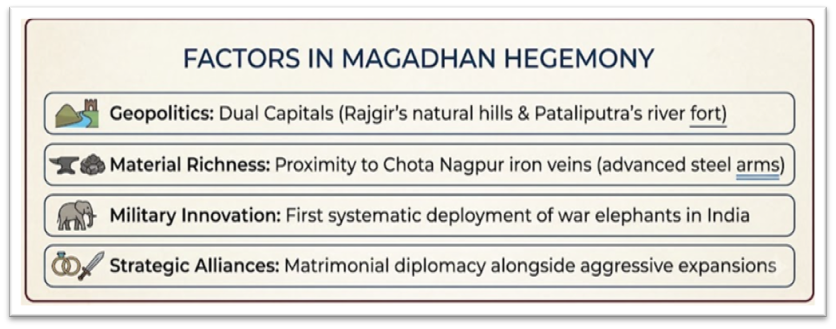
- Rajagriha (Rajgir): The old capital was surrounded by five natural hills that formed a natural stone fortification, making it virtually impregnable to contemporary siege tactics.
- Pataliputra: The later capital was a premier Jala-durga (Water Fort). Situated at the confluence of four major rivers—the Ganga, Son, Gandak, and Ghaghra—it controlled riverine trade across the entire Gangetic valley and allowed rapid, long-distance military deployment via naval boats.
- Agricultural Abundance: Magadha occupied the fertile alluvial soil of the southern Middle Ganga Plain. This region received consistent monsoon rainfall and was naturally fertilized by river floods, enabling regular double-cropping. The resulting food surplus sustained a large standing army and a extensive administrative state.
B. Access to Critical Resources
- The Iron Advantage: Magadha was located near the richest iron ore deposits in the subcontinent, found in the Chota Nagpur Plateau (Barabar and Rajgir hills). This direct access allowed Magadha to build a superior military industrial complex, outfitting its troops with high-grade steel weapons like broadswords and iron-tipped lances far more efficiently than its rivals.
- Timber Supply: The dense forests of nearby south Bihar provided an endless supply of high-grade timber, which was essential for constructing large-scale city fortifications, palace complexes, and river fleets.
C. Military and Tactical Innovations
- The Elephant Force: Magadha was the first Indian state to systematically capture, train, and deploy war elephants on a large scale. In the swampy, forested terrain of the Ganga valley, elephant corps could smash through enemy infantry formations and tear down fortified wooden stockades, rendering traditional chariot warfare obsolete.
- Advanced Weaponry: Magadha’s military engineers developed new weapon systems that transformed siege warfare:
- Mahashilakantaka: A heavy catapult system capable of launching massive stone blocks over city walls.
- Rathamusala: A specialized chariot fitted with rotating blades and maces, designed to cut through infantry ranks.
D. Bold Leadership & Dynastic Continuity
Magadha was ruled by a succession of ambitious, ruthless kings who prioritized pragmatic statecraft over traditional ritual limits.
1. The Haryanka Dynasty (c. 544 BCE – 413 BCE)
- Bimbisara (c. 544 – 492 BCE): The true architect of Magadha’s rise. He used a dual strategy of Matrimonial Alliances and aggressive military expansion:
- He married Kosala Devi (receiving a revenue-rich district of Kashi as a dowry), Chellana (a Lichchhavi princess of Vaishali), and Khema (from the Madra clan of Punjab). This secured his western and northern borders.
- He launched an invasion of Anga, annexing its rich river port of Champa and gaining direct access to maritime trade routes.
- He institutionalized a permanent, salaried bureaucracy and established an early network of royal roads.
- Ajatashatru (c. 492 – 460 BCE): Came to power by assassinating his father, Bimbisara. He pursued an aggressive expansionist foreign policy:
- The Kosala War: He defeated his uncle Prasenajit, forcing the total annexation of Kashi into Magadha.
- The Vajji Campaign: To defeat the powerful Lichchhavi republic of Vaishali, he deployed his minister Vassakara on a three-year covert mission to plant seeds of internal division within the Vajji assembly hall. Once the republic’s unity was fractured from within, Ajatashatru launched a full-scale invasion, capturing the territory using the Mahashilakantaka and Rathamusala.
- Udayin (c. 460 – 444 BCE): Recognized the changing geopolitical map of northern India and officially shifted the imperial capital from Rajgir to Pataliputra.
2. The Shishunaga Dynasty (c. 413 BCE – 345 BCE)
- Shishunaga: A former viceroy of Benares who was elevated to the throne following a popular revolt against the Haryanka rulers. His greatest historical achievement was the total defeat and annexation of the Avanti Kingdom (Pradyota Dynasty). This ended a century-long war for supremacy, bringing central India under Magadhan control.
- Kalashoka (Kakavarna): Hosted the Second Buddhist Council at Vaishali (c. 383 BCE), a key event that marked the first institutional split within the early Buddhist community.
3. The Nanda Dynasty (c. 345 BCE – 321 BCE)
The Nandas marked a major break from tradition, establishing the first truly centralized empire in Indian history.
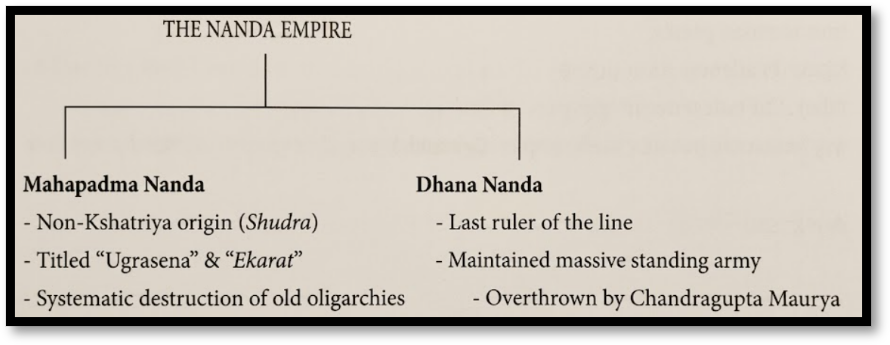
- Mahapadma Nanda: Ancient Puranic texts describe him as a ruler of low caste, non-Kshatriya origin. He launched campaigns that systematically destroyed the traditional ruling houses of Northern India, including the Ikshvakus, Panchalas, and Kurus.
- Imperial Titles: He claimed the titles of Ekarat (Sole Sovereign) and Sarva-Kshatrantaka (Uprooter of all Kshatriyas), shifting the nature of kingship away from old ritual validations.
- He expanded the empire’s borders deep into Orissa (Kalinga) and across parts of the Deccan, as confirmed by the later Hathigumpha Inscription of King Kharavela.
- Dhana Nanda: The last ruler of the Nanda line. Greek accounts refer to him as Agrammes or Xandrames, describing a ruler who commanded a massive standing army of 200,000 infantry, 20,000 cavalry, 2,000 war chariots, and 3,000 war elephants. The fear of clashing with this immense Nanda army was a primary reason why Alexander the Great’s battle-weary troops mutinied at the Beas River, forcing him to abort his eastward advance into India.
6. SOCIAL, ECONOMIC, AND LEGAL STRUCTURES
The Mahajanapada era saw the formal institutionalization of early Indian social and economic laws.
A. The Guild System (Srenis)
As trade grew, artisans and merchants organized into self-governing professional corporations called Srenis (Guilds).
- Internal Autonomy: Each guild operated under its own distinct legal code, known as Sreni-dharma, which was officially recognized and protected by the state judiciary.
- Judicial Executive: Guilds were led by a hereditary chief called the Jetthaka or Pramukha. They functioned as independent economic units: they set quality standards, fixed commodity prices, acted as early banks, and issued their own punch-marked coins.
B. Land Use and Rural Social Orders
- Grama (The Village Unit): Agriculture was organized around villages, which were managed by a village headman known as the Gramabhojaka or Gramika.
- The Social Hierarchy: Land ownership became increasingly unequal, creating a multi-tiered rural class structure:
- Gahapatis: A prosperous class of non-noble, independent peasant landowners whose economic power came from managing agrarian estates.
- Dasa-Karmakaras: A landless class of agricultural laborers and bondservants who provided the manual labor on the estates of the Gahapatis and the state.
- Taxation: The state levied a regular agrarian tax called the Bhaga (representing a share of the harvest, typically fixed at 1/6th of total agricultural produce).
C. Legal Codes and Varna Stratification
This period saw the compilation of the Dharmasutras (including the early codes of Apastamba, Gautama, and Baudhayan). These texts laid down strict legal guidelines aimed at preserving social order.
- Institutionalization of Varna: Social status was tied explicitly to birth rather than occupation. The upper two Varnas—the Brahmins and Kshatriyas—enjoyed broad legal immunities, while the fiscal burden of state taxation fell primarily on the Vaishyas.
- Rise of Untouchability: The period witnessed the initial emergence of marginalized social groups like the Chandalas and Pukkusas. These communities were forced to live outside city walls and perform stigmatized tasks like handling corpses and executing criminals.
7. INTELLECTUAL CURRENTS: THE SHRAMANA MOVEMENT
The rapid pace of urbanization, the rise of centralized states, and the growth of a wealthy merchant class created friction with the old, ritual-heavy Vedic social structures. This friction sparked a major intellectual rebellion known as the Shramana Movement.
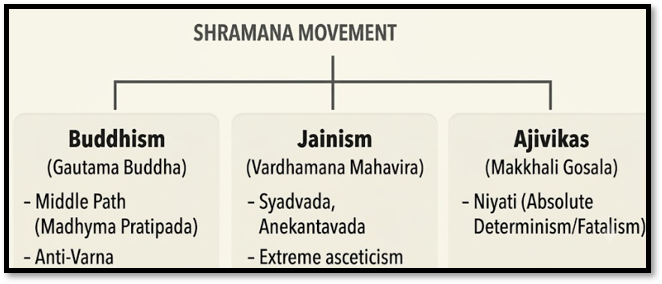
The Shramana movements shared a set of core principles that challenged orthodox Brahmanism:
- Rejection of Vedic Authority: They denied the divine origin and infallibility of the Vedas.
- Opposition to Animal Sacrifices: They spoke out against the expensive, bloody animal sacrifices (Yajnas) that drained the livestock needed for the new plow-based agricultural economy.
- Critique of the Hereditary Varna System: They opened their monastic orders (Sanghas) to individuals regardless of social background, offering a path to spiritual liberation based on conduct rather than birth.
Key Contemporary Heterodox Sects
- Buddhism (Gautama Buddha): Advocated the Middle Path (Madhyama Pratipada), avoiding both luxury and extreme self-mortification. It gained widespread support among the urban mercantile classes (Setthis) and rulers like Bimbisara and Prasenajit, who valued its focus on social stability and pacifism.
- Jainism (Vardhamana Mahavira): Emphasized extreme asceticism and strict non-violence (Ahimsa). Its absolute ban on harming any living being led its followers away from farming (which could harm soil organisms) and toward professions like trade and banking, making Jainism a major influence in urban commercial centers.
- Ajivikas (Makkhali Gosala): Maintained a philosophy of absolute determinism (Niyati-vada). They argued that human effort was powerless to change one’s destiny, as all events were completely predetermined by cosmic fate. The sect retained a strong following for centuries, even receiving patronage from early Mauryan emperors.
- Lokayata / Charvaka (Ajita Kesakambalin): An early school of radical materialism. It rejected ideas of karma, an afterlife, and the soul, instead asserting that the physical world was the only reality and encouraging people to live fully in the present
8. FOREIGN INVASIONS AND THEIR GEOPOLITICAL IMPACT
While the Middle Ganga Valley was consolidating into an empire, the northwestern frontier of the Indian subcontinent remained fragmented, leaving it open to foreign invasions.
A. The Persian Achaemenid Invasion (c. 516 BCE)
- The Campaigns: Cyrus the Great crossed the Hindu Kush and extracted tribute from regions west of the Indus. Later, around 516 BCE, Darius I (Darius the Great) launched an expedition that annexed the fertile Indus Valley, Gandhara, and Sindh, organizing them into the 20th Satrapy (Province) of the Persian Empire.
- Long-Term Impacts on India:
- Introduction of Kharosthi Script: The Persian administration brought the Aramaic script into the northwest frontier, which evolved into the local Kharosthi script. This script, written from right to left, was later utilized by Ashoka for his major rock edicts across the region.
- Monolithic Artistic Styles: Achaemenid architectural designs heavily influenced later Indian stonecraft, particularly the polished finish, floral motifs, and bell-shaped capitals characteristic of Mauryan pillars.
B. The Macedonian Invasion of Alexander the Great (c. 326 BCE)
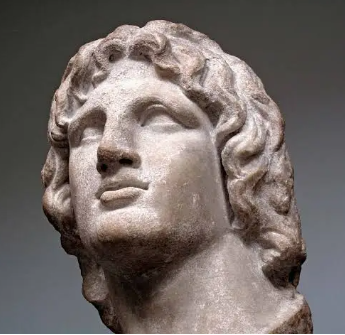
- The Historical Context: Following his total destruction of the Persian Empire, Alexander the Great marched toward India’s northwestern frontier to secure the eastern edge of his known world.
- Major Military Encounters:
- Surrender of Ambhi: The ruler of Taxila chose to submit without a fight, offering Alexander a strategic base and supplies in exchange for protection against regional rivals.
- The Battle of the Hydaspes (326 BCE): Fought on the banks of the Jhelum River against King Porus (Puru), the ruler of the territory between the Jhelum and Chenab. Despite Porus deploying a formidable war elephant corps, Alexander’s tactical positioning and swift cavalry maneuvers secured a hard-fought victory. Impressed by Porus’s bravery and defiance, Alexander restored him to his throne and expanded his territorial authority.
- The Mutiny at the Hyphasis (Beas River): Alexander’s troops, exhausted by years of continuous campaigning and terrified by reports of the massive infantry, cavalry, and elephant forces commanded by the Nanda Empire further east, staged a mutiny. They refused to cross the Beas River, forcing Alexander to turn back down the Indus and bring his eastern campaign to an end.
- Key Long-Term Impacts:
- Creation of Interconnected Trade Routes: Alexander’s campaign opened up four distinct land and sea routes between India and the Greek world, paving the way for increased commercial exchange.
- Establishment of Hellenistic Settlements: The founding of Greek cities along the frontier, such as Alexandria on the Indus and Boukephala, laid the cultural foundation for the later Indo-Greek Kingdoms and the development of the Gandhara School of Art.
- Paving the Way for Maurya Consolidation: By crushing the small, independent tribal principalities and oligarchies across the northwest, the Greek invasion cleared away regional political fragmentation. This vacuum allowed Chandrupugta Maurya to sweep through the region, annex the frontier, and integrate it into the newly forming Mauryan Empire.
9. CIVIL SERVICES PRELIMS: REVISION SHEET (FAST FACTS)
High-Yield Terms and Concepts
- Bhagadugha / Balisadhaka: Royal fiscal officers responsible for assessing and collecting taxes from rural districts.
- Shaulkika / Shulkadhyaksha: Toll collectors stationed at city gates and river crossings to tax incoming merchandise.
- Rajabhatas: Security personnel or military police tasked with maintaining order in urban centers and protecting trade caravans.
- Vassakara: Ajatashatru’s chief minister, famous for his successful covert mission to undermine the internal unity of the Vajji confederacy.
- Jivaka: The legendary royal physician of Magadha who treated both King Bimbisara and Gautama Buddha; his medical travels point to advanced knowledge of surgery and herbal medicine during this era.
- Asanapannapaka: The official responsible for arranging seating, ensuring protocol, and verifying the attendance quorum in republican assembly halls.
Mahanagaras: The canonical list of six preeminent cities during the Buddha’s lifetime: Champa, Rajagriha, Shravasti, Saketa, Kausambi, and Varanasi.