
UPSC & GPSC · Editorial Analysis
Unwelcome Surge: The Buoyancy in GST Collections
Source: The Hindu Editorial
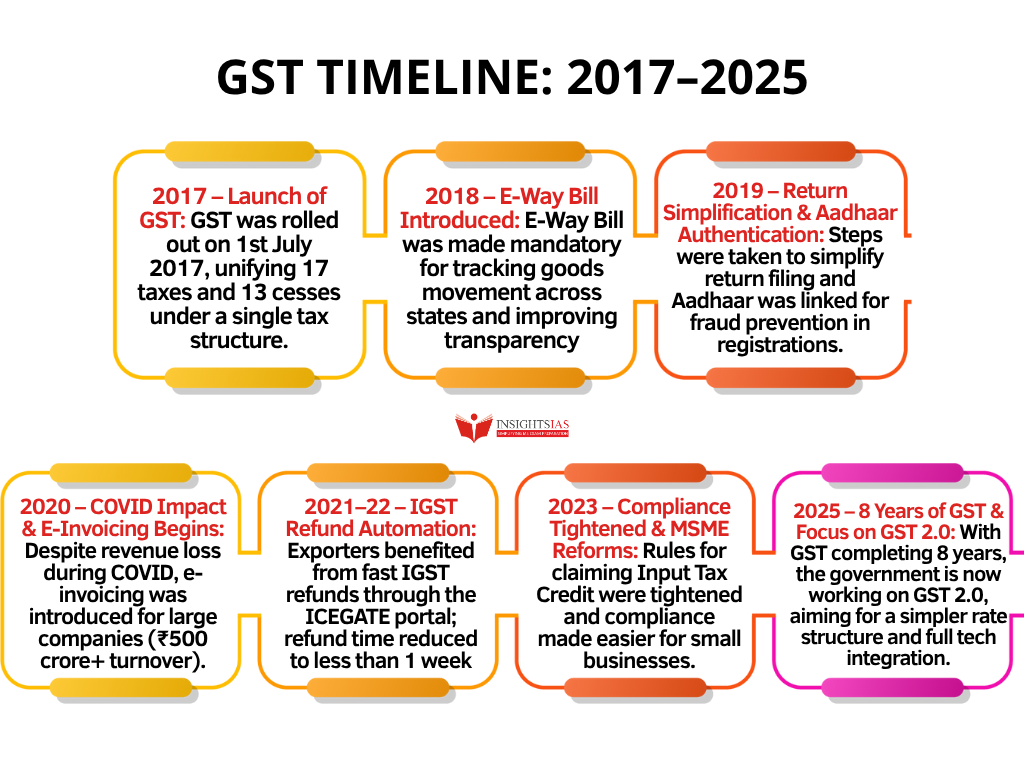
Strong tax collections are often viewed as indicators of robust economic activity and rising formalisation. However, an increase in indirect tax collections driven primarily by inflation rather than higher production or consumption can paint a misleading picture of economic health.
Recent trends in GST revenues suggest that imported inflation, rising commodity prices and higher input costs may be contributing significantly to revenue growth, warranting a closer examination of the underlying economic fundamentals.
Key Issues
1. Inflation-Driven Increase in GST Collections
- Higher prices automatically generate higher GST collections even if the volume of goods and services sold remains unchanged.
- Rising crude-oil prices can increase transportation and logistics costs, thereby raising final prices and associated tax collections.
2. Imported Inflation
- India remains dependent on imports for several critical commodities, making domestic prices vulnerable to external shocks.
- Examples: crude oil, fertiliser, edible oil, and industrial raw material imports.
3. Divergence Between Revenue and Economic Activity
- Tax collections may grow faster than actual production and consumption levels.
- The value of goods imports may rise because of higher prices even when import volumes remain stagnant or decline.
4. Pressure on Consumers and Industry
- Inflation can increase household expenditure burdens, input costs for manufacturers, and working-capital requirements for businesses.
5. Risks to Consumption-Led Growth
- Persistent inflation reduces purchasing power and can weaken discretionary consumption demand.
- Over time, this may affect investment and employment generation.
Global Practices
United States: The Federal Reserve closely monitors the distinction between nominal growth and real growth, with policy decisions relying on inflation-adjusted indicators.
European Union: The European Central Bank relies heavily on inflation indicators to assess underlying economic trends.
Japan: Japan’s experience highlights the importance of balancing inflation management with growth stimulation.
OECD Economies: Advanced economies evaluate real wage growth, real consumption growth and volume-based trade indicators rather than relying solely on nominal tax collections.
Indian Policies & Recommendations
Kelkar Task Force on Fiscal Responsibility
- Recommended broadening the tax base, improving tax efficiency, and enhancing fiscal transparency.
Fifteenth Finance Commission
- Emphasised revenue stability, fiscal sustainability, and strengthening the GST architecture.
GST Council
- Responsible for GST rate rationalisation, improving compliance mechanisms, and strengthening cooperative fiscal federalism.
RBI Monetary Policy Committee
- Continuously monitors inflation trends and their implications for economic growth and monetary stability.
UPSC Prelims Pointers
GST – Basic Concepts
- GST: Goods and Services Tax, a destination-based indirect tax collected on the supply of goods and services.
- GST replaced multiple indirect taxes through a unified framework.
- Tax collections can rise because of higher prices even when the physical volume of goods and services does not increase.
GST Council
- The GST Council is a constitutional body established under Article 279A of the Constitution.
- It plays a major role in GST-related recommendations, including taxation rates, and is an important example of cooperative fiscal federalism.
Inflation, GST, and Growth
- Higher prices lead to higher taxable value, which can lead to higher GST collection – but higher GST collection does not automatically mean higher real economic growth.
- Nominal growth is growth measured at prevailing prices; real growth is growth after adjusting for price changes.
- Imported inflation arises when external factors increase the domestic prices of imported goods or inputs, such as crude oil, fertilisers, edible oils, and industrial raw materials.
Way Forward
1. Focus on Real Economic Indicators
- Policymakers should complement tax data with industrial production, employment trends, consumption indicators, and investment data.
2. Reduce Import Dependence
- Promote domestic manufacturing, energy security, and supply-chain diversification through initiatives such as Make in India and Atmanirbhar Bharat.
3. Strengthen Inflation Management
- Maintain coordination between fiscal policy, monetary policy, and supply-side interventions to moderate price pressures.
4. Continue GST Rationalisation
- Simplify GST rates and improve compliance so that revenue growth increasingly reflects economic expansion rather than merely higher prices.
5. Encourage Productivity Growth
- Invest in infrastructure, technology adoption, logistics efficiency, and manufacturing competitiveness.
6. Improve Data-Based Policymaking
- Use inflation-adjusted and volume-based indicators for a more accurate assessment of economic performance.
Conclusion
Rising GST collections are an important sign of fiscal strength, but their interpretation requires careful analysis of the underlying drivers. Revenue growth rooted in inflationary pressures differs fundamentally from growth generated through higher productivity, investment and consumption.
For India’s long-term economic stability, the objective should be to ensure that tax buoyancy reflects genuine economic expansion rather than merely higher prices.
Practice Questions
Consider the following statements regarding Goods and Services Tax (GST):
1. GST is a destination-based indirect tax.
2. The GST Council is established under Article 279A of the Constitution.
3. Higher inflation can increase GST collections even without an increase in the volume of goods sold.
Which of the statements given above are correct?
All three statements are correct.
“Rising GST collections do not necessarily indicate stronger economic fundamentals.” Examine the relationship between inflation, tax buoyancy and economic growth in India.