
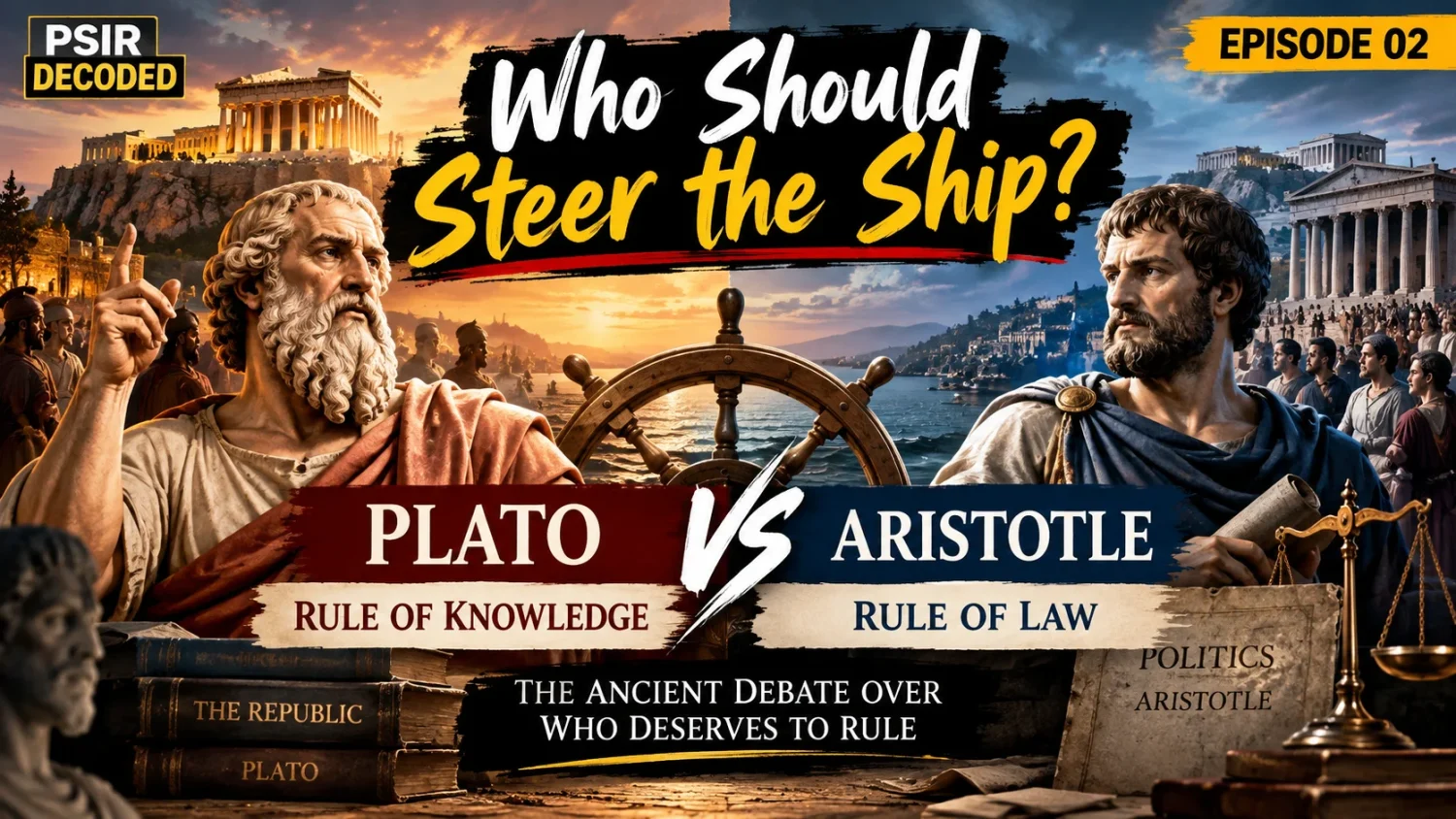
PSIR Decoded: Philosophy to Policy
EPISODE 02
Who Should Steer the Ship?
Plato, Aristotle, and the Ancient Debate Over Who Deserves to Rule
Thematic Conflict: Rule of Knowledge vs. Rule of Law
By: Apurva Jani | PSIR Decoded: Philosophy to Policy Series | Reading Time: 12 mins
|
Dimension |
Syllabus Mapping & High-Yield Indicators |
|---|---|
|
PSIR Paper 1A |
Plato: Theory of Forms, Form of the Good, Ideal State, Philosopher King, Communism of Property & Families, Ship of State, Doxa vs. Episteme Aristotle Political Animal, Rule of Law vs. Rule of Men, Theory of Justice, Theory of Citizenship, Polity, Critique of Platonic Idealism |
|
GS Paper 2 |
Article 14 (Rule of Law vs. Arbitrary Discretion); Lateral Entry into Civil Services; Collegium System vs. NJAC; Basic Structure Doctrine (Kesavananda Bharati); Constitutional Morality |
|
GS Paper 4 |
Meritocracy vs. Democratic Inclusivity; Aristotelian Virtue Ethics (Arete & Phronesis); Technocratic Disconnection vs. Administrative Humility; Constitutional Morality in Public Service |
|
Essay Paper |
“The wisdom of the many vs. the expertise of the few.” | “Knowledge without character is an administrative hazard.” | “Knowledge is power but is power ever knowledge?” |
|
High-Yield Terms |
Epistocracy · Ship of State · Philosopher King · Theory of Forms · Form of the Good · Doxa vs. Episteme · Functional Specialization · Golden Mean (Mesotes) · Polity · Constitutionalism · Phronesis · Epieikeia · Political Animal · Common Good |
BLOCK 1 | THE EVERYDAY DILEMMA
Imagine you are scheduled for complex open-heart surgery tomorrow morning.
How would you choose your surgical team? Would you gather twenty neighbours, conduct a secret ballot, and let the majority vote decide who makes the incision? Or would you entrust the scalpel strictly to an experienced, certified cardiac surgeon regardless of whether they are charismatic, popular, or well-liked?
The answer is obvious. When lives are at stake, you demand specialized knowledge. You reject democracy and embrace expertise.
Now consider governance. A government manages public health emergencies, sets monetary policy, navigates geopolitical crises, and balances multi-trillion-rupee budgets. The consequences of administrative incompetence affect hundreds of millions of lives. Yet in modern representative democracies, the primary qualification to steer a ministry is not deep domain expertise, it is the ability to win the most votes on election day.
If the experts genuinely know what is best why should constitutional procedure, parliamentary debate, and judicial scrutiny stop them?
Over 2,300 years ago in classical Athens, two foundational thinkers clashed over this exact dilemma.
One argued that governance is a science to be entrusted exclusively to an educated intellectual elite Plato’s Rule of Knowledge (Epistocracy). The other warned that even the wisest ruler is corrupted by unchecked power Aristotle’s Rule of Law (Constitutionalism).
|
PLATO (427–347 BCE) Rule of Knowledge |
ARISTOTLE (384–322 BCE) Rule of Law |
|
Doxa vs. Episteme |
Phronesis (Practical Wisdom) |
|
The Ship of State |
The Feast Metaphor |
|
Philosopher King |
Polity + Constitutional Order |
|
Theory of Forms |
Political Animal + Common Good |
BLOCK 2 | THE CORE THEORY IN PLAIN ENGLISH
Part A
PLATO: The Case for Epistocracy (Rule of Knowledge)
Background
Plato (427-347 BCE) grew up during the catastrophic Peloponnesian War, watching Athenian democracy collapse into factionalism, corruption, and demagoguery. The defining trauma of his life occurred in 399 BCE, when an Athenian democratic jury voted to execute his teacher, Socrates the wisest man in Athens on fabricated charges. Plato concluded that direct democracy was not liberty; it was mob rule (ochlocracy), where smooth-talking rhetoricians manipulate uneducated public passions.
Knowledge vs. Opinion: The Foundation (Doxa vs. Episteme)
|
Term |
Meaning |
|
Doxa |
Ordinary opinion — what people believe |
|
Episteme |
Genuine knowledge — rational understanding of what is actually true |
Politics becomes dangerous when opinion masquerades as knowledge. Therefore:
- Rhetorical skill ≠ Political wisdom
- Popularity ≠ Knowledge
- Majority opinion ≠ Truth
The Theory of Forms and the Form of the Good
Before we can understand Plato’s politics, we need to understand one big idea he had about reality itself.
Plato believed that the world we see around us governments, people, opinions is always changing and therefore unreliable as a guide to truth. Behind this changing world, he argued, exist permanent, perfect blueprints of things he called these the Forms. The Form of a chair is the perfect idea of ‘chair’ that every real chair imperfectly copies. Similarly, there is a perfect Form of Justice, and a perfect Form of Goodness.
The highest of all Forms is the Form of the Good the ultimate source of all truth and knowledge.
Think of it this way: just as the sun lights up the physical world so your eyes can see, the Form of the Good ‘lights up’ the world of ideas so your mind can understand what is truly just and truly right. The philosopher is someone whose long, rigorous education has trained them to see by this light to understand justice not as popular opinion defines it, but as it actually is.
The Ship of State: Why Democracy Fails (Republic, Book VI)
Picture a ship whose owner is taller and stronger than anyone else on board, but short-sighted, hard of hearing, and inexperienced in navigation. The crew members squabble over the helm, each claiming the right to steer, though none has studied seamanship. They drug or overpower the master, feast on the stores, and treat whoever flatters them best as the true pilot. Meanwhile, they dismiss the genuine navigator the one who studies the seasons, winds, and stars as a useless, stargazing philosopher.
For Plato: The ship = the state. The squabbling crew = populist politicians. The true navigator = the Philosopher equipped with genuine knowledge (episteme) rather than shifting public opinion (doxa).
The Philosopher King and Functional Specialization
|
Soul Element |
Class |
Function |
|
Reason |
Ruling Class (Philosopher Kings) |
Governance |
|
Spirit / Courage |
Auxiliary Class (Soldiers, Guardians) |
Defence |
|
Appetite |
Producing Class (Farmers, Artisans, Traders) |
Economic Production |
Chain of Authority: Education → Knowledge → Virtue → Political Authority
The Philosopher does not rule simply because he is intelligent. He rules because he has undergone a fifty-year moral and intellectual formation directed towards knowledge of the Good and crucially, he possesses zero personal wealth or private family, eliminating every incentive for self-serving rule.
Plato on Law
Law, for Plato, is a blunt, second-best instrument. A written code is rigid incapable of accommodating the full nuance of every human dilemma. True justice requires the living discretion of the wise ruler. However, in the later Laws, written law becomes substantially more important as a practical mechanism of political order for communities that cannot produce philosopher-rulers.
Myth-Buster: “Plato Simply Advocated Elite Dictatorship”
Too simplistic. Plato’s Philosopher Kings do not lust for power they are reluctantly compelled to govern as a moral duty. They hold zero personal wealth and are bound by fifty years of rigorous intellectual and ethical conditioning. The real modern critique is: Who verifies that the ruler actually possesses knowledge of the Good? This is where Plato becomes vulnerable to the critique of epistocracy; governance by those who merely presume to possess superior knowledge.
PART B
ARISTOTLE: The Case for Constitutionalism (Rule of Law)
Background
Aristotle (384-322 BCE) spent twenty years as Plato’s student at the Academy but the two men thought very differently. Plato sat in his study and designed the perfect city from scratch, reasoning purely from ideas. Aristotle went in the opposite direction: he collected and compared 158 real Greek constitutions before writing The Politics. Where Plato asked ‘what should the ideal state look like?’, Aristotle asked ‘what actually works for real, flawed human beings?’
Human Beings Are Political Animals (Zoon Politikon)
Human beings are by nature political animals (zoon politikon).
Why? Because human beings possess logos the ability to use reasoned speech. Unlike animals that can only signal pleasure or pain, humans can talk about what is just, what is unjust, what is good, what is harmful. We are built for moral conversation. That is why living together in a political community is not just a practical arrangement for safety it is how human beings naturally fulfil their potential as thinking, reasoning, social creatures.
Family → Village → Polis — each stage is not merely larger but more complete.
Politics Is About the Common Good
For Aristotle, the fundamental question is not ‘Who has power?’ but: ‘For whose benefit is power exercised?’
|
Number of Rulers |
Correct Form (serves common good) |
Deviant Form (serves rulers only) |
|
One |
Monarchy |
Tyranny |
|
Few |
Aristocracy |
Oligarchy |
|
Many |
Polity |
Democracy* |
*Aristotle uses ‘democracy’ as the deviant form when rule serves only the sectional interest of the majority. Do NOT write ‘Aristotle was a democrat in the modern sense.’
Critique of Plato: Excessive Unity
- A state is not a monolith: it is an aggregate of diverse individuals. Plato sought excessive unity, reducing a complex symphony to a single monotone note.
“That which is common to the greatest number has the least care bestowed upon it. Everyone thinks chiefly of his own, hardly at all of the common interest.”
- Private property and family are not vices: they are vital psychological anchors for personal responsibility and civic virtue.
The Doctrine of Collective Wisdom: The Feast Metaphor
A potluck feast where each guest brings a dish is richer and more varied than a banquet catered by a single cook. Similarly, ordinary citizens may not match an expert individually but when they deliberate collectively under constitutional procedures, their accumulated judgments compensate for individual blind spots.
The wearer of the shoe knows best where it pinches not the shoemaker who built it.
The Supremacy of the Rule of Law
- Even the most virtuous ruler possesses emotions, interests, personal loyalties, and passions.
- Law is formulated in general terms, after deliberation, representing generations of collective distilled experience.
“Reason unaffected by desire” (lex est mens sine affectu).
Epieikeia Equity: The Critical Nuance
Aristotle is NOT ‘law = rigid rules.’ He recognises that general laws cannot perfectly anticipate every circumstance. Equity (epieikeia) steps in when mechanical application of law produces unjust outcomes in exceptional cases.
Good governance = Law + Judgment + Equity NOT: Law = mechanical application
The Polity: The Rule of the Middle Class
Applying his Doctrine of the Golden Mean (Mesotes) to statecraft:
- Extreme wealth breeds arrogance, the rich begin to treat the state as their private property.
- Extreme poverty breeds resentment and desperation.
- Solution: Polity governed by a robust middle class that neither covets others’ property nor excites envy, providing the socio-economic anchor for constitutional stability.
Myth-Buster: “Aristotle Created Modern Constitutional Democracy”
No. Aristotle contributed foundational concepts rule of law, regime classification, civic participation, mixed government that later became influential in constitutional thought. But his own political community was exclusionary: women, slaves, and many resident populations were entirely excluded from citizenship. Use: ‘Aristotle contributed important conceptual resources to later constitutional thought’ not ‘Aristotle invented modern democracy.’
BLOCK 3 | COMPARISON MATRIX
|
Dimension |
Plato (The Republic / Laws) |
Aristotle (The Politics) |
|
Central Problem |
Ignorance in political rule |
Arbitrary and unstable personal rule |
|
Philosophical Method |
Deductive, normative, idealist : World of Forms |
Inductive, empirical, comparative : World of Facts |
|
Human Nature |
Soul divided: Reason, Spirit, Appetite |
Humans naturally political (zoon politikon) |
|
View of the Masses |
Driven by appetites (doxa); swayed by rhetoric |
Capable of collective practical judgment (phronesis) |
|
Political Goal |
Justice as functional harmony |
Common advantage / the good life |
|
Source of Authority |
Knowledge of the Good (episteme) |
Constitution, law, civic order, and practical wisdom |
|
Role of Law |
Second-best in Republic; grows in importance in Laws |
‘Reason unaffected by desire’ : central safeguard |
|
Ideal Regime |
Monarchy / Aristocracy of Intellect |
Polity: middle class, constitutional order |
|
Property & Family |
Communism for the ruling class |
Private property and family = moral anchors |
|
Equity / Flexibility |
Living discretion of philosopher-ruler |
Epieikeia: equity within law |
|
Core Vulnerability |
Who verifies the ruler has knowledge of the Good? |
Who defines ‘common good’? Exclusionary citizenship. |
|
Core Keyword |
EPISTOCRACY |
CONSTITUTIONALISM |
Mental Map for UPSC
PLATO: Socrates Executed → Distrust of Masses → Doxa vs. Episteme → Theory of Forms → Philosopher King → Just State
ARISTOTLE: 158 Constitutions → Empirical Method → Political Animal → Common Good → Rule of Law → Polity → Stable State
MODERN INDIA: Power → Constitution → Institutions → Rights → Judicial Review → Rule of Law → Accountability
BLOCK 4 | THE CONTEMPORARY MIRROR
Case 1 : Lateral Entry into Senior Civil Services
Policy Conflict: The Government of India introduced Lateral Entry to appoint private-sector domain specialists directly at Joint Secretary and Director level, bypassing the traditional UPSC civil services pipeline.
PLATONIC LOGIC
21st-century governance quantum computing policy, green hydrogen regulation, macro-prudential financial oversight demands deep domain expertise (techne). The generalist IAS officer, rotated across unrelated departments every two or three years, resembles Plato’s untrained sailor attempting to navigate complex oceanic currents without studying the stars.
ARISTOTELIAN COUNTERCHECK
Technocrats selected without transparent constitutional testing often lack grounding in administrative law, constitutional morality, and grassroots realities of implementation. More critically, bypassing the UPSC pipeline sidesteps constitutional reservation mandates (SC/ST/OBC representation), undermining the pluralistic, representative character of the Indian State. Expertise does not confer constitutional legitimacy.
UPSC Bridge: The lateral entry debate is a live institutional re-enactment of the Platonic case for technocracy versus the Aristotelian insistence that expertise must be embedded within constitutional accountability frameworks.
Case 2 Judicial Collegium System vs. NJAC
Policy Conflict: The Supreme Court in the NJAC Case (2015) struck down the 99th Constitutional Amendment, preserving the Collegium System under which senior sitting judges appoint future judges with minimal executive involvement.
PLATONIC LOGIC
The majority effectively argued for judicial epistocracy: only judges possess the specialized, non-partisan competence to evaluate judicial temperament and legal excellence. To allow the political executive into this process would be to let Plato’s untrained sailors grab the helm of the ship of justice.
ARISTOTELIAN COUNTERCHECK
In his lone dissent, Justice J. Chelameswar invoked precisely the Aristotelian warning unchecked self-selection breeds institutional opacity. A system entirely devoid of legislative check transforms the judiciary into an unaccountable epistocracy. Judicial independence must operate within constitutional checks and balances, not above them.
UPSC Bridge: The NJAC judgment illustrates how Platonic epistocratic reasoning insulation of expert institutions from popular interference must always be weighed against Aristotle’s constitutional warning that no institution, however wise, should be self-appointing and self-accountable.
Case 3 RBI’s Monetary Policy Committee and Parliamentary Oversight
Policy Conflict: The ongoing tension between the autonomy of the RBI’s Monetary Policy Committee (MPC), composed of professional macroeconomists, and Parliament’s democratic oversight authority.
PLATONIC LOGIC
Monetary policy: interest rates, inflation targeting, liquidity management is highly technical. Subjecting it to direct parliamentary vote or electoral cycle pressures would, from a Platonic standpoint, be as catastrophic as letting the ship’s crew vote on the navigator’s course correction.
ARISTOTELIAN COUNTERCHECK
The RBI Act requires the MPC to submit a public report to the government whenever it fails to meet its inflation target and Parliament retains the power to amend the framework through legislation. Domain expertise informs the decision, but statutory mandate and parliamentary oversight preserve the supremacy of constitutional law over technical discretion.
UPSC Bridge: Independent regulators like the MPC represent Plato’s epistocratic logic in institutional form but their statutory accountability to Parliament preserves Aristotle’s foundational principle that expert authority must remain anchored within the constitutional order.
Case 4 The Basic Structure Doctrine: Constitutional Supremacy Over Political Will
Policy Conflict: Kesavananda Bharati v. State of Kerala (1973): Parliament can amend the Constitution, but cannot destroy its essential or basic structure even through a supermajority.
PLATONIC QUESTION
If elected political representatives possess superior political knowledge and a democratic mandate, why should constitutional limitations prevent them from restructuring the system entirely?
ARISTOTELIAN ANSWER
Because constitutional democracy is not simply ‘rule by those who temporarily possess political power.’ It is ‘rule under a higher constitutional framework.’ Even the most popular, technically competent majority government does not transcend the Constitution it operates within it. Law must represent ‘Reason unaffected by desire’ even when that desire is expressed through democratic mandate.
UPSC Bridge: The Basic Structure doctrine is the Indian Constitution’s most profound Aristotelian moment, it enshrines the principle that even sovereign political power, however expertly exercised, must remain subject to a higher constitutional order that no temporary majority can dissolve.
EXAM CAUTION
- DO NOT write: ‘Plato invented technocracy and Aristotle wrote the Indian Constitution.’
- DO write: ‘The friction between Lateral Entry and cadre-based civil services reflects the foundational tension between Platonic epistocracy (rule by specialized competence) and Aristotelian constitutionalism (governance through procedural, representative accountability under the constitutional order).’
BLOCK 5 | THE MAINS ANSWER SHEET
Trigger Keywords: When to Deploy Plato and Aristotle
|
Question Trigger Keyword |
Primary Conceptual Deployment |
|
Technocracy vs. Democracy |
Contrast Plato’s Ship of State + Doxa/Episteme with Aristotle’s Feast Metaphor + Polity |
|
Rule of Law vs. Arbitrary Discretion |
Deploy Aristotle (‘Reason unaffected by desire’) + Article 14 |
|
Lateral Entry / Civil Services Reforms |
Plato for domain competence; Aristotle for constitutional representation and reservation |
|
Judicial Independence / Collegium System |
Plato (judicial epistocracy) vs. Aristotle (checks and balances / NJAC dissent) |
|
Basic Structure / Constitutionalism |
Aristotle’s Rule of Law: power must operate under a higher constitutional framework |
|
Independent Regulators (RBI, SEBI, ECI) |
Platonic expertise in design; Aristotelian accountability through statutory law and Parliament |
|
Democratic Decentralization / Panchayats |
Aristotle’s theory of collective civic participation (73rd & 74th Amendments) |
|
Ideal State / Philosopher King |
Deploy Plato’s epistocracy and then counter with Aristotle and Popper |
|
Knowledge and Power |
Plato: knowledge should guide power. Aristotle: knowledge ≠ legitimacy. |
Counter-Thinkers for High-Scoring Balance
To Critique Plato
Accuses Plato of laying the ideological foundations for totalitarian engineering. Challenges the claim that any political class possesses privileged access to political truth.
Individual liberty, diversity of opinion, and democratic participation strengthen governance. No single group holds a monopoly on wisdom.
Justice is realized through public discussion and real-world outcomes (Nyaya), not through rigid institutional perfection (Niti).
To Critique Aristotle
Proceduralism and popular deliberation can paralyze governance during existential crises demanding decisive, specialized intervention.
Aristotle’s conception of citizenship systematically excluded women, slaves, and manual labourers, a fundamental limitation any contemporary answer must acknowledge.
Connects institutional rationality and bureaucratic expertise to legitimate authority, bridges Plato’s knowledge concern with Aristotle’s institutional framework.
Master UPSC Mains PYQ Archive
1.PSIR Optional Paper 1A
|
Year |
Question |
Deployment Strategy |
|
2025 |
“Karl Popper presents a defence of the open society against its enemies.” Elaborate. |
Counter-perspective on Platonic political philosophy |
|
2024 |
“Critically examine Plato’s theory of Forms.” |
Forms → Knowledge → Good → Philosopher-Ruler → Political Authority |
|
2021 |
“Explain the Aristotelian view of politics. To what extent has it contributed to modern constitutional democracies?” |
Political animal → common good → constitution → rule of law → modern India |
|
2019 |
“Explain Aristotle’s critique of Plato’s Idealism.” |
Metaphysics → method → politics → ideal state → practical constitutionalism → law |
|
2018 |
“Plato was an enemy of the open society.” (Popper). Critically evaluate. |
Philosopher King → hierarchy → epistocracy → Popper → open society |
|
2017 |
“Everywhere, inequality is a cause of revolution.” (Aristotle). Comment. |
Inequality → faction → instability → revolution → Polity + middle class |
|
2016 |
Compare Plato and Aristotle on the nature and purpose of the State. |
Full Block 3 matrix |
|
2015 |
Explain Aristotle’s doctrine of the Golden Mean and its application to classification of constitutions. |
Mesotes → Polity → middle class → constitutional balance |
|
2014 |
“Central to Aristotle’s political thought is his classification of constitutions.” Evaluate. |
Constitution → regime classification → common good → polity |
|
2013 |
“Aristotle is the father of political science, while Plato is the father of political philosophy.” Comment. |
Plato: normative idealism; Aristotle: empirical political science |
2.General Studies Paper 2
|
Year |
Question |
Connection |
|
2023 |
“Constitutionally guaranteed judicial independence is a prerequisite of democracy.” Comment. |
Rule of law → institutional independence → Collegium/NJAC |
|
2021 |
“Lateral Entry into higher civil services is a double-edged sword.” Analyze. |
Platonic technocracy vs. Aristotelian constitutional accountability |
|
2021 |
“Constitutional Morality is rooted in the Constitution itself.” Explain with judicial decisions. |
Constitutional values → institutional restraint → Aristotelian rule of law |
|
2019 |
“Parliament’s power to amend the Constitution is a limited power.” |
Basic Structure → constitutionalism → power under a higher framework |
|
2016 |
“Executive discretion without procedural guidelines violates the Rule of Law.” Examine with Article 14. |
Aristotle’s lex est mens sine affectu → Article 14 non-arbitrariness |
3.GS Paper 4 (Ethics) & Essay
|
Year |
Paper |
Question |
Connection |
|
2022 |
GS-4 |
“Technical competence without ethical commitment is dangerous.” Discuss. |
Plato: competence matters; Aristotle: competence does not eliminate institutional constraints |
|
2018 |
GS-4 |
Differentiate moral intellectualism and practical wisdom (phronesis). How does Aristotle’s virtue ethics guide civil servants? |
Phronesis → virtue ethics → constitutional morality in administration |
|
2020 |
Essay |
“Simplicity is the ultimate sophistication; wisdom is the ultimate law.” |
Aristotle’s rule of law → wisdom embedded in institutional order |
|
2017 |
Essay |
“Fulfillment of New India lies in balancing the wisdom of the masses with the vision of experts.” |
Full Plato-Aristotle synthesis |
|
2015 |
Essay |
“Can democracy deliver development, or do we need an enlightened despot?” |
Ship of State vs. Polity |
Plug-and-Play Evaluative Conclusions
Match the conclusion to your question’s marks. Do not mix them. Each is calibrated to fit as the closing paragraph of its specific answer type only.
|
Marks |
Word Limit |
Papers |
|
10 marks |
~150 words total → ~60 word conclusion |
GS-1, GS-2, GS-3, GS-4 Theory, PSIR Optional |
|
15 marks |
~250 words total → ~85 word conclusion |
GS-1, GS-2, GS-3, PSIR Optional |
|
20 marks |
~250–300 words total → ~110 word conclusion |
GS-4 Section B (case studies), PSIR Optional ONLY |
10-Marker — GS-1 / GS-2 / GS-3 / GS-4 Theory / PSIR Optional
10 marks · GS-1 / GS-2 / GS-3 / GS-4 Theory / PSIR Optional · ~~60 words
Plato’s epistocracy and Aristotle’s constitutionalism are not opposites but complements. Modern democratic governance demands both: domain expertise to navigate complex policy, and constitutional law to prevent that expertise from becoming arbitrary authority. The Indian Constitution embodies this balance, expert bodies inform decisions, but judicial review and parliamentary oversight ensure no institution stands above the law.
15-Marker — GS-1 / GS-2 / GS-3 / PSIR Optional
15 marks · GS-1 / GS-2 / GS-3 / PSIR Optional · ~~85 words
Plato and Aristotle identify two permanent anxieties of political governance; the danger of ignorant rule and the danger of unchecked personal power. Neither epistocracy nor populism alone produces just outcomes. Modern constitutional democracy resolves this by embedding expertise within institutional accountability: technocrats inform policy, but constitutional law, judicial review, and parliamentary oversight constrain their authority. As India’s Basic Structure doctrine confirms, even sovereign political power must operate within, never above the constitutional order. Knowledge needs institutions; institutions need wisdom.
20-Marker — GS-4 Section B / PSIR Optional ONLY
20 marks · GS-4 Section B (case studies) / PSIR Optional ONLY · ~~110 words
The Plato-Aristotle debate endures because modern states face both their anxieties simultaneously. Governments require Platonic expertise central banks, independent regulators, and specialised agencies exist because complex policy cannot be decided by uninformed popular vote alone. Yet the Aristotelian warning holds: expertise confers knowledge, not legitimacy. Power exercised outside constitutional constraint becomes arbitrary, however technically correct. India’s constitutional jurisprudence from Article 14’s anti-arbitrariness doctrine to the Basic Structure’s limits on amending power reflects this synthesis. The enduring formula of constitutional democracy is neither blind majoritarianism nor unaccountable technocracy. It is competent governance under the discipline of law: expertise without arbitrariness, authority without absolutism.
GS-4 Theory 10-Marker One-Liner
10 marks · GS-4 Theory only NOT Section B case studies · ~~40 words
The ethical public servant marries Platonic competence with Aristotelian practical wisdom (phronesis) exercising technical expertise within the discipline of constitutional morality, serving neither personal interest nor populist pressure, but the enduring common good.
One-Line Revision Sheet
|
Thinker |
Core Formula |
|
Plato |
“The right to rule follows from knowledge of the Good.” |
|
Aristotle |
“Political authority must be organised through constitutional institutions and directed towards the common good.” |
|
Modern Constitutionalism |
“Power may be exercised, but not arbitrarily.” |
|
Indian Constitution |
“Political authority is legitimate only within the constitutional framework.” |
30-Second Revision
|
|
PLATO |
ARISTOTLE |
MODERN INDIA |
|
Problem |
Ignorant rulers |
Arbitrary and unstable rule |
Concentrated / arbitrary power |
|
Solution |
Philosopher King |
Constitution + Law + Epieikeia |
Constitution + Rights + Institutions |
|
Basis |
Knowledge of the Good (episteme) |
Common good, political animal |
Constitutionalism |
|
Risk / Safeguard |
Who verifies the philosopher? |
Exclusionary citizenship |
Judiciary + Legislature + Basic Structure |
KNOWLEDGE → AUTHORITY → LAW → INSTITUTIONS → ACCOUNTABILITY
That is the journey from philosophy to policy.
← Previous: Episode 01: Why Do We Obey? Thomas Hobbes, John Locke, and the Social Contract That Rules Your Life
→ Next: Episode 03: Can a Good Leader Be a Good Person? Machiavelli, Kautilya, and the Brutal Logic of State Survival
PSIR Decoded
EPISODE 02
Who Should Steer the Ship?
Plato
Rule of Knowledge
Aristotle
Rule of Law
UPSC
PSIR Optional