Introduction
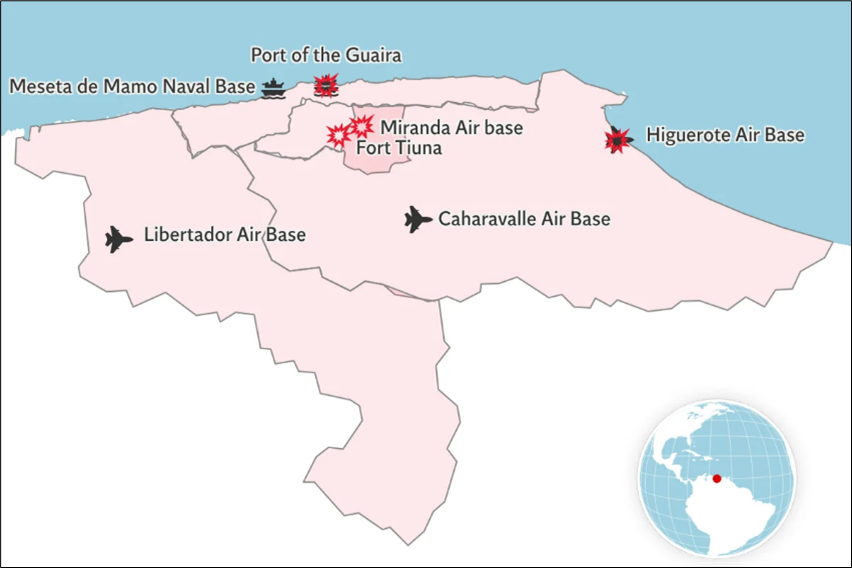
“Tragedy and farce” aptly captures the latest chapter in U.S. foreign policy as President Donald Trump’s coercive actions against Venezuela revive the language and methods of imperial intervention. Presented as a moral crusade against authoritarianism, the strikes instead expose the erosion of international law, the selective use of democratic values, and the persistence of power politics in a supposedly rule-based global order.
Key Facts From the Article
● U.S. actions involved coercive diplomacy, naval blockades and “interdictions” without UN Security Council approval.
● Actions justified under domestic executive authority, not international mandate.
● References to Article 2(4) of the UN Charter, which prohibits use of force against sovereign states.
● Venezuela targeted despite no imminent armed attack on the U.S.
● Strategic interest linked to oil reserves-Venezuela holds one of the world’s largest proven oil reserves.
Key Issues & Insights
- Erosion of International Law
- Use of force without UN authorisation undermines global norms.
- Example: Bypassing UNSC mirrors Iraq (2003) precedent.
- Revival of the Monroe Doctrine
- Latin America treated as U.S. sphere of influence.
- Example: Coercion against Venezuela, Cuba echoes Cold War logic.
- Selective Use of Democracy Narrative
- Authoritarianism invoked selectively to justify regime change.
- Example: Friendly autocracies remain untouched.
- Energy-Driven Interventionism
- Venezuela’s oil resources central to strategic calculus.
- Example: Sanctions and strikes weaken state control over energy.
- Silence of the International Community
- Weak global response reflects declining multilateral authority.
- Example: UN institutions sidelined, global norms diluted.
Global Practices / International Norms (5)
| UN Charter Framework | Use of force only in self-defence or UNSC approval. |
| Responsibility to Protect (R2P) | Requires multilateral consensus, not unilateral action. |
| International Court of Justice (ICJ) | Peaceful dispute resolution over force. |
| EU Model | Sanctions through collective mechanisms, not military coercion. |
| Non-Aligned Movement (NAM) | Respect for sovereignty and non-intervention. |
Indian Policy & Institutional Perspective
| Strategic Autonomy | India avoids bloc politics and unilateral interventions. |
| Support for UN Centrality | Emphasis on UNSC legitimacy. |
| Non-Intervention Principle | Rooted in Panchsheel. |
| Energy Diplomacy | Diversification, not coercion. |
| Multilateralism | Preference for dialogue and institutional solutions. |
Way Forward
1. Reassert UN authority over use of force and conflict resolution.
2. Strengthen multilateral checks on unilateral military actions.
3. Delink energy access from coercive geopolitics.
4. Promote regional dialogue mechanisms in Latin America.
5. Revive respect for sovereignty as a core global norm.
6. Encourage middle powers (India, EU) to act as stabilising voices.
Conclusion
The Venezuelan episode reveals not the strength but the fragility of U.S. power. When international law bends to executive convenience, tragedy follows and farce repeats. A stable global order demands restraint, legitimacy, and collective responsibility—without which sovereignty becomes conditional and peace precarious.
UPI Goes Live in Greece: India Expands Digital Payments Footprint in Europe
UPSC & GPSC · Current Affairs UPI Goes Live in Greece: India Expands Digital Payments Footprint in Europe Source: PIB [...]
Prime Minister Pays Tribute to Brave Warriors on Hul Divas
UPSC & GPSC · Current Affairs Prime Minister Pays Tribute to Brave Warriors on Hul Divas Source: PIB Delhi What's [...]
Medical Innovations Patent Mitra Platform
UPSC & GPSC · Current Affairs Medical Innovations Patent Mitra Platform Source: Indian Council of Medical Research (ICMR) What's in [...]
International Renewable Energy Agency (IRENA)
UPSC & GPSC · Current Affairs International Renewable Energy Agency (IRENA) Source: IRENA What's in News Recently, a report by [...]
International Maritime Organization (IMO)
UPSC & GPSC · Current Affairs International Maritime Organization (IMO) Source: United Nations What's in News Recently, the Secretary-General of [...]
India & Malaysia Review Bilateral Military Cooperation during 12th SCMC Meeting
UPSC & GPSC · Current Affairs India & Malaysia Review Bilateral Military Cooperation during 12th SCMC Meeting Source: PIB Delhi [...]