Introduction
“Tragedy and farce” aptly captures the latest chapter in U.S. foreign policy as President Donald Trump’s coercive actions against Venezuela revive the language and methods of imperial intervention. Presented as a moral crusade against authoritarianism, the strikes instead expose the erosion of international law, the selective use of democratic values, and the persistence of power politics in a supposedly rule-based global order.
Key Facts From the Article
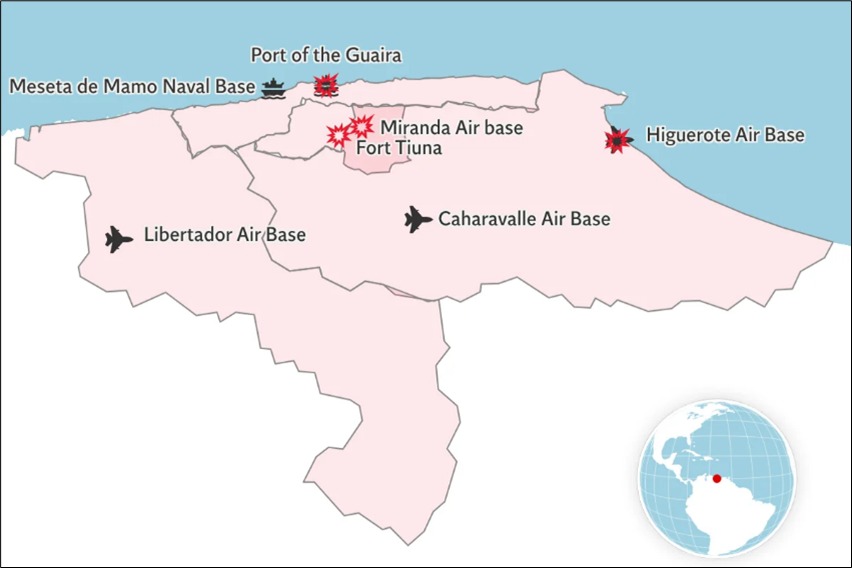
● U.S. actions involved coercive diplomacy, naval blockades and “interdictions” without UN Security Council approval.
● Actions justified under domestic executive authority, not international mandate.
● References to Article 2(4) of the UN Charter, which prohibits use of force against sovereign states.
● Venezuela targeted despite no imminent armed attack on the U.S.
● Strategic interest linked to oil reserves-Venezuela holds one of the world’s largest proven oil reserves.
Key Issues & Insights
- Erosion of International Law
- Use of force without UN authorisation undermines global norms.
- Example: Bypassing UNSC mirrors Iraq (2003) precedent.
- Revival of the Monroe Doctrine
- Latin America treated as U.S. sphere of influence.
- Example: Coercion against Venezuela, Cuba echoes Cold War logic.
- Selective Use of Democracy Narrative
- Authoritarianism invoked selectively to justify regime change.
- Example: Friendly autocracies remain untouched.
- Energy-Driven Interventionism
- Venezuela’s oil resources central to strategic calculus.
- Example: Sanctions and strikes weaken state control over energy.
- Silence of the International Community
- Weak global response reflects declining multilateral authority.
- Example: UN institutions sidelined, global norms diluted.
Global Practices / International Norms (5)
| UN Charter Framework | Use of force only in self-defence or UNSC approval. |
| Responsibility to Protect (R2P) | Requires multilateral consensus, not unilateral action. |
| International Court of Justice (ICJ) | Peaceful dispute resolution over force. |
| EU Model | Sanctions through collective mechanisms, not military coercion. |
| Non-Aligned Movement (NAM) | Respect for sovereignty and non-intervention. |
Indian Policy & Institutional Perspective
| Strategic Autonomy | India avoids bloc politics and unilateral interventions. |
| Support for UN Centrality | Emphasis on UNSC legitimacy. |
| Non-Intervention Principle | Rooted in Panchsheel. |
| Energy Diplomacy | Diversification, not coercion. |
| Multilateralism | Preference for dialogue and institutional solutions. |
Way Forward
1. Reassert UN authority over use of force and conflict resolution.
2. Strengthen multilateral checks on unilateral military actions.
3. Delink energy access from coercive geopolitics.
4. Promote regional dialogue mechanisms in Latin America.
5. Revive respect for sovereignty as a core global norm.
6. Encourage middle powers (India, EU) to act as stabilising voices.
Conclusion
The Venezuelan episode reveals not the strength but the fragility of U.S. power. When international law bends to executive convenience, tragedy follows and farce repeats. A stable global order demands restraint, legitimacy, and collective responsibility—without which sovereignty becomes conditional and peace precarious.
Pramukh Prelims Pointers (10-11 Sept 2026)
Current Affairs · UPSC Prelims & MainsPramukh Prelims Pointers10–11 September 2026PolityInternational RelationsEnvironmentScience & TechnologyDefenceSources: The Hindu, Indian Express, Mint and PIB08Topics [...]
Current Affairs MCQs by Divas Sir – 10 September 2026 | Hindi & English
Daily practice · Hindi + EnglishCurrent Affairs MCQsby Divas Sir10 September 2026 · Test your recall. Understand the why.UPSC CSEState PSCsSSC [...]
Parliament Monsoon Session 2026: Understanding Indian Polity Through Current Affairs
Parliament Monsoon Session 2026 explained for UPSC - parliamentary productivity, executive accountability, Question Hour, committees, a Prelims MCQ and a Mains answer approach.
Independence Day Celebration at Pramukh Academy
Pramukh Academy Vadodara celebrates Independence Day 2026 with Pujya Sadhujans and students - explore our UPSC and GPSC preparation ecosystem.
12 Schedules of the Indian Constitution: Complete UPSC & GPSC Notes
All 12 Schedules of the Indian Constitution explained for UPSC and GPSC Prelims & Mains — memory tricks, amendment years, and a quick revision table.
Shaheed Udham Singh: The Courageous Avenger of Jallianwala Bagh
India’s struggle for independence was shaped not only by political movements but also by the fearless acts of revolutionaries who [...]