Source: The hindu
India’s Fisheries and Aquaculture: A Promising Growth Story
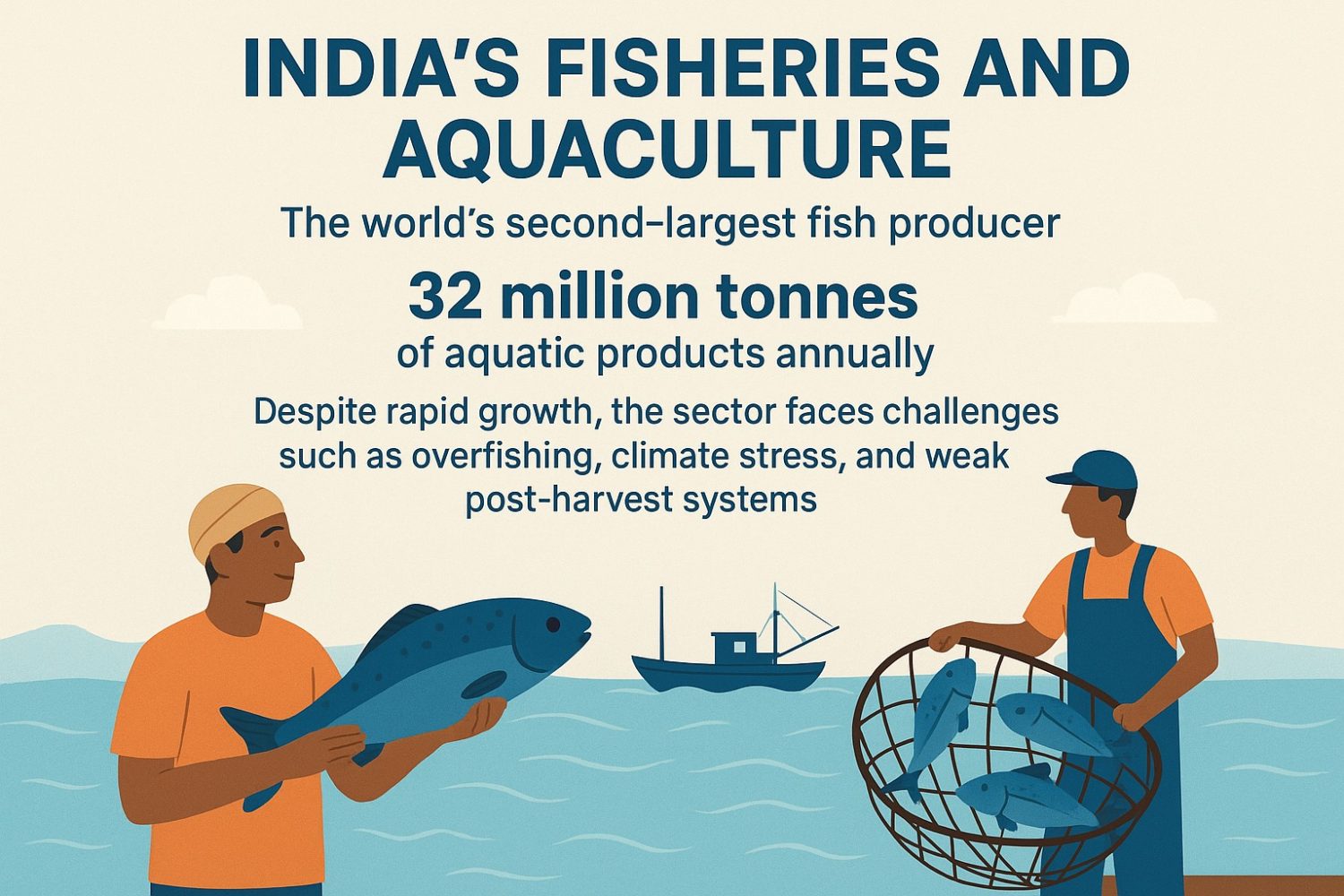
India is the world’s second-largest producer of fish, generating 32 million tonnes (2022) of aquatic products valued at ₹3.3 lakh crore, according to FAO-SOFIA 2024. Over the past decade, India’s fisheries and aquaculture sectors have expanded rapidly due to technological innovation, institutional support, coastal aquaculture reforms, and schemes like PMMSY. Yet, despite 90% of fishers being small-scale, the sector continues to face challenges such as overfishing, pollution, climate stress, lack of credit, weak traceability, and poor post-harvest infrastructure, limiting global competitiveness and domestic sustainability.
Key Issues
1. Overfishing and Environmental Stress
-
FAO notes depletion of several species in India due to
overextraction,
pollution, and habitat loss.
- Coastal aquaculture often strains ecosystems through nutrient loading, salinity changes, and land degradation.
2. Limited Access for Small-Scale Fishers
- >90% of fishers are small-scale, but they face constraints in:
- formal credit
- cold-chain logistics
- modern boats and gear
- quality seed and feed
- Result: Loss of income and poor integration into high-value export chains.
3. Weak Value-Chain Infrastructure
- India’s post-harvest losses exceed 20–25%, reducing export potential.
- Traceability and certification requirements for EU/US markets still lag behind global benchmarks.
4. Climate Change Vulnerability
- Increasing sea temperatures, acidity, cyclones and coastal erosion directly reduce fish stocks and fishing days.
- Inland aquaculture faces challenges related to water scarcity and extreme rainfall cycles.
5. Policy and Regulatory Gaps
- Fragmented institutional oversight between Centre, States, and coastal authorities slows approvals.
- Monoculture plantations (e.g., shrimp-only farms) reduce biodiversity and long-term sustainability.
Global Practices
1. Norway – Digital Traceability Leadership
- Uses blockchain-enabled systems for complete traceability “boat-to-plate”.
- India can adopt similar mechanisms for export competitiveness.
2. Vietnam – Farmer Clusters for Aquaculture
- Organises small farmers into cooperatives for quality control, feed purchases, and market access.
3. Chile – Climate-Resilient Aquaculture Zones
- Regulates aquaculture spatially to reduce disease risk and environmental strain.
4. Japan – Integrated Port Infrastructure
- Modern fishing harbours provide cold storage, processing, and logistics, boosting value addition.
Indian Committee Recommendations
1. FAO–BOBLME Small Fisheries Report
- Strengthen coastal ecosystem management, co-management, and post-harvest improvements.
2. Meenakshi Committee (Export Competitiveness)
- Calls for modernising fishing harbours, boosting food safety labs, and global traceability compliance.
3. National Fisheries Development Board (NFDB)
- Promote species diversification, RAS (Recirculatory Aquaculture Systems), and modern hatchery technology.
4. Blue Revolution & PMMSY Review Committees
- Strengthen digital fishery records, expand “Matsya Seva Kendras”, and ensure climate adaptation support.
Way Forward
1. Strengthen Small-Scale Fisheries
Expand formal credit through Kisan Credit Card—Fisheries Edition.- Organise fishers into FPOs/cooperatives to enhance bargaining power.
2. Climate-Resilient Aquaculture
- Promote IMTA (Integrated Multi-Trophic Aquaculture), low-carbon shrimp farming, and climate-resilient seed varieties.
3. Modernise Fishing Harbours
- Implement FAO Technical Cooperation Projects to upgrade processing, storage, and value addition facilities.
4. Ensure Traceability and Certification
- Create a national digital traceability platform, especially for shrimp and seabass exports.
5. Promote Sustainable Aquaculture Practices
- Reduce monoculture; increase native species production; adopt water-efficient, land-efficient farming systems.
6. Strengthen Research & Innovation
- Invest in genomics, disease-resistant broodstock, data-driven fishery forecast models.
Conclusion
India’s fisheries and aquaculture sectors are on a high-growth, high-potential trajectory, supported by reforms, technology, and global demand. However, future success requires shifting from volume-based expansion to sustainable, climate-resilient, community-centric growth. Strengthening small-scale fishers, adopting global best practices, and modernising value chains will define India’s leadership in the Blue Economy.
Pramukh Prelims Pointers (10-11 Sept 2026)
Current Affairs · UPSC Prelims & MainsPramukh Prelims Pointers10–11 September 2026PolityInternational RelationsEnvironmentScience & TechnologyDefenceSources: The Hindu, Indian Express, Mint and PIB08Topics [...]
Current Affairs MCQs by Divas Sir – 10 September 2026 | Hindi & English
Daily practice · Hindi + EnglishCurrent Affairs MCQsby Divas Sir10 September 2026 · Test your recall. Understand the why.UPSC CSEState PSCsSSC [...]
Parliament Monsoon Session 2026: Understanding Indian Polity Through Current Affairs
Parliament Monsoon Session 2026 explained for UPSC - parliamentary productivity, executive accountability, Question Hour, committees, a Prelims MCQ and a Mains answer approach.
Independence Day Celebration at Pramukh Academy
Pramukh Academy Vadodara celebrates Independence Day 2026 with Pujya Sadhujans and students - explore our UPSC and GPSC preparation ecosystem.
12 Schedules of the Indian Constitution: Complete UPSC & GPSC Notes
All 12 Schedules of the Indian Constitution explained for UPSC and GPSC Prelims & Mains — memory tricks, amendment years, and a quick revision table.

Shaheed Udham Singh: The Courageous Avenger of Jallianwala Bagh
India’s struggle for independence was shaped not only by political movements but also by the fearless acts of revolutionaries who [...]