News
“The quiet foundations for India’s next growth phase” highlights a critical truth of economic reform: durable growth is rarely built through dramatic announcements alone. As Reform Express 2025 concludes, India’s real economic momentum lies in incremental but credible reforms across governance, trade, logistics, energy, and regulation—changes that reduce uncertainty, crowd in private investment, and convert policy intent into execution.
Key Issues Addressed
- Policy Credibility over Policy Announcements
- Predictable rules encourage long-term private investment.
-
- Example: Time-bound approvals replacing discretionary clearances.
- Trade Agreements as Growth Multipliers
- High-quality FTAs deepen market access and value-chain integration.
-
- Example: India–UK CEPA and expanded services mobility.
- Logistics as a Growth Constraint
- High logistics costs reduce export competitiveness.
-
- Example: Port modernisation and Shipping Act reforms.
- Energy as an Enabler of Industrial Growth
- Reliable, affordable energy underpins manufacturing.
-
- Example: Nuclear Energy Mission and offshore energy blocks.
- Governance Capacity at the Cutting Edge
- Digitalisation improves regulatory certainty and compliance.
-
- Example: Single-window systems and market-based regulation.
Global Practices
| Germany | Logistics-led industrial competitiveness. |
| South Korea | Export facilitation through digital trade platforms. |
| Singapore | Predictable, time-bound regulatory approvals. |
| France | Nuclear energy as long-term energy security. |
| Vietnam | Trade agreements driving manufacturing growth. |
Lesson: Growth accelerates when reforms are cumulative and execution-focused.
Indian Committees / Policy References
| PM GatiShakti National Master Plan | Integrated infrastructure planning. |
| National Logistics Policy (2022) | Cost and time efficiency. |
| Energy Reforms (Oil, Gas & Nuclear) | Long-cycle investment certainty. |
| Digital Public Infrastructure (DPI) | Governance and market efficiency. |
| NITI Aayog | Strategic coordination of reforms. |
Way Forward
- Institutionalise time-bound approvals across all economic sectors.
- Deepen trade agreements with focus on services, MSMEs, and standards.
- Reduce logistics costs through last-mile connectivity and port reforms.
- Ensure long-term energy predictability via stable pricing and regulation.
- Strengthen State capacity to implement central reforms effectively.
- Maintain reform continuity beyond electoral cycles to build investor trust.
Conclusion
India’s next growth phase will not be driven by headline reforms but by the quiet consolidation of credibility, coordination, and capacity. When governance becomes predictable and infrastructure efficient, private capital follows naturally. Reform Express 2025 shows that sustainable growth is built not in bursts, but brick by brick.
Prelims MCQ
Q1. With reference to India’s economic reforms, consider the following statements:
1. Predictable and time-bound regulations encourage private investment.
2. High logistics costs reduce export competitiveness.
3. Energy security is critical for long-term industrial growth.
4. Trade agreements have no role in services-led growth.
Which of the statements given above is/are correct?
a) 2 and 3 only
b) 1 and 3 only
c) 1 and 2 only
d) 1, 2 and 3
Answer: D) 1, 2 and 3 only
UPSC Mains Practice Question
Q1. “Sustainable economic growth depends more on the credibility and continuity of reforms than on their visibility.”
Discuss in the context of India’s recent governance, trade, and energy reforms. (250 words)
Pramukh Prelims Pointers (10-11 Sept 2026)
Current Affairs · UPSC Prelims & MainsPramukh Prelims Pointers10–11 September 2026PolityInternational RelationsEnvironmentScience & TechnologyDefenceSources: The Hindu, Indian Express, Mint and PIB08Topics [...]
Current Affairs MCQs by Divas Sir – 10 September 2026 | Hindi & English
Daily practice · Hindi + EnglishCurrent Affairs MCQsby Divas Sir10 September 2026 · Test your recall. Understand the why.UPSC CSEState PSCsSSC [...]
Parliament Monsoon Session 2026: Understanding Indian Polity Through Current Affairs
Parliament Monsoon Session 2026 explained for UPSC - parliamentary productivity, executive accountability, Question Hour, committees, a Prelims MCQ and a Mains answer approach.
Independence Day Celebration at Pramukh Academy
Pramukh Academy Vadodara celebrates Independence Day 2026 with Pujya Sadhujans and students - explore our UPSC and GPSC preparation ecosystem.
12 Schedules of the Indian Constitution: Complete UPSC & GPSC Notes
All 12 Schedules of the Indian Constitution explained for UPSC and GPSC Prelims & Mains — memory tricks, amendment years, and a quick revision table.
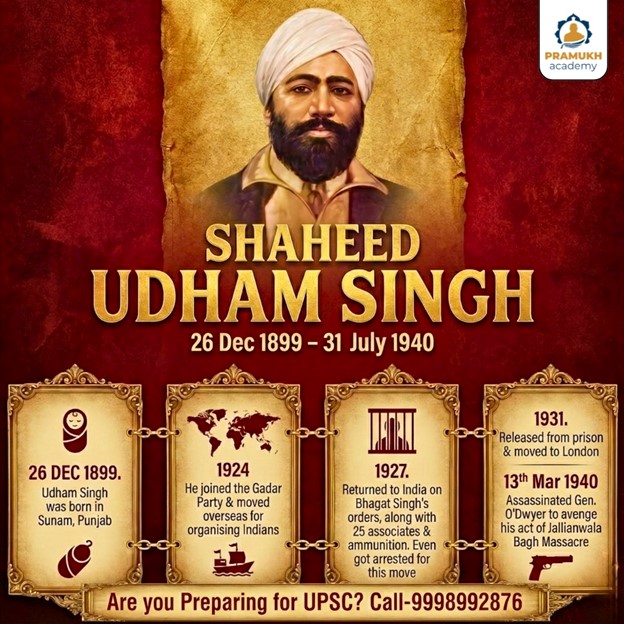
Shaheed Udham Singh: The Courageous Avenger of Jallianwala Bagh
India’s struggle for independence was shaped not only by political movements but also by the fearless acts of revolutionaries who [...]